
Visual Theology – Ephesians
The Visual Theology charts are designed to help you see the structure and movement of Scripture. They highlight patterns, contrasts, and developments that are often difficult to hold together when reading line by line.
These charts show the structure of the argument. The accompanying articles develop each part in full.
This approach follows a long tradition of visual teaching in the Church. The well-known charts of Clarence Larkin helped many grasp the broad outline of Scripture. In the same spirit, these charts aim to make visible what the Word of God is revealing.
Charts and teaching notes for the book of Ephesians. Select a chart below to view the image and article.
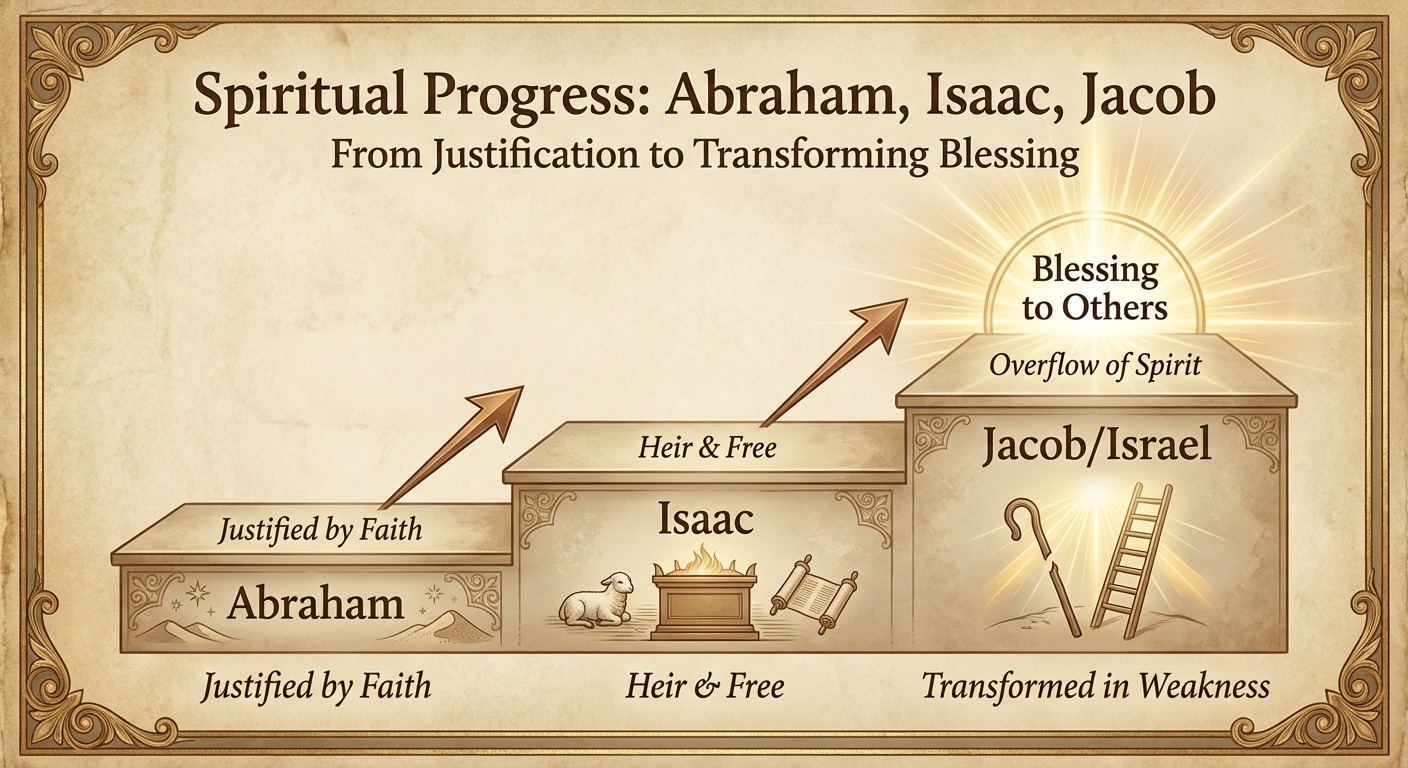
Click chart to view larger
From the teaching in: EPHESIANS: THE VISION OF BETHEL FOR THE ISRAEL OF GOD (Vol 1: The Foundation of the House)
Ephesians 1:17
Spiritual Progress: Abraham, Isaac, Jacob
Galatians 4:21–31 -- Heirs, Not Slaves
This chart shows the structure. What follows explains each part.
Galatians 4:21–31
Tell me, ye that desire to be under the law, do ye not hear the law? For it is written that Abraham had two sons, the one by a bondmaid, the other by a freewoman. But he who was of the bondwoman was born after the flesh; but he of the freewoman was by promise. Which things are an allegory: for these are the two covenants; the one from the mount Sinai, which gendereth to bondage, which is Agar. For this Agar is mount Sinai in Arabia, and answereth to Jerusalem which now is, and is in bondage with her children. But Jerusalem which is above is free, which is the mother of us all. For it is written, Rejoice, thou barren, that bearest not; break forth and cry, thou that travailest not: for the desolate hath many more children than she which hath an husband. Now we, brethren, as Isaac was, are the children of promise. But as then he that was born after the flesh persecuted him that was born after the Spirit, even so it is now. Nevertheless what saith the scripture? Cast out the bondwoman and her son: for the son of the bondwoman shall not be heir with the son of the freewoman. So then, brethren, we are not children of the bondwoman, but of the free.
The believer’s spiritual journey is mapped out in the lives of Abraham, Isaac, and Jacob, whom Paul refers to as types for the “Israel of God.” Each patriarch represents a distinct stage in realizing God’s purpose for His heirs, a pattern foundational to Paul’s teaching in Galatians 4:21–31.
Abraham: Justification by Faith
Abraham is the starting point. Paul states in Romans 4:2 that Abraham “had nothing to glory of,” for he was justified not by works but by faith in God’s promise: “So shall thy seed be” (Genesis 15:5). Though his body was as good as dead, Abraham was “fully persuaded that, what he had promised, he was able also to perform” (Romans 4:21). This is the essence of justifying faith—resting in God’s word apart from any evidence in oneself. Abraham represents the realization: “I am justified apart from works, simply by believing God’s promise.”
Isaac: Realization of Heirship and Freedom
Isaac signifies the realization of heirship and freedom. His birth resulted from God’s promise, not human striving. In Galatians 4, Paul identifies Isaac as the “child of promise,” contrasting him with Ishmael, born after the flesh and associated with Hagar, the bondwoman and the law (Galatians 4:28-30). With Isaac comes the recognition: “I am an heir. Everything is mine (for free).” An heir does not work for his inheritance; he simply receives it. The scripture commands, “Cast out the bondwoman and her son: for the son of the bondwoman shall not be heir with the son of the freewoman” (Galatians 4:30). This is the discovery that we live under grace, as sons and not slaves.
Jacob: Transformation Through Weakness
Jacob, later named Israel, represents the transformation that comes through the breaking of self-reliance. His life was marked by striving to obtain the blessing, but only after wrestling with God and having his natural strength taken away did he become Israel, the “prince of God.” This transformation occurs not by effort, but by being brought to weakness, where blessing is received in dependence on God alone. Jacob’s journey shows that even a justified heir must cease struggling to truly rest in God’s provision, as Galatians 5:17 describes the conflict between flesh and Spirit.
Israel: The Vessel of Blessing
Jacob’s transformation enables blessing to overflow to others. He could not bless anyone until he became Israel, weakened in himself but strong in God. Hebrews 11:21 notes, “By faith Jacob, when he was a dying, blessed both the sons of Joseph; and worshipped, leaning upon the top of his staff.” In Genesis 47:7-10, Israel blesses Pharaoh, showing that the transformed, dependent person—who has ceased from his own works—becomes a blessing to others.
The Progression of the "Israel of God"
This spiritual progression—justification by faith (Abraham), realization of heirship and freedom (Isaac), and transformation through weakness and dependence (Jacob/Israel)—is the journey from being justified to becoming a vessel of blessing. One must not only be positioned as a son and heir but also be brought to the end of self-effort, learning to walk in the Spirit. Only then, as the true “Israel of God” (Galatians 6:16), can we fulfill God’s purpose by becoming a blessing to others.
Every chart in this series is free to explore online.
 Get the full chart set (PDF – $8)
Members get all PDFs included → Why Membership
Log in with an active membership to download printable PDFs on this site. Purchased on the shop? Access downloads from your shop account.
If you would like to help fund this work:
These charts are based on the following books:

EPHESIANS: THE VISION OF BETHEL FOR THE ISRAEL OF GOD (Vol 1: The Foundation of the House)
Are you ready to move beyond a surface-level reading of Ephesians into the very heart of God's eternal plan. In The Foundation of the House, author David Benjamin unveils the book of Ephesians not as a mere list of bl...
View Related Book
Ephesians: The Bethel of the Israel of God - Vol 2: Building with Sword in Hand
Volume 2 of the Ephesians commentary: from Ephesians 4:1 onward—the worthy walk as attentiveness, not performance. For the beaten sheep outside the institutional church.
View Related Book