
Visual Theology – Ephesians
The Visual Theology charts are designed to help you see the structure and movement of Scripture. They highlight patterns, contrasts, and developments that are often difficult to hold together when reading line by line.
These charts show the structure of the argument. The accompanying articles develop each part in full.
This approach follows a long tradition of visual teaching in the Church. The well-known charts of Clarence Larkin helped many grasp the broad outline of Scripture. In the same spirit, these charts aim to make visible what the Word of God is revealing.
Charts and teaching notes for the book of Ephesians. Select a chart below to view the image and article.
Click chart to view larger
From the teaching in: EPHESIANS: THE VISION OF BETHEL FOR THE ISRAEL OF GOD (Vol 1: The Foundation of the House)
Ephesians 2:1-10
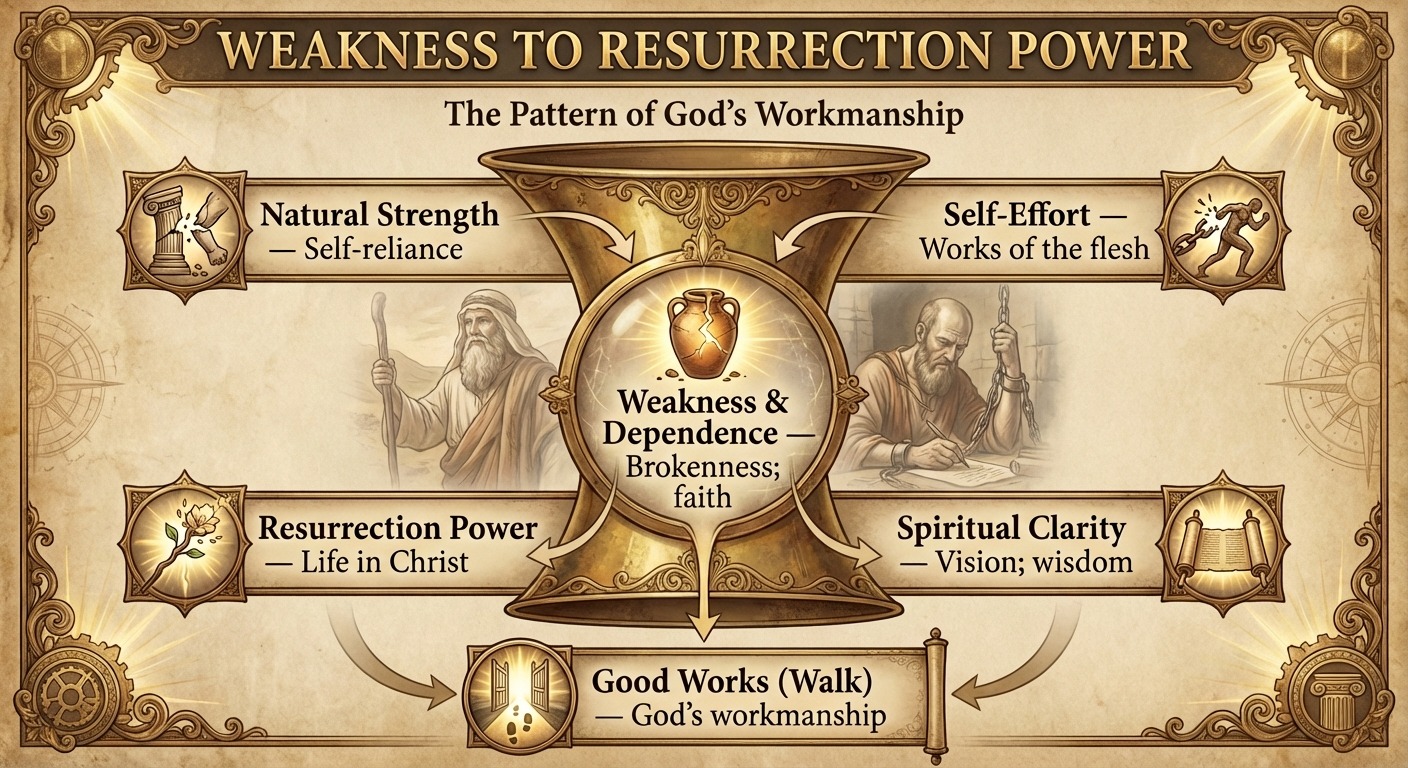
Weakness to Resurrection Power
Ephesians 2:1-10 -- From Weakness to Resurrection Power
This chart shows the structure. What follows explains each part.
Ephesians 2:1-10
And you hath he quickened, who were dead in trespasses and sins; wherein in time past ye walked according to the course of this world, according to the prince of the power of the air, the spirit that now worketh in the children of disobedience: among whom also we all had our conversation in times past in the lusts of our flesh, fulfilling the desires of the flesh and of the mind; and were by nature the children of wrath, even as others. But God, who is rich in mercy, for his great love wherewith he loved us, even when we were dead in sins, hath quickened us together with Christ, (by grace ye are saved;) and hath raised us up together, and made us sit together in heavenly places in Christ Jesus: that in the ages to come he might show the exceeding riches of his grace in his kindness toward us through Christ Jesus. For by grace are ye saved through faith; and that not of yourselves: it is the gift of God: not of works, lest any man should boast. For we are his workmanship, created in Christ Jesus unto good works, which God hath before ordained that we should walk in them.
The Pattern of Weakness and Resurrection Power
Ephesians reveals a believer's journey contrary to worldly wisdom. God's masterpiece—His workmanship—emerges not through human strength or religious effort, but through a process from natural ability, through brokenness, to resurrection power and spiritual clarity.
The Example of Jacob
This pattern is seen in Jacob, marked by cunning and self-reliance. His long sojourn in Laban's house wore down his natural vigor. At Peniel, he wrestled with God, who touched his thigh, leaving him with a permanent limp. This weakness was the turning point: blessing comes from God's grace, not striving. Only then was he named Israel, granted spiritual clarity, and able to bless others prophetically (Genesis 32:25, 28; 47:7; 49).
Paul's Personal Testimony
Paul identifies the “Israel of God” as those transformed through weakness and dependence, not outward religious works (Galatians 6:13-16). He was brought repeatedly to the end of his strength so he would trust not in himself, but in "the God who raises the dead" (2 Corinthians 1:9). He learned that God's power is perfected in weakness: “My grace is sufficient for thee: for my strength is made perfect in weakness” (2 Corinthians 12:9). Outward frailty conceals inward resurrection life.
The Ephesians 2 Journey
Ephesians 2:1-10 traces this movement. We once walked “according to the course of this world,” driven by fleshly desires and spiritual forces (Ephesians 2:2-3). We were dead—spiritually blind and captive. But God, “rich in mercy,” intervened. “Even when we were dead in sins, [He] hath quickened us together with Christ... And hath raised us up together, and made us sit together in heavenly places in Christ Jesus” (Ephesians 2:4-6). We are no longer dependent on our own strength. Resurrection power reaches us in our weakness, upholding us as Jacob's cane did.
The Nature and Purpose of Resurrection Life
This resurrection life is seen in endurance—being sustained though beset by weakness. God's power keeps us coming to Christ, renews the inner man, and maintains our testimony even as the outer man wastes away (2 Corinthians 4:16-18). We are “his workmanship, created in Christ Jesus unto good works, which God hath before ordained that we should walk in them” (Ephesians 2:10). These works are not self-generated striving, but the natural outflow of walking in the light, upheld by God's power.
God's purpose is to fill us with the knowledge of His love in Christ, bringing spiritual clarity and fashioning us as His masterpiece. The path of weakness displays the exceeding riches of His grace. The believer's walk testifies not to human achievement, but to God's sustaining and transforming power, perfected in our weakness.
Every chart in this series is free to explore online.
 Get the full chart set (PDF – $8)
Members get all PDFs included → Why Membership
Log in with an active membership to download printable PDFs on this site. Purchased on the shop? Access downloads from your shop account.
If you would like to help fund this work:
These charts are based on the following books:

EPHESIANS: THE VISION OF BETHEL FOR THE ISRAEL OF GOD (Vol 1: The Foundation of the House)
Are you ready to move beyond a surface-level reading of Ephesians into the very heart of God's eternal plan. In The Foundation of the House, author David Benjamin unveils the book of Ephesians not as a mere list of bl...
View Related Book
Ephesians: The Bethel of the Israel of God - Vol 2: Building with Sword in Hand
Volume 2 of the Ephesians commentary: from Ephesians 4:1 onward—the worthy walk as attentiveness, not performance. For the beaten sheep outside the institutional church.
View Related Book