
Visual Theology – Ephesians
The Visual Theology charts are designed to help you see the structure and movement of Scripture. They highlight patterns, contrasts, and developments that are often difficult to hold together when reading line by line.
These charts show the structure of the argument. The accompanying articles develop each part in full.
This approach follows a long tradition of visual teaching in the Church. The well-known charts of Clarence Larkin helped many grasp the broad outline of Scripture. In the same spirit, these charts aim to make visible what the Word of God is revealing.
Charts and teaching notes for the book of Ephesians. Select a chart below to view the image and article.
Click chart to view larger
From the teaching in: EPHESIANS: THE VISION OF BETHEL FOR THE ISRAEL OF GOD (Vol 1: The Foundation of the House)
Ephesians 1:17-22
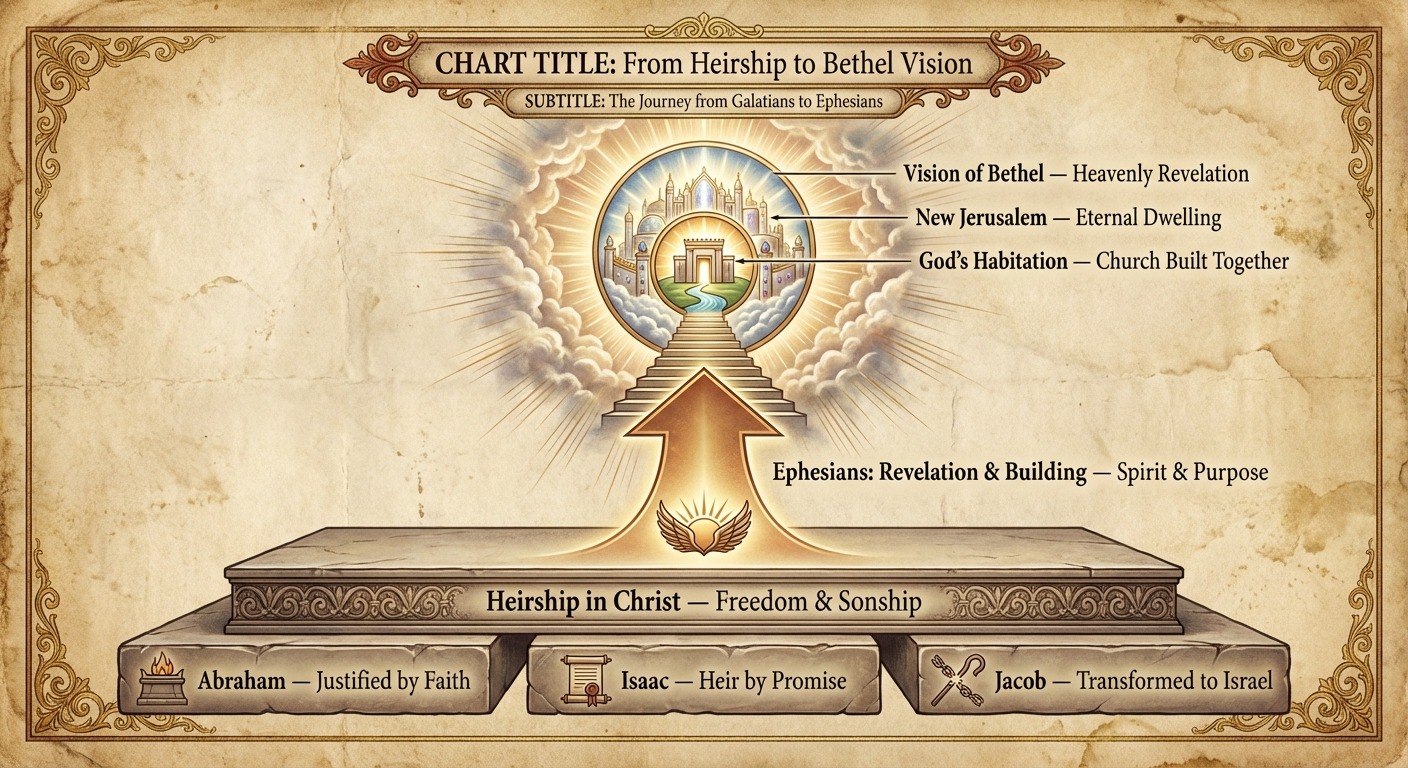
From Heirship to Bethel Vision
Ephesians 1:17-22 -- The Vision of Bethel for the Heirs
This chart shows the structure. What follows explains each part.
Ephesians 1:17-22
That the God of our Lord Jesus Christ, the Father of glory, may give unto you the spirit of wisdom and revelation in the knowledge of him: the eyes of your understanding being enlightened; that ye may know what is the hope of his calling, and what the riches of the glory of his inheritance in the saints, and what is the exceeding greatness of his power to us-ward who believe, according to the working of his mighty power, which he wrought in Christ, when he raised him from the dead, and set him at his own right hand in the heavenly places, far above all principality, and power, and might, and dominion, and every name that is named, not only in this world, but also in that which is to come.
The chart "From Heirship to Bethel Vision" depicts the Christian journey from qualification as heirs in Galatians to the unveiling of God's purpose in Ephesians. This is the path for the "Israel of God" (Galatians 6:16), founded on the experiences of Abraham, Isaac, and Jacob.
Abraham represents justification by faith, not works (Romans 4:3; Galatians 3). Isaac embodies heirship—the inheritance received as a gift, freeing believers from the law (Galatians 4:28-31). Jacob (Israel) signifies transformation through broken self-reliance (Genesis 32; Hebrews 11:21). Together, they establish the believer's position: "no more a servant, but a son; and if a son, then an heir" (Galatians 4:7 KJV). The chart's "Heirship in Christ" platform represents this freedom and sonship through the Spirit (Galatians 3:14; 4:6). Yet Galatians reveals the qualification, not the purpose.
Ephesians unveils the heavenly vision, typified by Bethel—"the house of God" where heaven and earth join (Genesis 28:10-22; John 1:51). Paul prays for "the eyes of your understanding being enlightened; that ye may know... the riches of the glory of his inheritance in the saints" (Ephesians 1:17-18 KJV). This vision is not personal blessing alone, but participation in building God’s habitation, the Church (Ephesians 2:22). The chart's upward movement, "Ephesians: Revelation & Building," marks the transition from heirship to engagement in God's eternal plan. The "Vision of Bethel" sustains and gives context to the heirs' lives.
The concentric circles represent "God’s Habitation" (Ephesians 2:22) and the eternal "New Jerusalem" (Revelation 21:2-3). God's purpose is not merely justified sons, but bringing them into the vision of His building, culminating in the New Jerusalem. Thus, the journey from Galatians to Ephesians moves from freedom from law to receiving the revelation of God's purpose, transforming heirs into participants in His eternal plan.
Every chart in this series is free to explore online.
 Get the full chart set (PDF – $8)
Members get all PDFs included → Why Membership
Log in with an active membership to download printable PDFs on this site. Purchased on the shop? Access downloads from your shop account.
If you would like to help fund this work:
These charts are based on the following books:

EPHESIANS: THE VISION OF BETHEL FOR THE ISRAEL OF GOD (Vol 1: The Foundation of the House)
Are you ready to move beyond a surface-level reading of Ephesians into the very heart of God's eternal plan. In The Foundation of the House, author David Benjamin unveils the book of Ephesians not as a mere list of bl...
View Related Book
Ephesians: The Bethel of the Israel of God - Vol 2: Building with Sword in Hand
Volume 2 of the Ephesians commentary: from Ephesians 4:1 onward—the worthy walk as attentiveness, not performance. For the beaten sheep outside the institutional church.
View Related Book