
Visual Theology – Ephesians
The Visual Theology charts are designed to help you see the structure and movement of Scripture. They highlight patterns, contrasts, and developments that are often difficult to hold together when reading line by line.
These charts show the structure of the argument. The accompanying articles develop each part in full.
This approach follows a long tradition of visual teaching in the Church. The well-known charts of Clarence Larkin helped many grasp the broad outline of Scripture. In the same spirit, these charts aim to make visible what the Word of God is revealing.
Charts and teaching notes for the book of Ephesians. Select a chart below to view the image and article.
Click chart to view larger
From the teaching in: EPHESIANS: THE VISION OF BETHEL FOR THE ISRAEL OF GOD (Vol 1: The Foundation of the House)
Ephesians 4:17-32
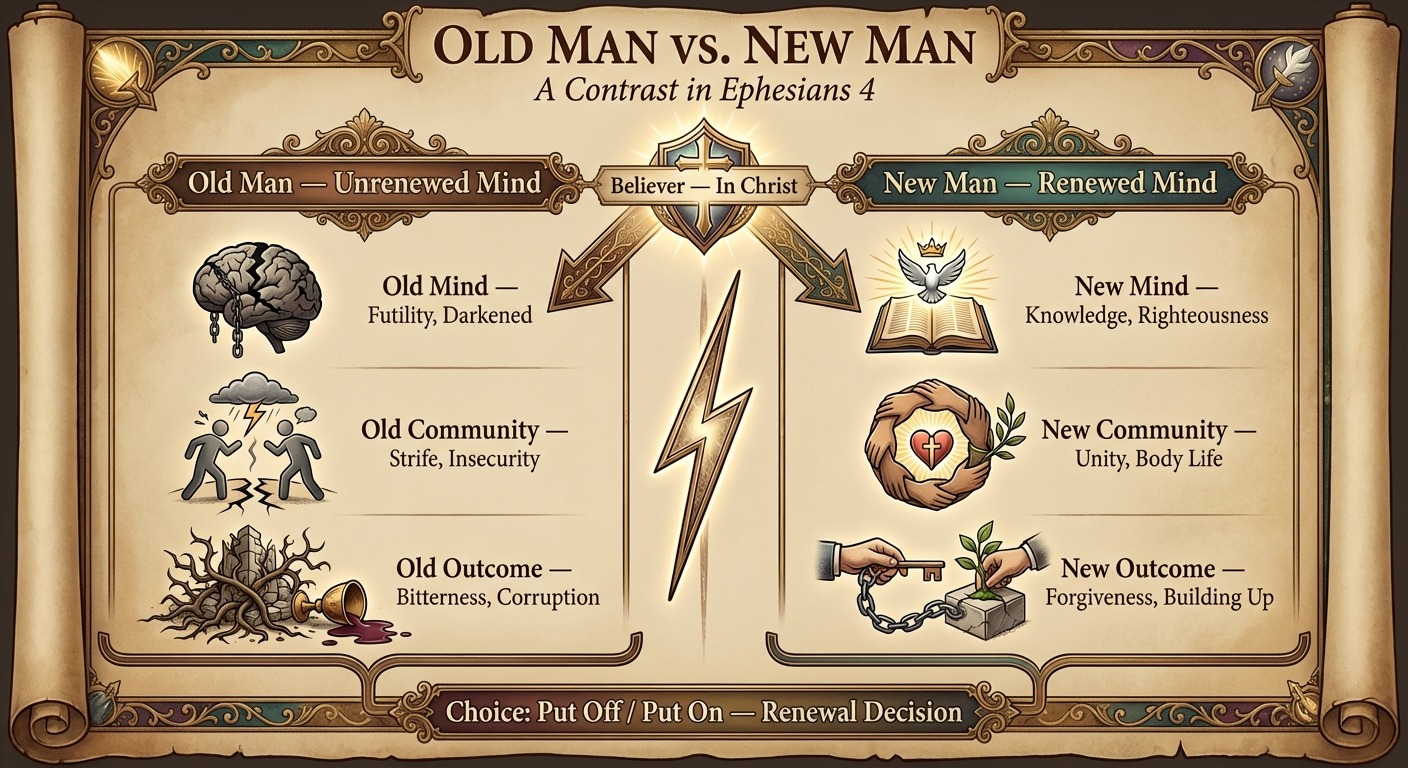
Old Man vs. New Man
Ephesians 4:17-32 -- The Old and New Man
This chart shows the structure. What follows explains each part.
Ephesians 4:17-32
This I say therefore, and testify in the Lord, that ye henceforth walk not as other Gentiles walk, in the vanity of their mind, having the understanding darkened, being alienated from the life of God through the ignorance that is in them, because of the blindness of their heart: who being past feeling have given themselves over unto lasciviousness, to work all uncleanness with greediness. But ye have not so learned Christ; if so be that ye have heard him, and have been taught by him, as the truth is in Jesus: that ye put off concerning the former conversation the old man, which is corrupt according to the deceitful lusts; and be renewed in the spirit of your mind; and that ye put on the new man, which after God is created in righteousness and true holiness. Wherefore putting away lying, speak every man truth with his neighbour: for we are members one of another. Be ye angry, and sin not: let not the sun go down upon your wrath: neither give place to the devil. Let him that stole steal no more: but rather let him labour, working with his hands the thing which is good, that he may have to give to him that needeth. Let no corrupt communication proceed out of your mouth, but that which is good to the use of edifying, that it may minister grace unto the hearers. And grieve not the holy Spirit of God, whereby ye are sealed unto the day of redemption. Let all bitterness, and wrath, and anger, and clamour, and evil speaking, be put away from you, with all malice: and be ye kind one to another, tenderhearted, forgiving one another, even as God for Christ's sake hath forgiven you.
Paul’s exhortation in Ephesians 4:17-32 draws a sharp line between the "old man" and the "new man" in the believer. This is not about moral self-improvement. The "old man" is characterized by an unrenewed mind, fleshly reactions, and insecurity, walking "in the vanity of their mind, having the understanding darkened, being alienated from the life of God" (Ephesians 4:17-18). Behaviors like bitterness and wrath spring from a mind not renewed by Christ.
The call to "put off... the old man" (Ephesians 4:22) is corporate, for "we are members one of another" (Romans 12:5). God’s renewal builds up the Body of Christ. The new man is "created in righteousness and true holiness" (Ephesians 4:24), the result of Christ’s work on the cross to make "one new man" (Ephesians 2:15).
To be "renewed in the spirit of your mind" (Ephesians 4:23) is to receive the spirit of wisdom and revelation (Ephesians 1:17). We draw near to God based on Christ’s blood, not our performance, and stand in faith like Abraham (Romans 4:20).
The old man’s insecurity becomes an "airport" for the enemy. Operating from the old creation leads to strife, giving place to the devil (Ephesians 4:26-27) and grieving the Spirit (Ephesians 4:30). The enemy’s strategy is to undermine the Body by sowing bitterness and error.
Putting on the new man means walking in the knowledge of Christ and our forgiveness. "Be ye kind one to another, tenderhearted, forgiving one another, even as God for Christ's sake hath forgiven you" (Ephesians 4:32). Virtues like lowliness and meekness are the fruit of seeing ourselves in Christ.
This renewal is both individual and corporate. We must refuse lies that dehumanize others and judge fruit, not motives. Weakness is an opportunity for tenderness; what disqualifies is a refusal to be renewed.
Ultimately, the contrast is a call to live from the finished work of Christ. The new man is a reality created by Christ, expressed in forgiveness and unity, safeguarding the Body for God’s glory.
Every chart in this series is free to explore online.
 Get the full chart set (PDF – $8)
Members get all PDFs included → Why Membership
Log in with an active membership to download printable PDFs on this site. Purchased on the shop? Access downloads from your shop account.
If you would like to help fund this work:
These charts are based on the following books:

EPHESIANS: THE VISION OF BETHEL FOR THE ISRAEL OF GOD (Vol 1: The Foundation of the House)
Are you ready to move beyond a surface-level reading of Ephesians into the very heart of God's eternal plan. In The Foundation of the House, author David Benjamin unveils the book of Ephesians not as a mere list of bl...
View Related Book
Ephesians: The Bethel of the Israel of God - Vol 2: Building with Sword in Hand
Volume 2 of the Ephesians commentary: from Ephesians 4:1 onward—the worthy walk as attentiveness, not performance. For the beaten sheep outside the institutional church.
View Related Book