
Visual Theology – Ephesians
The Visual Theology charts are designed to help you see the structure and movement of Scripture. They highlight patterns, contrasts, and developments that are often difficult to hold together when reading line by line.
These charts show the structure of the argument. The accompanying articles develop each part in full.
This approach follows a long tradition of visual teaching in the Church. The well-known charts of Clarence Larkin helped many grasp the broad outline of Scripture. In the same spirit, these charts aim to make visible what the Word of God is revealing.
Charts and teaching notes for the book of Ephesians. Select a chart below to view the image and article.
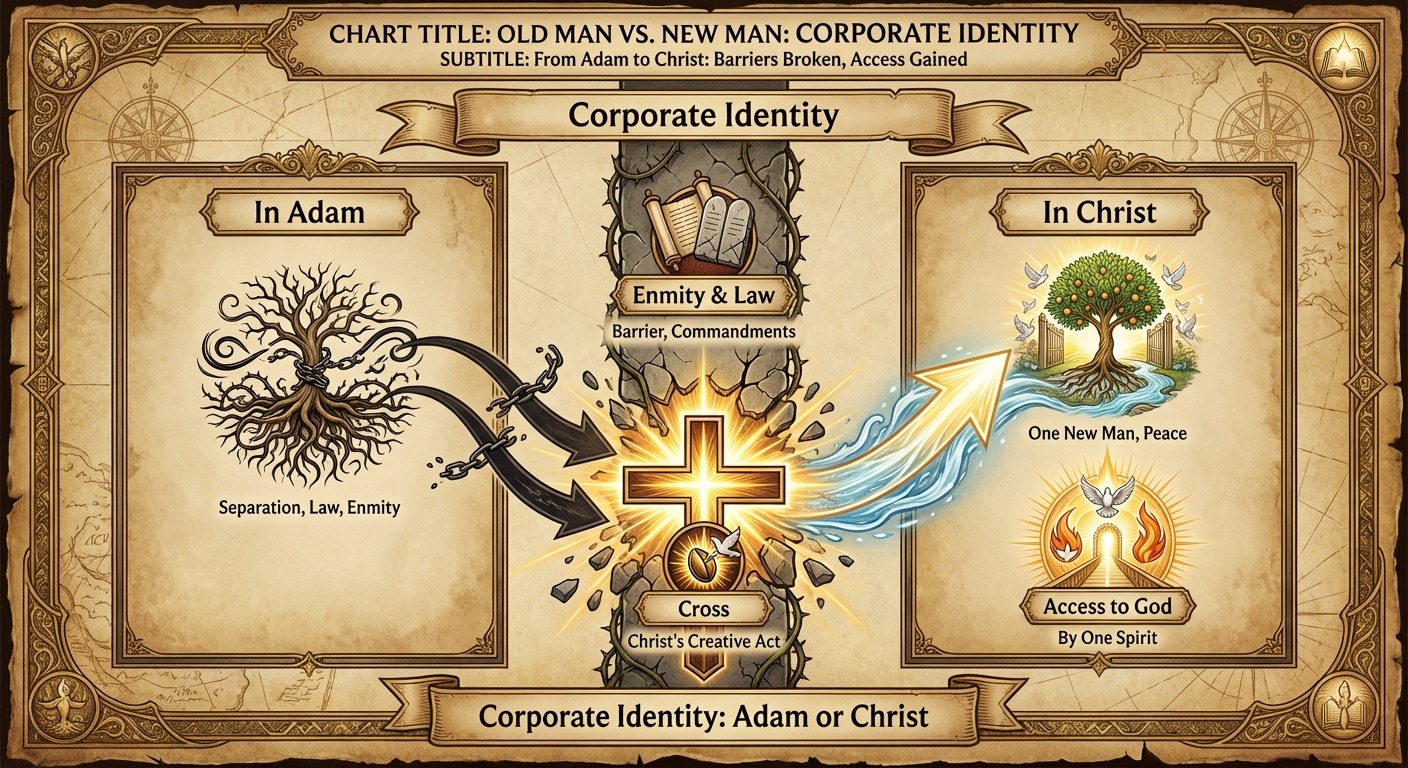
Click chart to view larger
From the teaching in: EPHESIANS: THE VISION OF BETHEL FOR THE ISRAEL OF GOD (Vol 1: The Foundation of the House)
Ephesians 2:11-18
Old Man vs. New Man: Corporate Identity
Ephesians 2:11-18 -- The One New Man in Christ
This chart shows the structure. What follows explains each part.
Ephesians 2:11-18
Wherefore remember that ye being in time past Gentiles in the flesh who are called Uncircumcision by that which is called Circumcision in the flesh made by hands; that at that time ye were without Christ, being aliens from the commonwealth of Israel, and strangers from the covenants of promise, having no hope, and without God in the world: but now in Christ Jesus ye who sometimes were far off are made nigh by the blood of Christ. For he is our peace, who hath made both one, and hath broken down the middle wall of partition between us; having abolished in his flesh the enmity, even the law of commandments contained in ordinances; for to make in himself of twain one new man, so making peace; and that he might reconcile both unto God in one body by the cross, having slain the enmity thereby: and came and preached peace to you which were afar off, and to them that were nigh. For through him we both have access by one Spirit unto the Father. Now therefore ye are no more strangers and foreigners, but fellow citizens with the saints, and of the household of God; and are built upon the foundation of the apostles and prophets, Jesus Christ himself being the chief corner stone; in whom all the building fitly framed together groweth unto an holy temple in the Lord: in whom ye also are builded together for an habitation of God through the Spirit.
The Old Identity: Separation and Enmity
Paul reminds the Gentiles they were once "without Christ, aliens from the commonwealth of Israel, strangers from the covenants of promise, having no hope, and without God in the world" (Ephesians 2:12). This old identity was marked by separation, law, and enmity. Gentiles were excluded from Israel’s blessings. Yet Israel itself, though "near," was kept at a distance from God by the law of commandments and ordinances, which served as a barrier.
The New Creation: The "One New Man"
In Christ, a dramatic change has occurred: "But now in Christ Jesus ye who sometimes were far off are made nigh by the blood of Christ. For he is our peace, who hath made both one, and hath broken down the middle wall of partition between us; Having abolished in his flesh the enmity, even the law of commandments contained in ordinances; for to make in himself of twain one new man, so making peace" (Ephesians 2:13-15). Christ’s work was a creative act, forming something entirely new. Jew and Gentile are not merged into national Israel; both are brought into the "one new man" found "in Christ." This is a corporate identity.
The phrase "in Christ Jesus" describes those baptized into His death and resurrection, transferred from Adam to Christ. In this new creation, ethnic distinctions are irrelevant: "Where there is neither Greek nor Jew, circumcision nor uncircumcision, Barbarian, Scythian, bond nor free: but Christ is all, and in all" (Colossians 3:11). The "new man" is the corporate body of Christ, with Christ as the Head.
Peace and Access: The Abolition of Barriers
The law created enmity between Jew and Gentile, and between man and God. Christ’s death tore down every barrier, "having slain the enmity thereby" (Ephesians 2:16). The peace established is not only between peoples but peace between us and God. "For through him we both have access by one Spirit unto the Father" (Ephesians 2:18). This access results from Christ’s finished work, enjoyed by faith. Our position is fixed: we are brought near, not trying to get near.
The Danger of Rebuilding Barriers
To insist believers must perform religious duties to access God is to re-erect the barriers Christ abolished. This turns the gospel into a system of works. Our standing before God is based solely on Christ, who is our peace.
Summary: From Old to New
The old man in Adam is characterized by separation, law, and enmity. The new man, created in Christ, is a corporate entity where all barriers are abolished, peace is established, and access to God is granted. This is the new creation, the body of Christ, in which Christ is all and in all.
Every chart in this series is free to explore online.
 Get the full chart set (PDF – $8)
Members get all PDFs included → Why Membership
Log in with an active membership to download printable PDFs on this site. Purchased on the shop? Access downloads from your shop account.
If you would like to help fund this work:
These charts are based on the following books:

EPHESIANS: THE VISION OF BETHEL FOR THE ISRAEL OF GOD (Vol 1: The Foundation of the House)
Are you ready to move beyond a surface-level reading of Ephesians into the very heart of God's eternal plan. In The Foundation of the House, author David Benjamin unveils the book of Ephesians not as a mere list of bl...
View Related Book
Ephesians: The Bethel of the Israel of God - Vol 2: Building with Sword in Hand
Volume 2 of the Ephesians commentary: from Ephesians 4:1 onward—the worthy walk as attentiveness, not performance. For the beaten sheep outside the institutional church.
View Related Book