Visual Theology – Ephesians
The Visual Theology charts are designed to help you see the structure and movement of Scripture. They highlight patterns, contrasts, and developments that are often difficult to hold together when reading line by line.
These charts show the structure of the argument. The accompanying articles develop each part in full.
This approach follows a long tradition of visual teaching in the Church. The well-known charts of Clarence Larkin helped many grasp the broad outline of Scripture. In the same spirit, these charts aim to make visible what the Word of God is revealing.
Charts and teaching notes for the book of Ephesians. Select a chart below to view the image and article.
Click chart to view larger
From the teaching in: EPHESIANS: THE VISION OF BETHEL FOR THE ISRAEL OF GOD (Vol 1: The Foundation of the House)
Ephesians 2:1-10
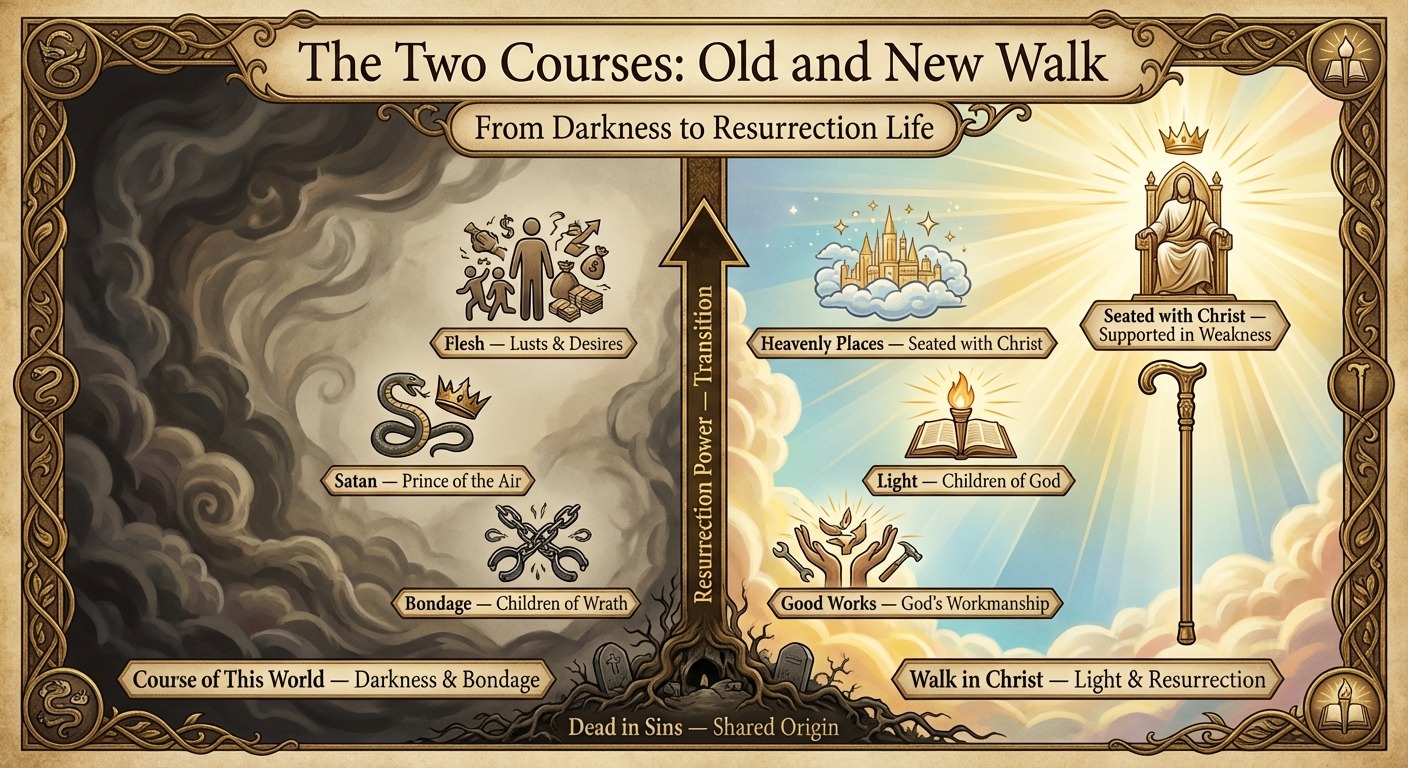
The Two Courses: Old and New Walk
Ephesians 2:1-10 -- From Old Walk to New
This chart shows the structure. What follows explains each part.
Ephesians 2:1-10
And you hath he quickened, who were dead in trespasses and sins; wherein in time past ye walked according to the course of this world, according to the prince of the power of the air, the spirit that now worketh in the children of disobedience: among whom also we all had our conversation in times past in the lusts of our flesh, fulfilling the desires of the flesh and of the mind; and were by nature the children of wrath, even as others. But God, who is rich in mercy, for his great love wherewith he loved us, even when we were dead in sins, hath quickened us together with Christ, (by grace ye are saved;) and hath raised us up together, and made us sit together in heavenly places in Christ Jesus: that in the ages to come he might show the exceeding riches of his grace in his kindness toward us through Christ Jesus. For by grace are ye saved through faith; and that not of yourselves: it is the gift of God: not of works, lest any man should boast. For we are his workmanship, created in Christ Jesus unto good works, which God hath before ordained that we should walk in them.
The Old Walk and the New Walk
Ephesians 2:1-10 presents a decisive contrast between two courses: the old walk, marked by darkness and bondage under the prince of the power of the air, and the new walk in Christ, established by resurrection power and supported in weakness.
In time past, we “walked according to the course of this world, according to the prince of the power of the air, the spirit that now worketh in the children of disobedience” (Ephesians 2:2). Our conversation was “in the lusts of our flesh, fulfilling the desires of the flesh and of the mind; and were by nature the children of wrath, even as others” (Ephesians 2:3). This was like being trapped in a dark hall—a passage where the lights were dim, the air was heavy, and every step was shaped by shadows. In that corridor, visibility was limited, and the spirit that works in the children of disobedience set the pace. We stumbled forward, reacting to echoes and whispers, not realizing that the path itself bent according to the schemes of the prince of the power of the air.
The Intervention of Resurrection Power
But resurrection power reached us there. “But God, who is rich in mercy, for his great love wherewith he loved us, Even when we were dead in sins, hath quickened us together with Christ, (by grace ye are saved;) And hath raised us up together, and made us sit together in heavenly places in Christ Jesus” (Ephesians 2:4-6). He pulled us out of that narrow, suffocating hall and set our feet on a new course—no longer the course of this world, but the one God mapped out in predestination, as He works all things together to fulfill His eternal purpose. Now we walk in a hall flooded with light, where the windows are thrown wide and the Sun of righteousness shines in. What once was a prison corridor has become a broad and purposeful way, the very pathway of Christ Himself.
Walking with the Cane of Weakness
This new walk is not marked by our own strength, but by weakness and dependence. Like Jacob, who after wrestling with God was touched in his thigh and from then on walked with the support of a cane, we too are supported in our weakness by resurrection life. Outwardly, those who lean on this cane may appear frail, but the Spirit within us is that resurrection life—our daily support, our quiet strength, the power that heads everything up in Christ, even in the smallest steps of our walk. Resurrection is our “cane,” and we walk with a limp, no longer able to rely on our natural strength. This is the mark of the “Israel of God,” who discerns spiritual truth not by boasting in merit or virtue, but through weakness that compels us to depend on God (2 Corinthians 12:9-10). In contrast, the Judaizers in Galatians boasted in circumcision as if it were a badge of merit, but the true circumcision is not an exhibition of virtue, but the transformation that comes through weakness and dependence on God.
The True Nature of God’s Power
God’s power is not measured by how powerful we feel, nor is it the kind of power the world imagines—crude force like Superman, demolishing buildings or bending steel. The charismatics have it wrong, thinking the Christian life is a matter of experiencing power. Actually, the Christian life is harmonized with God by seeing His power and understanding His purpose. His power is displayed not in smashing weakness but in sustaining it. “A bruised reed shall He not break, and smoking flax shall He not quench” (Isaiah 42:3). It takes far more strength to uphold the fragile than to shatter it, far more majesty to restrain infinite might than to unleash it in destruction. The cross itself was the greatest demonstration of this—omnipotence cloaked in weakness, restraint, and suffering love. His greatest demonstrations of power are often invisible to the natural eye: the quiet keeping of a saint, the gentle leading of a bruised soul, the patient sustaining of us in trials.
God’s Workmanship on a New Path
We are “his workmanship, created in Christ Jesus unto good works, which God hath before ordained that we should walk in them” (Ephesians 2:10). We are God’s masterpiece, His poema, fashioned by the resurrection of Christ. The good works are not something separate from our lives, as if we step aside to perform them. Rather, He lifts us up and puts us on another path with a totally different trajectory and a different course. We are the clay; He is the potter, and He knows what He is building. The path of the just is as the shining light, that shineth more and more unto the perfect day (Proverbs 4:18). Our walk is simply to know Christ, and that walk will be revealed and manifested as a walk of the children of God in the light, full of good works.
The Foundation of Our Walk
Our qualification is always justification: “Therefore being justified by faith, we have peace with God through our Lord Jesus Christ” (Romans 5:1). It is through His blood and by faith in the blood that we come forward, not by our own strength or merit. The transition from the old walk to the new is not a matter of self-effort, but of deliverance by God’s mercy and resurrection power. We walk a new course, seated with Christ in the heavenlies, upheld in weakness, as a testimony to the exceeding riches of His grace and kindness toward us through Christ Jesus.
Every chart in this series is free to explore online.
 Get the full chart set (PDF – $8)
Members get all PDFs included → Why Membership
Log in with an active membership to download printable PDFs on this site. Purchased on the shop? Access downloads from your shop account.
If you would like to help fund this work:
These charts are based on the following books:

EPHESIANS: THE VISION OF BETHEL FOR THE ISRAEL OF GOD (Vol 1: The Foundation of the House)
Are you ready to move beyond a surface-level reading of Ephesians into the very heart of God's eternal plan. In The Foundation of the House, author David Benjamin unveils the book of Ephesians not as a mere list of bl...
View Related Book
Ephesians: The Bethel of the Israel of God - Vol 2: Building with Sword in Hand
Volume 2 of the Ephesians commentary: from Ephesians 4:1 onward—the worthy walk as attentiveness, not performance. For the beaten sheep outside the institutional church.
View Related Book