
Visual Theology – Understanding the Rapture
The Visual Theology charts are designed to help you see the structure and movement of Scripture. They highlight patterns, contrasts, and developments that are often difficult to hold together when reading line by line.
These charts show the structure of the argument. The accompanying articles develop each part in full.
This approach follows a long tradition of visual teaching in the Church. The well-known charts of Clarence Larkin helped many grasp the broad outline of Scripture. In the same spirit, these charts aim to make visible what the Word of God is revealing.
Charts and teaching notes for the book of Understanding the Rapture. Select a chart below to view the image and article.
Click chart to view larger
From the teaching in: Grace to Glory
The Jewish Character of the Tribulation Period
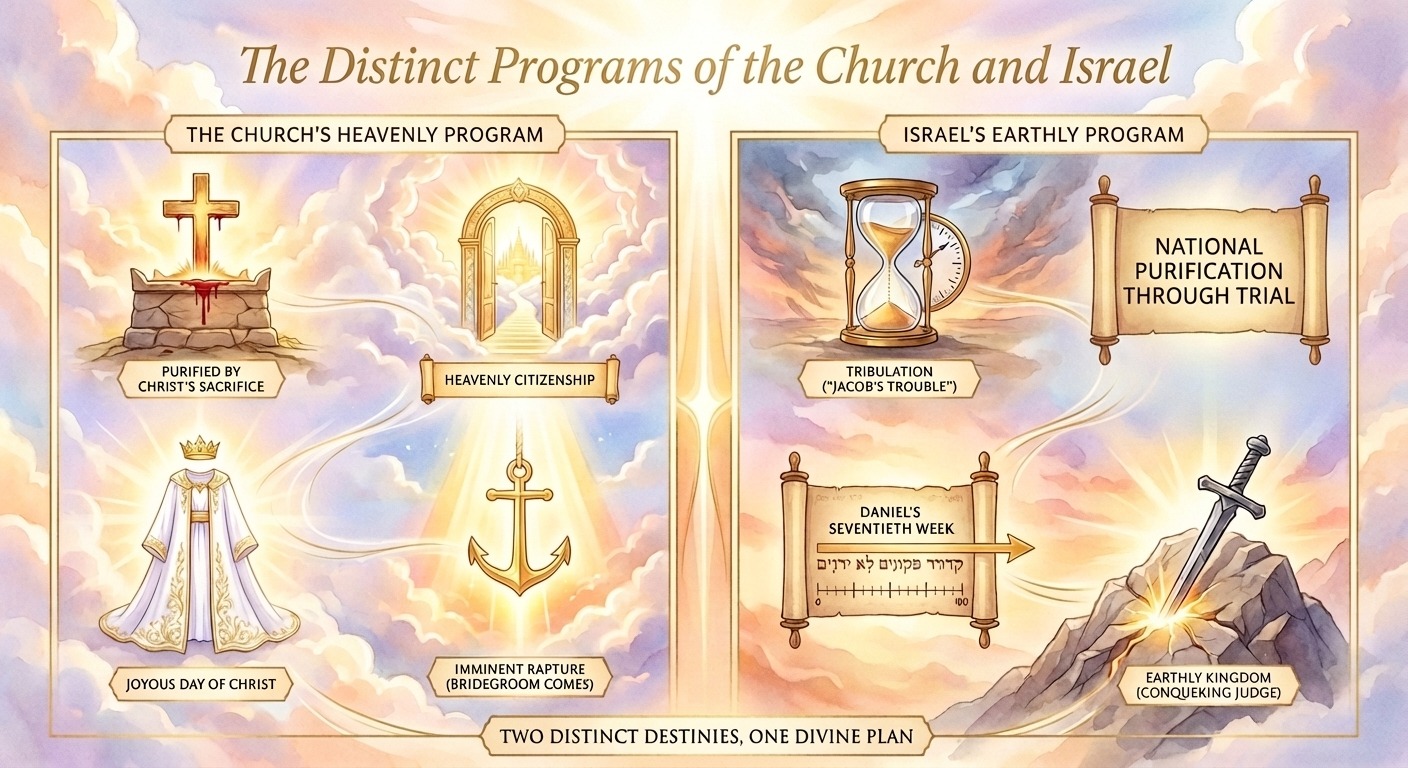
The Jewish Character of the Tribulation
This chart shows the structure. What follows explains each part.
The promise of Revelation 3:10 tells the Church she will be kept from the hour of trial -- but the force of that promise depends on understanding what kind of hour it is. An hour of ordinary difficulty is one thing; an hour that is specifically, structurally, prophetically not designed for the Church is something else entirely. This article makes a case that is sometimes missed even in pre-tribulation discussions: the tribulation is not simply a bad season for everyone on earth -- it is a distinctly Jewish program, shaped by Jewish categories, populated by Jewish servants, governed by Daniel's prophecy concerning Daniel's people and Daniel's holy city. And the Church is not Israel.
The Shift from Church to Israel in Prophecy
When the Church is removed from the earthly scene, as depicted in Revelation 4, the focus of God's prophetic program shifts dramatically from the Church to Israel. This transition is not arbitrary but is rooted in the very structure of biblical prophecy. The tribulation period, which unfolds after the Church's translation to heaven, is marked by overtly Jewish themes and the fulfillment of promises made to Israel, not the Body of Christ.
The Sealing of the 144,000
The first major event following the heavenly throne room scene is the sealing of the 144,000 from "all the tribes of the children of Israel" (Revelation 7:4). These are not Gentile believers, but specifically twelve thousand from each tribe of Israel—Jewish servants who are set apart for a unique ministry during this time. This immediate reorientation toward Israel is a fulfillment of the principle Paul articulates in Romans 11:25: "Blindness in part is happened to Israel, until the fulness of the Gentiles be come in." The present age, then, is the era in which God is calling out a people from among the Gentiles for His name. Once this work is complete—when the "fulness of the Gentiles" has come in—God resumes His prophetic dealings with Israel.
The Tribulation as Israel's Determined Time
The tribulation period itself is defined in Daniel's prophecy as "seventy weeks...determined upon thy people and upon thy holy city" (Daniel 9:24). This is a period specifically set upon Israel and Jerusalem, not the Church. The final week—seven years—accomplishes six purposes, all related to Israel: finishing transgression, making an end of sins, making reconciliation for iniquity, bringing in everlasting righteousness, sealing up vision and prophecy, and anointing the most holy place. These are not generic spiritual goals, but concrete objectives tied to Israel's national destiny.
Jeremiah 30:7 describes this period as "the time of Jacob's trouble"—Jacob being the covenant name of Israel. It is a time of national purification and preparation for the reception of their Messiah. Zechariah 13:8-9 adds further detail: "And it shall come to pass, that in all the land, saith the LORD, two parts therein shall be cut off and die; but the third shall be left therein. And I will bring the third part through the fire, and will refine them as silver is refined, and will try them as gold is tried: they shall call on my name, and I will hear them: I will say, It is my people: and they shall say, The LORD is my God." The tribulation, then, is a refining fire for Israel, a process through which a remnant will be brought to faith and restoration.
The Church's Distinct Position
The Church, however, has no part in this program of purification. Believers in Christ have already been purified by His blood and made complete in Him. Our calling is not earthly, but heavenly; our citizenship is not in the land of Israel, but "in heaven; from whence also we look for the Saviour, the Lord Jesus Christ: Who shall change our vile body, that it may be fashioned like unto his glorious body, according to the working whereby he is able even to subdue all things unto himself" (Philippians 3:20-21). The tribulation is not for the Church's perfection, but for Israel's restoration.
All New Testament prophecy concerning the tribulation—whether in Matthew 24, Luke 21, 2 Thessalonians 2, or Revelation 6-19—centers on Daniel's seventieth week and carries a tangible, earthly, and mathematical character (Daniel 9:24-27). The signs, judgments, and time frames are concrete and calculable, designed for a people whose prophetic destiny is rooted in the earth and in the fulfillment of covenants made to their fathers. The Church's hope, by contrast, is not subject to calculation or earthly signs, but is a blessed hope rooted in constant expectation and heavenly calling.
Preserving the Distinctions
These distinctions are not merely technicalities but reflect the very heart of God's dealings with His people. To the Church, Christ comes as Bridegroom, gathering His beloved to Himself in glory. To Israel and the world, He comes as Judge, establishing righteousness and fulfilling every promise made to the fathers. Maintaining these distinctions preserves the integrity of each prophecy and clarifies God's unfolding purpose.
As we await our blessed hope, we are reminded that our separation from departed believers is temporary, our limitations are not permanent, and Christ Himself will gather us home. This is not escapism, but the fulfillment of our heavenly calling and the realization of our true citizenship. Understanding the Jewish character of the tribulation period protects us from confusing law with grace and keeps our focus on the position the Church enjoys before God in Christ. Our anticipation of the rapture is not merely an event to be studied, but a living hope that shapes our perspective and perseverance in this age, anchoring our souls as we look for the Saviour from heaven.
The Jewish character of the tribulation is established from Daniel's seventy weeks, from the sealing of the twelve tribes, from the 'time of Jacob's trouble,' and from the refining-fire character of that period -- all of it designed for Israel's restoration, none of it designed for a Church that is already complete in Christ. This is confirmed not just by prophecy but by the types -- because God has demonstrated, in history, a consistent way of treating His people when judgment is about to fall.
Every chart in this series is free to explore online.
 Get the full chart set (PDF – $8)
Members get all PDFs included → Why Membership
Log in with an active membership to download printable PDFs on this site. Purchased on the shop? Access downloads from your shop account.
If you would like to help fund this work:
These charts are based on the following book:

Grace to Glory
Understanding the Rapture and What Happens Next - A vital restoration of this blessed hope doctrine with solid scriptural foundation.
View Related Book