Visual Theology – Understanding the Rapture
The Visual Theology charts are designed to help you see the structure and movement of Scripture. They highlight patterns, contrasts, and developments that are often difficult to hold together when reading line by line.
These charts show the structure of the argument. The accompanying articles develop each part in full.
This approach follows a long tradition of visual teaching in the Church. The well-known charts of Clarence Larkin helped many grasp the broad outline of Scripture. In the same spirit, these charts aim to make visible what the Word of God is revealing.
Charts and teaching notes for the book of Understanding the Rapture. Select a chart below to view the image and article.
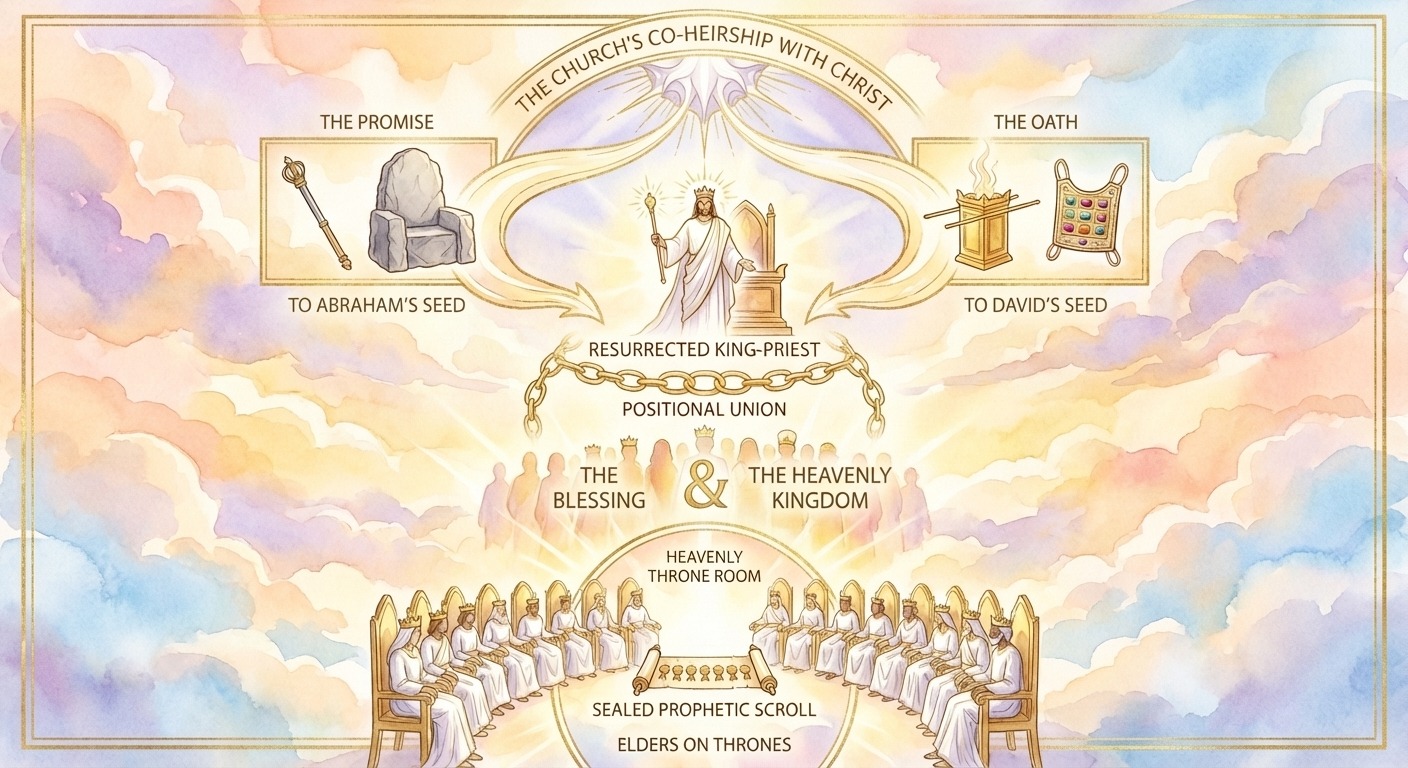
Click chart to view larger
From the teaching in: Grace to Glory
The Church's Co-Heirship with Christ
The Church's Co-Heirship with Christ
This chart shows the structure. What follows explains each part.
The twenty-four elders are crowned and enthroned -- but crowns and thrones do not simply appear. They rest on a legal foundation, a decree, an oath that was sworn before the Church even existed. The astonishing claim this article makes is that the Church's co-heirship with Christ is not a pleasant afterthought of grace but the logical consequence of two immutable things -- God's promise to Abraham, fulfilled in a single Seed, and God's oath to that Seed establishing him as both King and Priest forever. Before we can understand what the rapture means for the Church, we need to understand what the Father has already declared about the Son -- and what that declaration necessarily implies for everyone who is found in Him.
The Church's Co-heirship with Christ
The Church's co-heirship with Christ is grounded in the unique promises the Father made to the Son—promises that are now shared with the Church through our union with Him. This dual authority, both kingly and priestly, is not a mere metaphor but a concrete reality established by God's own decrees.
The Two Immutable Things
The foundation of the Church's co-heirship rests on what the writer of Hebrews calls "two immutable things, in which it was impossible for God to lie" (Hebrews 6:18). These are not abstract theological categories but concrete, historical acts of God directed toward Christ as the promised Seed.
The first is the promise — the gospel itself as it was first announced to Abraham. Paul identifies this in Galatians 3:8: "And the scripture, foreseeing that God would justify the heathen through faith, preached before the gospel unto Abraham." The promise was not made to seeds plural, but to one — "And to thy seed, which is Christ" (Galatians 3:16). Everything God pledged to Abraham finds its fulfillment in Christ alone, and in those who are "in Christ" by faith.
The second is the oath — the irreversible vow God swore to Christ as the seed of David. This oath accomplished two things simultaneously: it enthroned Him as King ("Sit thou at my right hand, until I make thine enemies thy footstool" — Psalm 110:1) and appointed Him as eternal High Priest ("The LORD hath sworn, and will not repent, Thou art a priest for ever after the order of Melchizedek" — Psalm 110:4). The oath is what makes the Melchizedek priesthood superior to the Levitical — it rests not on genealogy or law but on God's own unbreakable word (Hebrews 7:20-21).
From these two immutable witnesses flow the twin realities that define the Church's inheritance: the blessing — justification and every spiritual blessing secured through the promise to the Seed — and the heavenly kingdom, the Church's portion of Christ's reign, exercised not from an earthly throne but from the right hand of God. The Church does not inherit Canaan or an earthly scepter. The Church inherits what was sworn to the glorified Son, because the Church is in the glorified Son.
It is from this foundation that the two streams of the Church's co-heir authority — kingly and priestly — take their shape.
Kingly Authority: The Rod of Iron
Christ's kingly authority is rooted in the decree found in Psalm 2: "Yet have I set my king upon my holy hill of Zion. I will declare the decree: the LORD hath said unto me, Thou art my Son; this day have I begotten thee. Ask of me, and I shall give thee the heathen for thine inheritance, and the uttermost parts of the earth for thy possession. Thou shalt break them with a rod of iron; thou shalt dash them in pieces like a potter's vessel" (Psalm 2:6-9). The rod of iron is the symbol of Christ's absolute dominion and authority to rule and judge the nations, given to Him as the Son of God by divine right.
What is remarkable is that Christ does not retain this authority for Himself alone. In Revelation 2:26-27, He extends this very privilege to the overcomers: "And he that overcometh, and keepeth my works unto the end, to him will I give power over the nations: And he shall rule them with a rod of iron; as the vessels of a potter shall they be broken to shivers: even as I received of my Father." Here, the same authority—the rod of iron—granted to Christ by the Father is shared with believers, not as mere subordinates, but as co-heirs who exercise the Son’s own prerogatives because we have been made sons of God in Him.
Paul confirms the reality of this co-heirship in Romans 8: "The Spirit itself beareth witness with our spirit, that we are the children of God: And if children, then heirs; heirs of God, and joint-heirs with Christ; if so be that we suffer with him, that we may be also glorified together" (Romans 8:16-17). The Church, as joint-heirs with Christ, participates in His inheritance, authority, and glory. The rod of iron, the right to rule, is not merely delegated but shared, flowing from our union with the King of Kings. This is why, in the heavenly scene, the twenty-four elders are seen seated on thrones, crowned, exercising kingly authority before the Lamb opens the seals (Revelation 5:7; 6:1, 3, 5, 7). Their position is not future but present—they are already glorified and rewarded, indicating that the Church has been raptured and is now reigning with Christ from heaven, not enduring judgment on earth.
Priestly Authority: The Order of Melchizedek
Yet the Church's co-heirship is not limited to kingly authority. Christ also holds a priestly office, not after the order of Aaron, but after the order of Melchizedek. Psalm 110:4 records the Father's oath: "The LORD hath sworn, and will not repent, Thou art a priest for ever after the order of Melchizedek." The Melchizedek priesthood is distinct from the Levitical—it is based on an endless life and divine appointment, as Hebrews 7:16 explains. This priesthood unites the dignity of king and priest in one person, something impossible under the Old Testament, where kings and priests came from separate tribes.
The Church shares in this Melchizedek priesthood through union with Christ. Peter declares, "But ye are a chosen generation, a royal priesthood, an holy nation, a peculiar people; that ye should shew forth the praises of him who hath called you out of darkness into his marvellous light" (1 Peter 2:9). The Church is a royal priesthood—possessing both kingly and priestly dignity. Only those who share Christ's life through regeneration can participate in this dual authority, a privilege unique to the Body of Christ.
Our Exalted Position in Christ
Hebrews brings these truths together: "But unto the Son he saith, Thy throne, O God, is for ever and ever: a sceptre of righteousness is the sceptre of thy kingdom...But this man, after he had offered one sacrifice for sins for ever, sat down on the right hand of God; From henceforth expecting till his enemies be made his footstool" (Hebrews 1:8, 10:12-13). Christ's throne is eternal, His scepter is righteous, and He now sits at the Father's right hand, awaiting the fulfillment of all things. Because the Church is "seated together in heavenly places in Christ Jesus" (Ephesians 2:6), we share this exalted position—not waiting for an earthly kingdom, but reigning with Him from heaven as king-priests after the order of Melchizedek.
This heavenly calling and position are not abstract but the very reason the Church is seen in heaven, glorified and enthroned, before the tribulation judgments begin. The Church is not left to endure wrath but is removed, already rewarded and exercising co-heir authority with Christ. Our destiny is not to await kingdom blessings on earth, but to manifest the manifold wisdom of God in the heavenlies, reigning with our Lord as both kings and priests, sharing in all that the Father has given to the Son.
The Church's co-heirship is grounded in God's own sworn testimony to Christ -- not in performance, not in genealogy, but in the unbreakable oath that made Christ both King and eternal High Priest. That position is the Church's position because she is in the Seed. But there is one more layer of structural evidence in Revelation that confirms the Church's removal before the tribulation begins -- and it is not an argument from theology but an argument from what is conspicuously missing.
Every chart in this series is free to explore online.
 Get the full chart set (PDF – $8)
Members get all PDFs included → Why Membership
Log in with an active membership to download printable PDFs on this site. Purchased on the shop? Access downloads from your shop account.
If you would like to help fund this work:
These charts are based on the following book:

Grace to Glory
Understanding the Rapture and What Happens Next - A vital restoration of this blessed hope doctrine with solid scriptural foundation.
View Related Book