
Visual Theology – Understanding the Rapture
The Visual Theology charts are designed to help you see the structure and movement of Scripture. They highlight patterns, contrasts, and developments that are often difficult to hold together when reading line by line.
These charts show the structure of the argument. The accompanying articles develop each part in full.
This approach follows a long tradition of visual teaching in the Church. The well-known charts of Clarence Larkin helped many grasp the broad outline of Scripture. In the same spirit, these charts aim to make visible what the Word of God is revealing.
Charts and teaching notes for the book of Understanding the Rapture. Select a chart below to view the image and article.
Click chart to view larger
From the teaching in: Grace to Glory
The Absence of the Lampstands: A Telling Transition
The Absence of the Lampstands
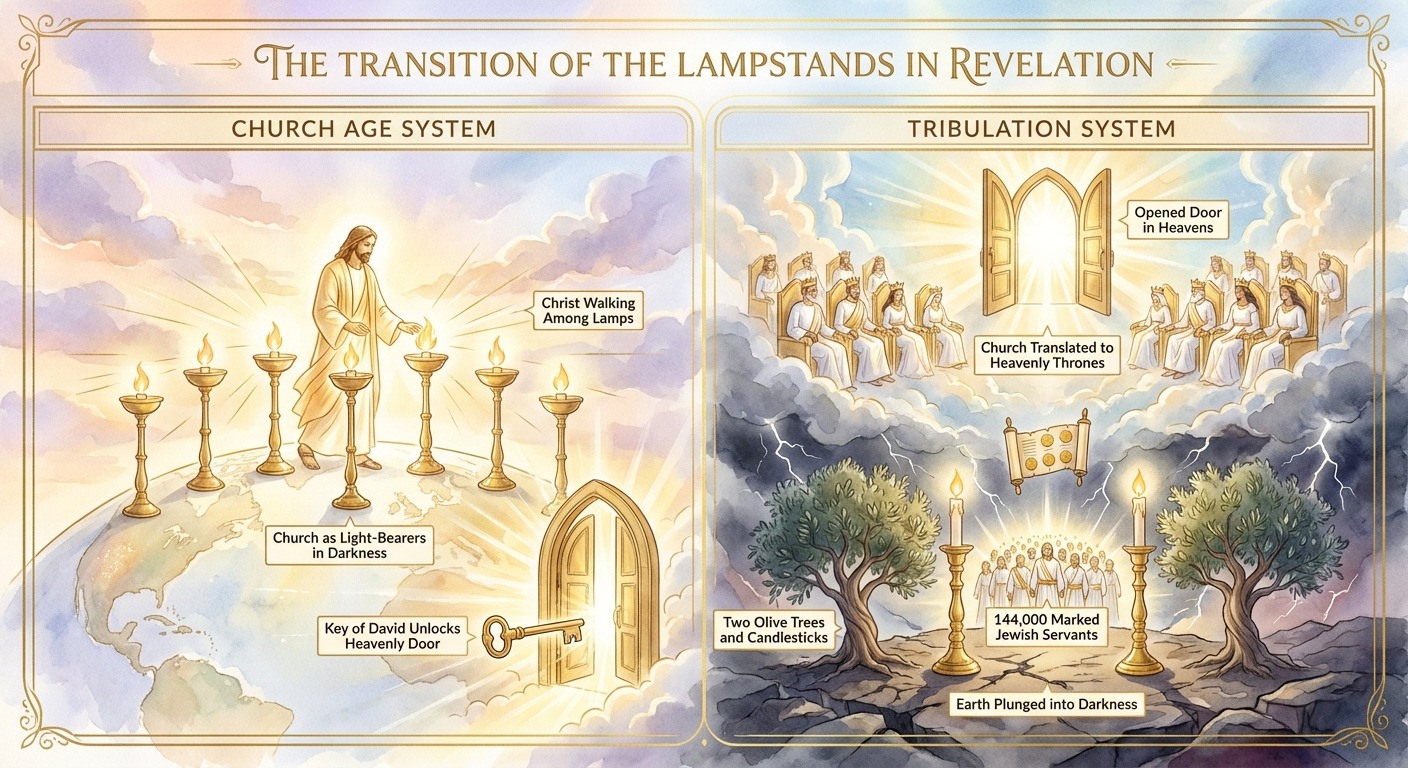
This chart shows the structure. What follows explains each part.
The explicit rapture passages are in place. John's translation is on the record. The twenty-four elders are identified. The legal basis of the Church's co-heirship is established. And now Revelation offers one more piece of evidence -- quieter than the rest, but in some ways the most haunting: the lampstands, which Christ Himself identified as the seven churches, simply disappear. They are present in chapters 1 through 3, the focus of Christ's own attentive ministry, the bearers of divine light in the world. And then they are gone -- not mentioned, not seen, not referenced anywhere in chapters 4 through 18, across the entire span of tribulation narrative. The question this article presses is whether that silence is accidental or whether it is one of the most deliberate structural moves in the entire book.
The Disappearance of the Lampstands
One of the most significant details underscoring the pre-tribulation rapture is the disappearance of the seven golden lampstands from the narrative after Revelation 3. In the opening chapters of Revelation, Christ is seen walking among these lampstands, which are explicitly identified as "the seven churches" (Revelation 1:20). These lampstands are not arbitrary symbols; they represent the Church's function on earth—to shine as lights in the darkness, bearing witness to Christ. As Jesus declared, "Ye are the light of the world. A city that is set on an hill cannot be hid. Neither do men light a candle, and put it under a bushel, but on a candlestick; and it giveth light unto all that are in the house" (Matthew 5:14-15).
During the Church age, Christ walks among these lampstands, tending, correcting, and encouraging them. The presence of the lampstands signifies the Church's ongoing role as God's testimony on earth. However, after Revelation 3, there is a striking absence: the lampstands vanish entirely from the narrative. They do not appear in the heavenly throne room scenes of chapters 4 and 5, nor are they mentioned throughout the tribulation judgments of chapters 6 through 18. The lampstands, and therefore the Church's earthly witness, are conspicuously missing.
A Deliberate Theological Transition
This absence is not merely a narrative omission; it is a deliberate theological transition. The seven letters to the seven churches in Revelation 2 and 3 do more than address local congregations of John's day—they prophetically outline the entire Church age. The order and content of these letters trace the full scope of Church history, ending with the Laodicean period. Once this age concludes, the lampstands and their function as light-bearers in the world are removed. The Church's role as the earthly vessel of divine light ceases when the Church itself is translated.
Yet God does not leave the earth without a witness during the tribulation. Instead, He raises up new light-bearers appropriate to that period. Immediately after the heavenly scenes of Revelation 4 and 5, the first event on earth is the sealing of 144,000 servants from the twelve tribes of Israel (Revelation 7:4-8). These Jewish evangelists take up the light-bearing role previously held by the Church, proclaiming the gospel of the kingdom throughout the tribulation. As a result, a great multitude is gathered—"which no man could number, of all nations, and kindreds, and people, and tongues" (Revelation 7:9). The function of shining truth in the darkness passes from the local assemblies to these new witnesses.
Additionally, God appoints the two witnesses to prophesy in Jerusalem for 1,260 days (Revelation 11:3-12). These are called "the two olive trees, and the two candlesticks standing before the God of the earth" (Revelation 11:4). Unlike the seven lampstands of the churches, these are two distinct lampstands with a ministry focused on Israel and Jerusalem during the tribulation. This shift is purposeful: the Church-age lampstands are removed, and new witnesses arise who are Jewish in character, serving God's purposes for Israel's reconciliation during what Scripture calls "the time of Jacob's trouble."
The Double Absence
The absence of the lampstands from Revelation 4 onward is mirrored by the absence of the word "church" (ekklesia) in these chapters. While the Church is frequently mentioned in chapters 1-3, it disappears from the narrative until the bride returns with Christ in Revelation 19. This double absence confirms that the Church has been removed from the earthly scene before the tribulation judgments unfold.
A Prophetic Type
John's own experience provides a prophetic type of this transition. When he hears the voice "as it were of a trumpet" saying, "Come up hither," he is instantly translated to heaven (Revelation 4:1). This catching up prefigures what Paul describes for the Church in 1 Thessalonians 4. Just as John is removed from the earthly scene to witness the judgments from above, so the Church will be caught up before the tribulation, observing from the heavenly perspective as represented by the twenty-four elders.
The Opened Door in Heaven
The opened door in heaven carries deep significance. Before John's translation, Christ had promised the church in Philadelphia, "Behold, I have set before thee an open door, and no man can shut it" (Revelation 3:8). The One who opens this door holds the key of David, symbolizing Christ's authority to grant access to heavenly realities. When John sees "a door opened in heaven," it is the fulfillment of this promise. Through this door, the Church enters the heavenly sphere to take its co-heir position alongside Christ, not merely as a vision but as the actual transition from earthly pilgrimage to heavenly inheritance.
Thus, the disappearance of the lampstands marks the end of the Church's earthly testimony and the beginning of a new phase in God's prophetic program. The Church is removed, the earthly witness passes to new light-bearers with a distinctly Jewish character, and the heavenly door stands open for the redeemed to enter their eternal inheritance. This transition is not symbolic only; it is the very mechanism by which the Church is brought into its heavenly calling, sharing in Christ's reign by virtue of the everlasting covenant and the authority of the key of David.
The lampstands are gone -- and the word 'church' goes with them, not to return until the Bride arrives from heaven in Revelation 19. God replaces the light-bearers with 144,000 sealed Jews and two witnesses in Jerusalem, both of distinctly Jewish character, because the program that resumes is Israel's program. What all of this establishes, taken together, is that the harpazo is not an isolated idea -- it is a principle woven into the fabric of how God moves His people. And Scripture offers far more evidence for that principle than most readers expect.
Every chart in this series is free to explore online.
 Get the full chart set (PDF – $8)
Members get all PDFs included → Why Membership
Log in with an active membership to download printable PDFs on this site. Purchased on the shop? Access downloads from your shop account.
If you would like to help fund this work:
These charts are based on the following book:

Grace to Glory
Understanding the Rapture and What Happens Next - A vital restoration of this blessed hope doctrine with solid scriptural foundation.
View Related Book