
Visual Theology – Understanding the Rapture
The Visual Theology charts are designed to help you see the structure and movement of Scripture. They highlight patterns, contrasts, and developments that are often difficult to hold together when reading line by line.
These charts show the structure of the argument. The accompanying articles develop each part in full.
This approach follows a long tradition of visual teaching in the Church. The well-known charts of Clarence Larkin helped many grasp the broad outline of Scripture. In the same spirit, these charts aim to make visible what the Word of God is revealing.
Charts and teaching notes for the book of Understanding the Rapture. Select a chart below to view the image and article.
Click chart to view larger
From the teaching in: Grace to Glory
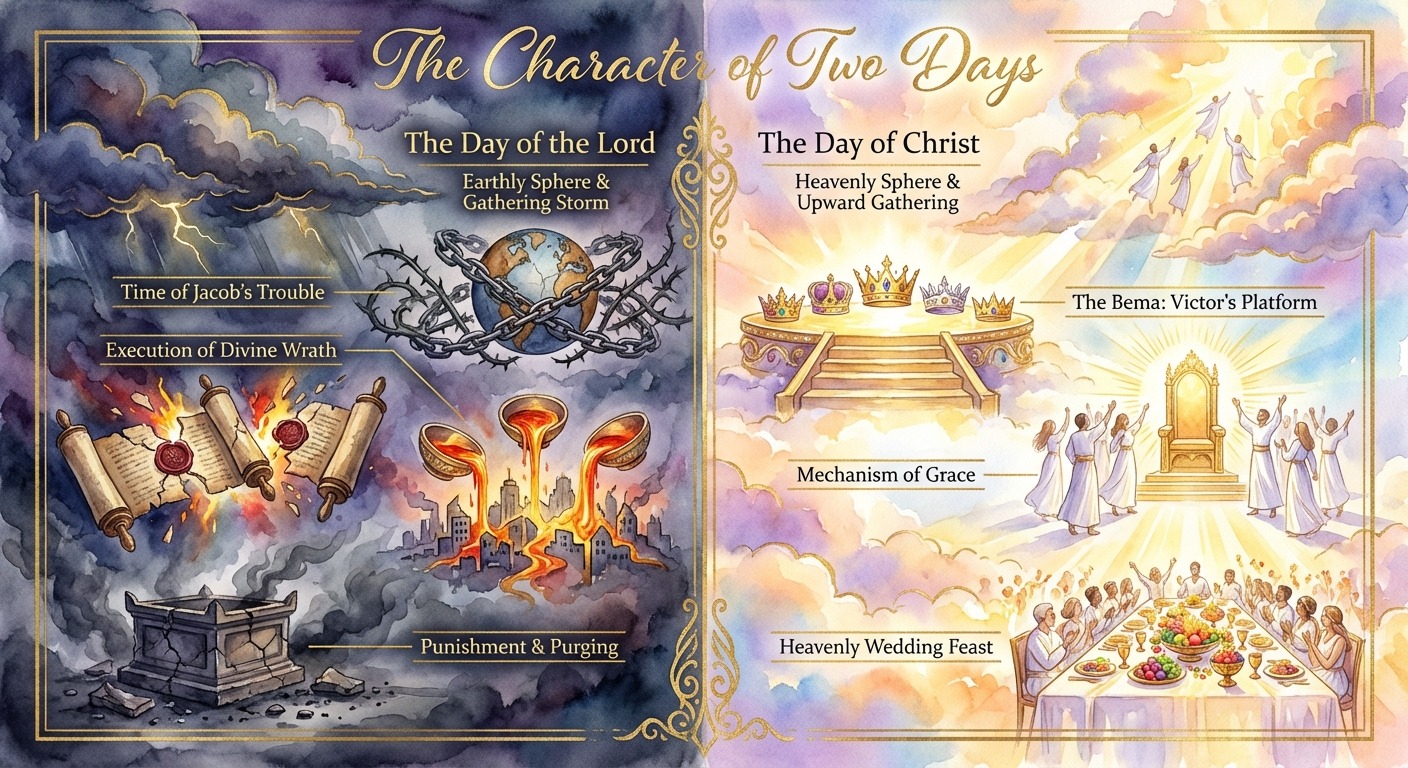
The Character of Two Days
The Character of Two Days
This chart shows the structure. What follows explains each part.
The blessed hope is meant to be exactly that -- blessed. But for many believers, the future carries a weight of anxiety rather than joyful expectation, in part because the Day of the Lord and the Day of Christ have been run together into a single undifferentiated event. If the Day of the Lord -- that terrifying period of darkness, wrath, and divine retribution upon the earth -- is the same event as the Church's gathering to Christ, then there is good reason to dread what is coming. But the testimony of Scripture is that these are not the same day, not the same character, not the same audience, not the same purpose. This article makes the distinction unavoidable.
The Vital Distinction: Day of the Lord vs. Day of Christ
In the landscape of biblical prophecy, few distinctions are as vital as the one between the Day of the Lord and the Day of Christ. These two days, though often conflated in popular teaching, are set in absolute contrast by the testimony of Scripture and are central to understanding both the prophetic chronology and the very character of the believer's hope.
The Day of the Lord: A Day of Judgment
The Day of the Lord is a theme that resounds throughout the Old Testament prophets. It is described as a time when God's focus returns to the earthly sphere, specifically to Israel. Jeremiah speaks of it as "the time of Jacob's trouble" (Jeremiah 30:7), a period designed to bring Israel to repentance and to fulfill God's covenant promises to that nation. The prophets paint this day as one of darkness and thick clouds: "A day of darkness and of gloominess, a day of clouds and of thick darkness" (Joel 2:2). It is a time when the Lord will "punish the world for their evil, and the wicked for their iniquity" (Isaiah 13:11).
This period, known as Daniel's seventieth week or the seven-year tribulation, is marked by the outpouring of God's wrath through the seal, trumpet, and bowl judgments described in Revelation. The Day of the Lord is thus characterized by judgment, wrath, and divine retribution upon the earth and its inhabitants.
The Day of Christ: A Day of Grace
In striking contrast stands the Day of Christ. This day is not marked by wrath, but by grace; not by condemnation, but by celebration. It is the day when believers are gathered to Christ, as Paul writes: "by our gathering together unto him" (2 Thessalonians 2:1). It is the day when Christ appears "without sin unto salvation" to those who eagerly await Him (Hebrews 9:28). The Day of Christ is not about the execution of judgment, but about the fulfillment of salvation. It is the moment when the Church stands before the Lord, not as criminals awaiting sentencing, but as sons presenting their lives to a loving Father who delights to reward the work He Himself has accomplished in them.
A Clear Scriptural Distinction
Paul draws this distinction with unmistakable clarity: "For God hath not appointed us to wrath, but to obtain salvation by our Lord Jesus Christ" (1 Thessalonians 5:9). The Church's destiny is not to endure the judgments of the Day of the Lord, but to share in the glory of the Day of Christ. We are not appointed to tribulation, but to transformation. Our expectation is not the outpouring of wrath, but the wedding feast; not judgment, but glorification.
This distinction is not a matter of mere chronology, but of character. The Day of the Lord is a day when God's righteous anger is poured out upon a world that has rejected Him. It is a day of reckoning, of darkness, and of sorrow for those who remain on the earth. The Day of Christ, on the other hand, is a day of joy, of reward, and of the revelation of sons. It is the culmination of God's purpose for the Church, the unveiling of His masterpiece, the Body of Christ, in glory.
The Believer's Assurance
For the believer, this truth is the foundation of assurance and joyful anticipation. The Church is not destined for wrath. The promise stands: "He that heareth my word, and believeth on him that sent me, hath everlasting life, and shall not come into condemnation; but is passed from death unto life" (John 5:24). Our hope is not in escaping judgment by our own merit, but in being gathered to Christ by His finished work.
Summary
In summary, the character of these two days could not be more different. The Day of the Lord brings judgment and wrath upon the earth; the Day of Christ brings the Church into glory and celebration. To conflate the two is to misunderstand both God's program for Israel and His purpose for the Church. But to distinguish them is to enter into the liberty and joy of the blessed hope, eagerly awaiting the day when we will be gathered to Him, transformed, and displayed as the trophies of His grace.
The Day of the Lord and the Day of Christ are now clearly distinguished -- not merely by chronology but by character: one brings wrath and darkness to a world that has rejected God, the other brings grace, transformation, and celebration to a Church that has been united to His Son. But these two aspects of the Day of Christ -- the rapture and the Bema -- are themselves more unified than they might first appear, and that unity has its own important implications.
Every chart in this series is free to explore online.
 Get the full chart set (PDF – $8)
Members get all PDFs included → Why Membership
Log in with an active membership to download printable PDFs on this site. Purchased on the shop? Access downloads from your shop account.
If you would like to help fund this work:
These charts are based on the following book:

Grace to Glory
Understanding the Rapture and What Happens Next - A vital restoration of this blessed hope doctrine with solid scriptural foundation.
View Related Book