
Visual Theology – Understanding the Rapture
The Visual Theology charts are designed to help you see the structure and movement of Scripture. They highlight patterns, contrasts, and developments that are often difficult to hold together when reading line by line.
These charts show the structure of the argument. The accompanying articles develop each part in full.
This approach follows a long tradition of visual teaching in the Church. The well-known charts of Clarence Larkin helped many grasp the broad outline of Scripture. In the same spirit, these charts aim to make visible what the Word of God is revealing.
Charts and teaching notes for the book of Understanding the Rapture. Select a chart below to view the image and article.
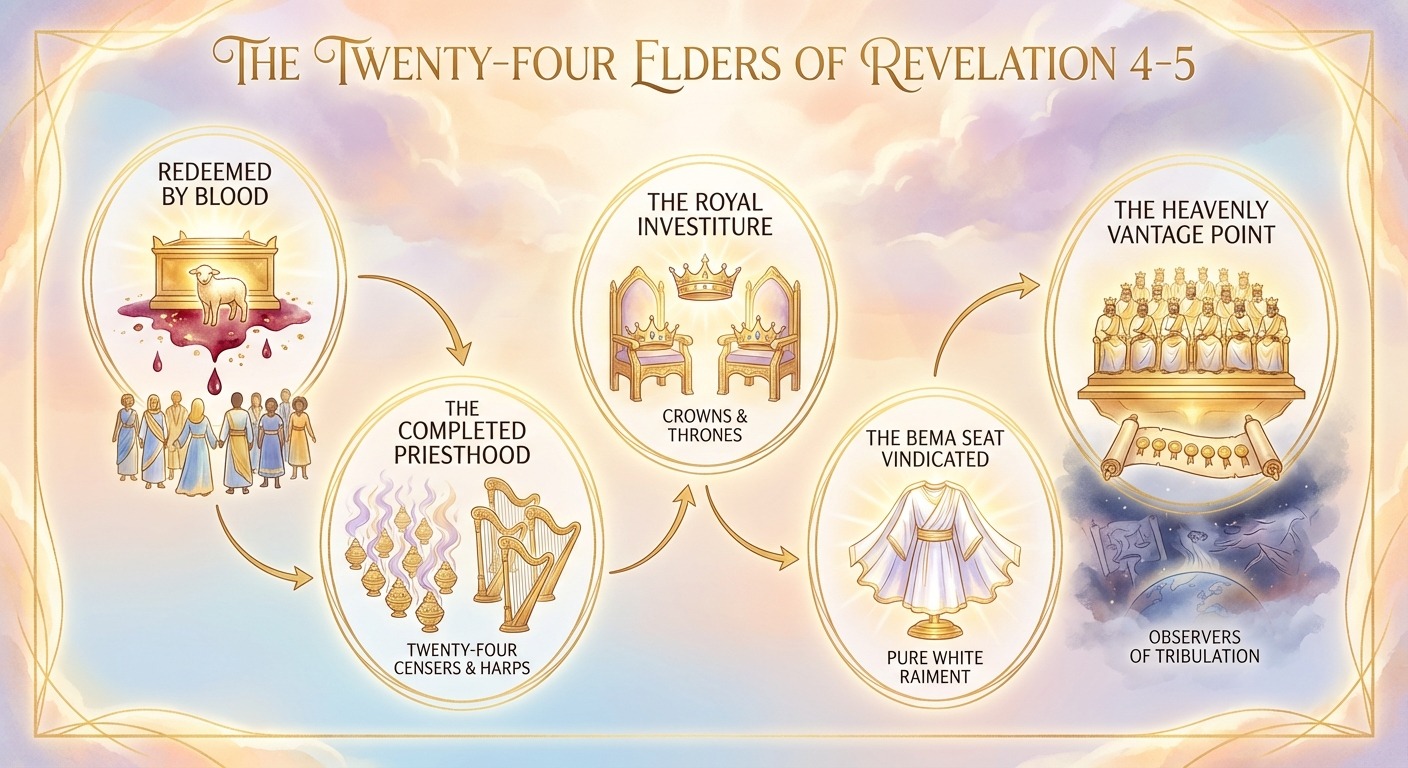
Click chart to view larger
From the teaching in: Grace to Glory
The Twenty-Four Elders: Representatives of the Raptured Church
The Twenty-Four Elders: Representatives of the Raptured Church
This chart shows the structure. What follows explains each part.
John is transported to heaven -- and the first thing he sees is not judgment, not the throne in isolation, but twenty-four elders, already seated, already crowned, clothed in white and positioned around the throne before a single seal of judgment has been opened. Their presence raises an immediate and unavoidable question: who are they? The answer Scripture gives is not ambiguous, but it requires careful attention to what these figures are wearing, what they are singing, and what the combination of their kingly and priestly authority actually means -- because no such combination existed in the Old Testament. This article works through the identity of the twenty-four elders from the inside out, letting their song, their crowns, and their position speak before drawing the conclusion that their presence in heaven at this precise moment in Revelation was designed to show.
The Twenty-Four Elders: The Church Glorified
Among the most profound visions John receives in the book of Revelation is the sight of twenty-four elders seated on thrones around the throne of God, clothed in white raiment and crowned with gold (Revelation 4:4). This scene, witnessed immediately after John’s translation to heaven, holds deep theological significance regarding the identity and destiny of the Church. The presence and characteristics of these elders provide crucial insight into the timing and participants of the rapture, as well as the Church’s glorified position in God’s eternal purpose.
The Significance of the Number Twenty-Four
The number twenty-four is not arbitrary; it echoes the priestly courses established in 1 Chronicles 24, where David divided the sons of Aaron into twenty-four orders to serve in the temple. These courses represented the totality of the priesthood in Israel. Yet, the elders John sees are not merely priests—they are both priests and kings. They sit on thrones, bearing crowns, and offer prayers as priests (Revelation 5:8). Under the Old Testament order, such a combination was impossible: the priesthood belonged to the tribe of Levi, while the kingship was reserved for Judah. The book of Hebrews makes clear that this distinction was absolute until Christ, who was made a priest after the order of Melchizedek, not by genealogy but by the power of an endless life (Hebrews 7:16).
The Identity of the Elders
Apart from the risen Christ, only one group in all of Scripture is vested with both kingly and priestly authority—the Church. Revelation 5:10 records the worship of these elders: “And hast made us unto our God kings and priests: and we shall reign on the earth.” This song is not that of angels, nor of Old Testament Israel, but of those redeemed “out of every kindred, and tongue, and people, and nation” (Revelation 5:9). It is the testimony of the Church, the body of Christ, formed from both Jews and Gentiles in the dispensation of the grace of God.
Their Position and Its Implications
The elders’ position is significant—they are already seated and crowned when John arrives in heaven, before any tribulation judgment begins. Their white raiment speaks of the righteousness imputed to them by Christ, and their crowns of gold indicate reward and authority already conferred. This strongly suggests that they represent the completed Church, already raptured and rewarded at the judgment seat of Christ. Their presence in heaven, rather than on earth during the unfolding of tribulation judgments, reveals that the Church has been removed prior to the outpouring of wrath.
The worship and prayers of these elders further confirm their identity. In Revelation 5:9-10, they sing of redemption by the blood of the Lamb and declare their destiny to reign with Him. They are not angels, for angels are never described as redeemed by blood. Nor are they limited to Israel, for their origin is “out of every kindred, and tongue, and people, and nation.” As glorified king-priests in the heavenly throne room, they manifest the Church’s unique calling—to be both kings and priests in union with Christ, the great High Priest and coming King.
A Dual Role Made Possible in Christ
This dual role was impossible under the Old Testament system. Only Christ, by virtue of His resurrection and appointment after the order of Melchizedek, could combine the offices of king and priest. The Church, united to Him by faith, shares in this dignity. Peter writes, “But ye are a chosen generation, a royal priesthood, an holy nation, a peculiar people” (1 Peter 2:9). The Church’s authority flows from her position in Christ, who sits at the right hand of God, having received all power and dominion.
A Testimony to the Pre-Tribulation Rapture
The scene of the twenty-four elders, therefore, is not merely symbolic but is the heavenly reality of the Church’s completed destiny. Their seating and crowning before the tribulation begins is a testimony to the pre-tribulation rapture. The Church is not present on earth for the outpouring of judgment but is already glorified, rewarded, and enthroned with Christ in the heavenly places. Their song celebrates redemption accomplished, authority received, and a future reign secured.
Summary
In summary, the twenty-four elders in Revelation stand as representatives of the raptured and glorified Church. Their identity as king-priests, their multinational origin, their seated and crowned position, and their song of redemption all testify to the Church’s unique destiny in God’s eternal purpose. They are the visible manifestation of what Paul described: “And hath raised us up together, and made us sit together in heavenly places in Christ Jesus” (Ephesians 2:6). Through the twenty-four elders, God displays the finished masterpiece of His workmanship in Christ—a Church redeemed, glorified, and enthroned, prepared to reign with Him forever.
The twenty-four elders -- glorified, enthroned, singing of redemption by blood from every nation -- are the Church in her completed state, already in heaven before the tribulation begins. Their authority as king-priests is not something they earned; it is the authority of the Seed they are in. Which raises the next question naturally: what is the legal basis for that authority? On what grounds does the Church share in the Son's own prerogatives as both King and High Priest?
Every chart in this series is free to explore online.
 Get the full chart set (PDF – $8)
Members get all PDFs included → Why Membership
Log in with an active membership to download printable PDFs on this site. Purchased on the shop? Access downloads from your shop account.
If you would like to help fund this work:
These charts are based on the following book:

Grace to Glory
Understanding the Rapture and What Happens Next - A vital restoration of this blessed hope doctrine with solid scriptural foundation.
View Related Book