
Visual Theology – Understanding the Rapture
The Visual Theology charts are designed to help you see the structure and movement of Scripture. They highlight patterns, contrasts, and developments that are often difficult to hold together when reading line by line.
These charts show the structure of the argument. The accompanying articles develop each part in full.
This approach follows a long tradition of visual teaching in the Church. The well-known charts of Clarence Larkin helped many grasp the broad outline of Scripture. In the same spirit, these charts aim to make visible what the Word of God is revealing.
Charts and teaching notes for the book of Understanding the Rapture. Select a chart below to view the image and article.
Click chart to view larger
From the teaching in: Grace to Glory
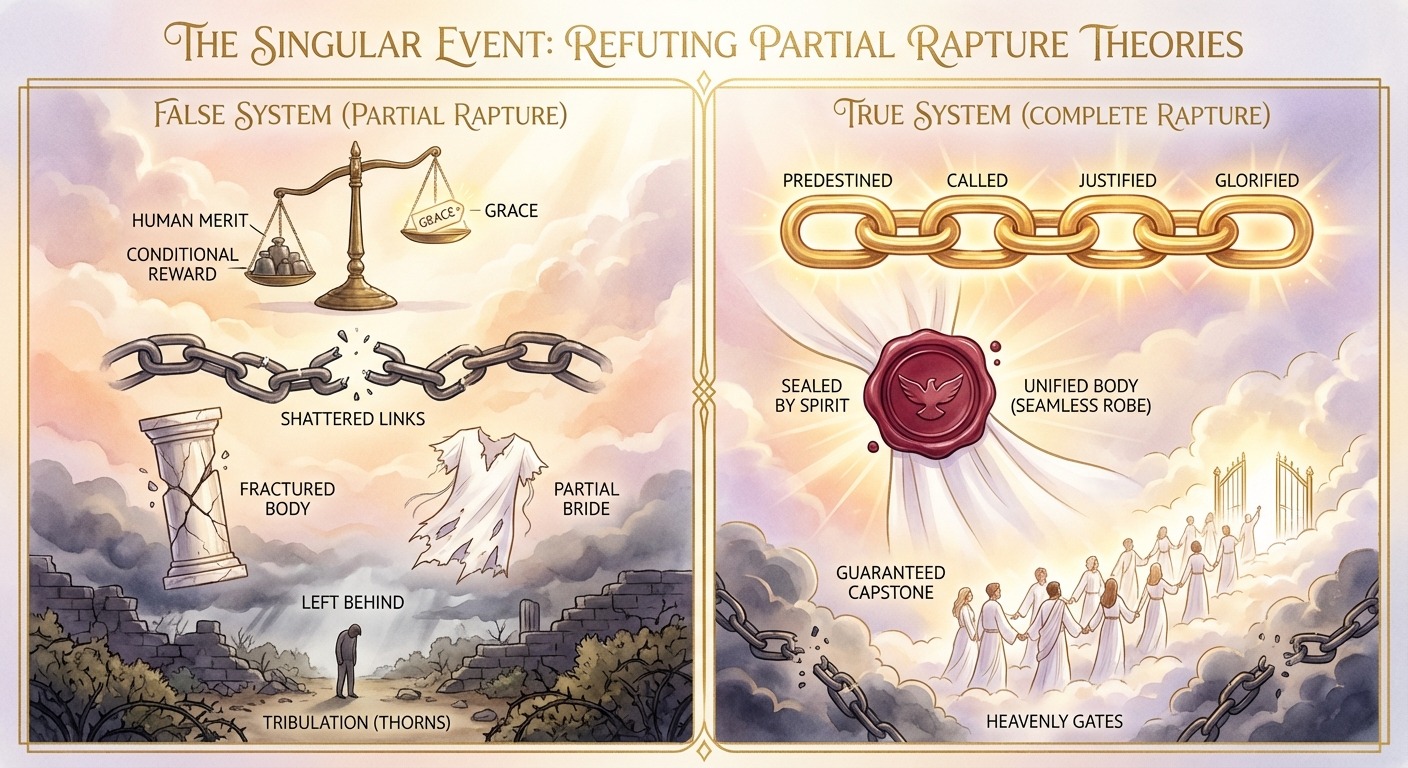
The Singular Event: Refuting Partial Rapture Theories
Refuting Partial Rapture Theories
This chart shows the structure. What follows explains each part.
The pre-tribulation case is now assembled from multiple lines of evidence: the explicit passages, the prophetic types, the structural arguments from Revelation, the promise of Revelation 3:10, the Jewish character of the tribulation, and the identity of the restrainer. But there is a view -- often sincere, sometimes serious -- that not all believers will be included in the rapture; that it is a reward for the faithful or the watchful, leaving carnal or uncommitted believers to face the tribulation. This is the partial rapture theory, and it must be addressed not because it is popular but because it strikes at something foundational: whether the rapture belongs to grace or to merit.
The Error of a Partial Rapture
Some have proposed that the rapture will be partial, suggesting that only especially faithful or watchful believers will be taken, while others will be left behind to face the tribulation. This teaching, though often well-intentioned, fundamentally misunderstands the nature of salvation and the unity of the Body of Christ as revealed in Scripture.
The Rapture as the Completion of Salvation
The rapture is not a reward for faithful service; it is the completion of our salvation, the final stage in God's redemptive work for every believer. Paul makes this unmistakably clear in Romans 8:30: "Moreover whom he did predestinate, them he also called: and whom he called, them he also justified: and whom he justified, them he also glorified." Here, the unbroken chain of God's saving work is evident. Everyone who is justified—declared righteous by faith in Christ—will be glorified, receiving the resurrection body. There are no exceptions, conditions, or qualifications added by human merit.
This assurance flows directly from Christ's imputed righteousness, received by faith alone apart from works. Just as our justification is a free gift grounded in His perfect obedience, so the rapture is the assured outcome of His redeeming work, not our personal faithfulness. Our inclusion in this glorification is anchored in Christ alone, guaranteeing that every believer will be caught up to meet Him.
Guaranteed by the Holy Spirit
The sealing ministry of the Holy Spirit further guarantees our participation in the rapture. Ephesians 1:13-14 declares: "In whom ye also trusted, after that ye heard the word of truth, the gospel of your salvation: in whom also after that ye believed, ye were sealed with that holy Spirit of promise, Which is the earnest of our inheritance until the redemption of the purchased possession, unto the praise of his glory." The Spirit is the earnest, the down payment, obligating God to complete our redemption through rapture and glorification.
A Gift of Grace, Not a Reward for Works
Partial rapture theories inevitably make our participation dependent on our obedience rather than Christ's finished work. But Paul emphatically rejects this notion: "For if by one man's offence death reigned by one; much more they which receive abundance of grace and of the gift of righteousness shall reign in life by one, Jesus Christ. Therefore as by the offence of one judgment came upon all men to condemnation; even so by the righteousness of one the free gift came upon all men unto justification of life" (Romans 5:17-18). Our participation in the rapture is secured by Christ's righteousness, not our own. It is a gift of grace, not a reward for works. To suggest otherwise is to undermine the very foundation of the gospel.
The Unity of the Body of Christ
The unity of the Church as the Body of Christ stands in direct opposition to the idea of a partial rapture. Paul writes, "For as the body is one, and hath many members, and all the members of that one body, being many, are one body: so also is Christ. For by one Spirit are we all baptized into one body, whether we be Jews or Gentiles, whether we be bond or free; and have been all made to drink into one Spirit" (1 Corinthians 12:12-13). The notion that Christ would rapture only a part of His Body while leaving the rest behind is unthinkable. The Body of Christ is a unified whole; when Christ comes for His Bride, He will take all of her, not just her most attractive parts.
A Singular, Complete Event
The rapture is a unique, complete event that involves all believers alive at that time, occurring simultaneously with the raising of all the dead who have been "in Christ" since His resurrection. Paul describes this singular event:
"For the Lord himself shall descend from heaven with a shout, with the voice of the archangel, and with the trump of God: and the dead in Christ shall rise first: Then we which are alive and remain shall be caught up together with them in the clouds, to meet the Lord in the air: and so shall we ever be with the Lord" (1 Thessalonians 4:16-17).
Again, he writes, "Behold, I shew you a mystery; We shall not all sleep, but we shall all be changed, In a moment, in the twinkling of an eye, at the last trump: for the trumpet shall sound, and the dead shall be raised incorruptible, and we shall be changed" (1 Corinthians 15:51-52).
The Distinct Hope of the Church
The phrase "in Christ" applies only to members of the New Creation, the Body of Christ—those baptized into His death, made alive together with Him, raised together, and seated in the heavenlies (Romans 6:3-5; Ephesians 2:5-6; Colossians 2:12). Their destiny is to meet the Lord in the air and be transformed instantly, taking on incorruptibility and being conformed to His image and glorified (1 Corinthians 15:52-54; Philippians 3:20-21; Romans 8:29-30). This is the manifestation of the heavenly sons of God (Romans 8:19).
In contrast, the Old Testament saints—Abraham, Isaac, Jacob, and the prophets—looked forward to seeing the Lord on earth, with their graves opened and standing on the ground to see Him (Job 19:25-27; Ezekiel 37:12-14; Daniel 12:2-3; John 11:24). The Church's hope is distinct and exclusively heavenly.
Summary
In summary, the rapture is not a selective or conditional event. It is the consummation of grace's work in every believer, grounded in Christ's finished work, guaranteed by the Spirit, and realized in the unity of the Body. Any teaching that makes the rapture a reward for merit or divides the Body of Christ contradicts the clear testimony of Scripture and the very heart of the gospel.
The partial rapture theory is dismantled on its own ground: the unbroken chain of Romans 8:30, the sealing of the Spirit as earnest and guarantee, the unity of the Body that cannot be divided, and the plain statement that whether believers wake or sleep, they live together with Him. The rapture is the consummation of grace's work, not the culmination of the believer's performance. Which sets up the final and most doxological stop in Part 2 -- a stop that steps back from all the individual arguments and asks what this consistent, recurring, pre-judgment pattern of removal says about who God is.
Every chart in this series is free to explore online.
 Get the full chart set (PDF – $8)
Members get all PDFs included → Why Membership
Log in with an active membership to download printable PDFs on this site. Purchased on the shop? Access downloads from your shop account.
If you would like to help fund this work:
These charts are based on the following book:

Grace to Glory
Understanding the Rapture and What Happens Next - A vital restoration of this blessed hope doctrine with solid scriptural foundation.
View Related Book