
Visual Theology – Understanding the Rapture
The Visual Theology charts are designed to help you see the structure and movement of Scripture. They highlight patterns, contrasts, and developments that are often difficult to hold together when reading line by line.
These charts show the structure of the argument. The accompanying articles develop each part in full.
This approach follows a long tradition of visual teaching in the Church. The well-known charts of Clarence Larkin helped many grasp the broad outline of Scripture. In the same spirit, these charts aim to make visible what the Word of God is revealing.
Charts and teaching notes for the book of Understanding the Rapture. Select a chart below to view the image and article.
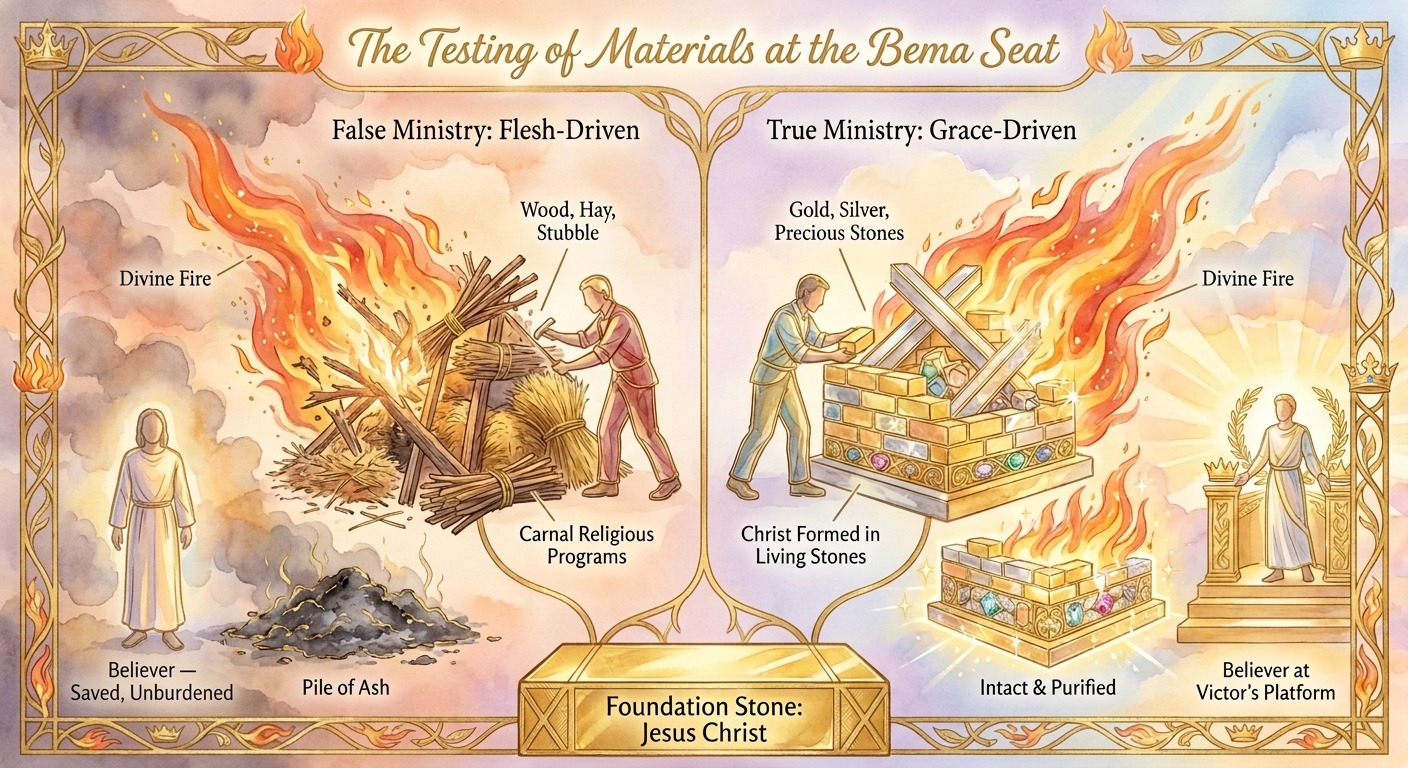
Click chart to view larger
From the teaching in: Grace to Glory
The Corinthian Crisis: False Ministry and Worthless Materials
False Ministry and Worthless Materials
This chart shows the structure. What follows explains each part.
The Bema is a victory platform, not a courtroom -- the believer's sins are settled, and the event is one of grace and celebration. But Paul does use language at the Bema that is sobering: some will 'suffer loss,' and their work will be 'burned.' If the Bema is not about sin, then what exactly is burning? And what does it mean to suffer loss there? The answer requires going back to the specific crisis Paul was responding to in Corinth -- the infiltration of false teachers who were building with materials that looked impressive but had no eternal substance. The warning at the Bema is not directed at the believer's character; it is directed at the ministry the believer has been participating in.
The True Meaning of Suffering Loss at the Bema Seat
Paul’s warning to the Corinthians about suffering loss at the Bema Seat (1 Corinthians 3:15) has often been misunderstood, leading many to fear that their failures will be replayed as a source of shame or punishment. However, a careful reading of the passage, in its original context, reveals a different message—one that speaks not of condemnation or diminished salvation, but of the tragic emptiness of false ministry and the absolute security of those who are in Christ.
The Corinthian Context: False Ministry
The situation at Corinth was not a general commentary on Christian works, but a direct response to the infiltration of false apostles who were undermining Paul’s ministry and leading believers astray. These were not humble servants pointing to Christ, but self-promoting ministers who “glory in appearance and not in heart” (2 Corinthians 5:12). Their ministry was marked by boasting in eloquence, spiritual experiences, and religious pedigree. Paul says they brought “another Jesus” and “another gospel” (2 Corinthians 11:4), pulling the Corinthians away from the simplicity that is in Christ and back into bondage under law.
Two Kinds of Building
Against this backdrop, Paul describes two kinds of building on the one true foundation: “For other foundation can no man lay than that is laid, which is Jesus Christ” (1 Corinthians 3:11).
- Some build with gold, silver, and precious stones—the true ministry of Christ that produces living stones for God’s building.
- Others build with wood, hay, and stubble—fleshly, man-made programs and teachings that may impress outwardly but lack any eternal substance.
Wood, hay, and stubble are not simply good deeds done with poor motives. They represent the entire system of false ministry: religious activity that is disconnected from the blood of Christ, not rooted in faith, and which fails to build up the body of Christ. Such ministry brings division, carnality, and damage to God’s house. The false ministers at Corinth excelled in this. Their efforts were impressive to the senses, drawing crowds and commanding respect, but their work was combustible—destined to be consumed when tested by fire.
Paul’s warning is not limited to the false teachers themselves. It extends to believers who, bewitched by the sensationalism and outward displays of such ministers, invest their time and energy in these fruitless endeavors. The tragedy is that genuine believers, sealed by the Holy Spirit, may be diverted from the true ministry of Christ by impressive but empty religious activity. When the day comes, their service in these things will amount to nothing.
The Crucial Assurance of Salvation
The crucial assurance comes in Paul’s next words: “but he himself shall be saved; yet so as by fire” (1 Corinthians 3:15). This is not a threat to the believer’s salvation or a prediction of shameful exposure. Rather, it is the unequivocal declaration of eternal security—even in the most extreme case, where everything a person built is consumed, the person himself is saved. The burning of wood, hay, and stubble will happen in the twinkling of an eye, as the corruptible is dissolved and we put on incorruptibility. There is no protracted reckoning or lingering shame; the worthless things simply disappear, consumed in the instant of our glorification.
This scenario of total loss is not the norm, but a rare outcome for those who, though genuinely saved, became so entangled in false, flesh-driven ministry that they caused great harm to God’s building. Their life’s work is left as ash, yet their salvation remains untouched. Paul himself embraced the loss of all things, counting them as dung for the excellency of the knowledge of Christ (Philippians 3:8). This is the attitude that will fill every believer when we see Him face to face—we will gladly let all the foolish things be burned away.
A Day of Celebration, Not Dread
For the believer who loves Christ, who desires to know Him and make Him known, who trusts in His grace and seeks to walk in fellowship with Him, there is no fear at the Bema. Even if there is some wood, hay, and stubble mixed among the gold, silver, and precious stones, the Bema is not a day of dread but a day of celebration. The work that Christ accomplished in and through us will be revealed and rewarded, and all that was worthless will simply vanish, leaving the believer secure in the embrace of grace.
Summary
In summary, Paul’s warning about suffering loss at the Bema Seat is not a threat of condemnation, but a sober reminder of the emptiness of false ministry. It is a call to remain in the simplicity that is in Christ, to build with eternal materials, and to rest in the assurance that, in Christ, even the weakest believer is eternally secure. The Bema is a celebration of what God has built, not a courtroom for exposing our failures. The tragedy is not loss of salvation, but the loss of what might have been, had we invested in that which endures forever.
What burns at the Bema is not the believer but the ministry -- specifically the wood, hay, and stubble of false, flesh-driven, Christ-diminishing religious activity that has no eternal weight. The person is saved, though 'as through fire.' The tragedy is not the loss of salvation but the loss of what might have been, had the life been invested in what endures. Which brings the natural positive question: what does it look like to build with materials that don't burn?
Every chart in this series is free to explore online.
 Get the full chart set (PDF – $8)
Members get all PDFs included → Why Membership
Log in with an active membership to download printable PDFs on this site. Purchased on the shop? Access downloads from your shop account.
If you would like to help fund this work:
These charts are based on the following book:

Grace to Glory
Understanding the Rapture and What Happens Next - A vital restoration of this blessed hope doctrine with solid scriptural foundation.
View Related Book