
Visual Theology – Understanding the Rapture
The Visual Theology charts are designed to help you see the structure and movement of Scripture. They highlight patterns, contrasts, and developments that are often difficult to hold together when reading line by line.
These charts show the structure of the argument. The accompanying articles develop each part in full.
This approach follows a long tradition of visual teaching in the Church. The well-known charts of Clarence Larkin helped many grasp the broad outline of Scripture. In the same spirit, these charts aim to make visible what the Word of God is revealing.
Charts and teaching notes for the book of Understanding the Rapture. Select a chart below to view the image and article.
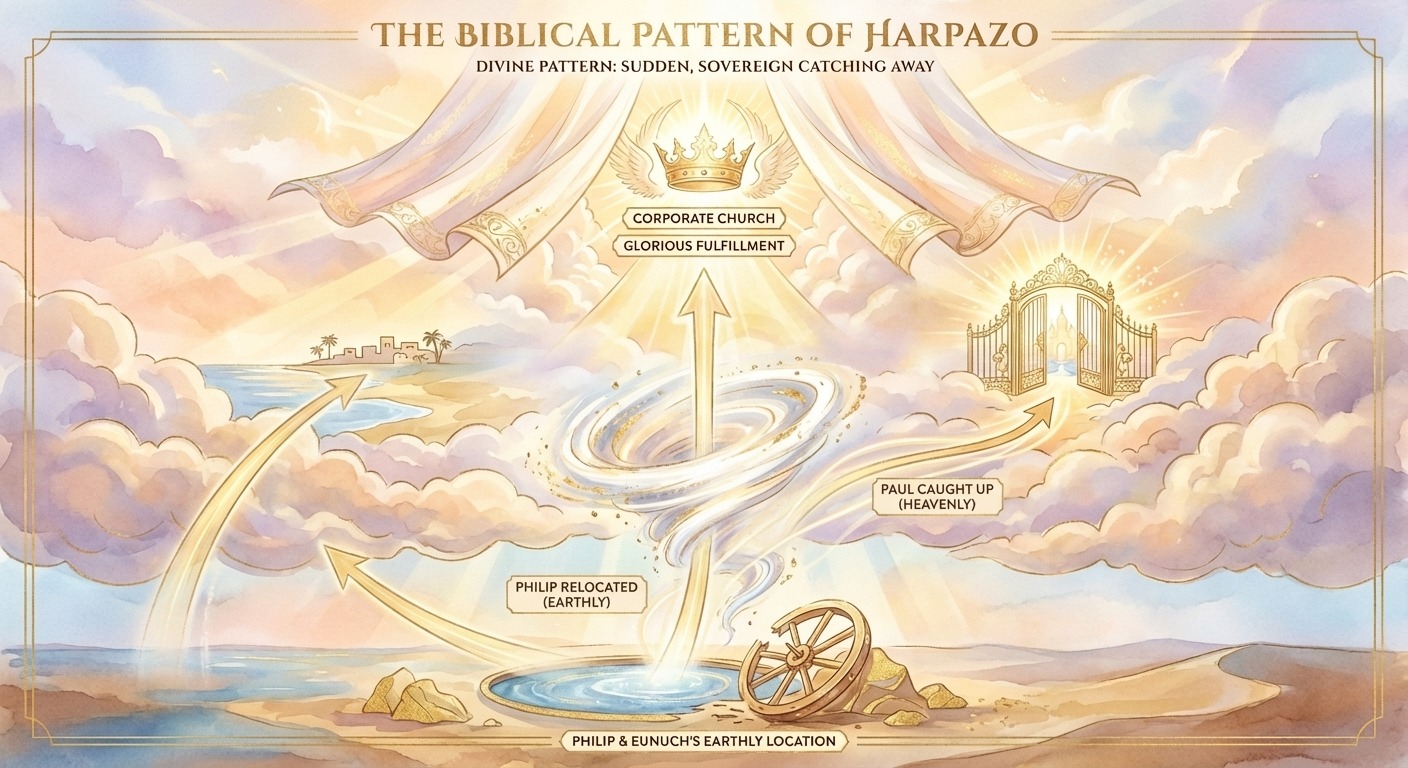
Click chart to view larger
From the teaching in: Grace to Glory
Understanding the "Catching Away" in Other Scriptures
The Harpazo Principle
This chart shows the structure. What follows explains each part.
The structural arguments from Revelation are strong -- the meta tauta outline, the prophetic type in John's translation, the missing lampstands, the twenty-four elders already crowned. But there is a question that cuts underneath all of them, one that asks not about the architecture of a book but about the character of God: has He ever done this before? Has He ever, in a moment, by His own sovereign power, snatched someone from one sphere to another without warning and without human preparation? This article looks at the specific Greek word that Paul used to describe the rapture -- harpazo, caught away -- and traces it back through the biblical record to show that the catching away of the Church is not a novel invention but the culmination of a pattern that runs through Philip's experience in Acts and Paul's own testimony in 2 Corinthians.
The Harpazo Principle: A Biblical Pattern
Throughout Scripture, the principle of harpazo—the supernatural catching away by divine power—emerges as a consistent pattern in God's dealings with His people. Far from being an isolated doctrine, the rapture stands as the glorious culmination of this principle, where God removes His chosen ones from one sphere to another, not by human effort, but by His own sovereign intervention.
The Example of Philip
Consider the experience of Philip after baptizing the Ethiopian eunuch. Acts 8:39 records, "And when they were come up out of the water, the Spirit of the Lord caught away Philip, that the eunuch saw him no more: and he went on his way rejoicing." Here, the same Greek word "harpazo" is used to describe Philip's sudden removal. One moment, Philip stood with the eunuch; the next, he was gone—caught away by the Spirit, transported instantly to another location. There was no preparation or warning, only the decisive action of God. This was not a gradual journey, but an immediate, supernatural relocation. The eunuch "saw him no more," testifying to the abruptness and completeness of the event.
The Example of Paul
This divine pattern is further seen in the apostle Paul's own testimony. In 2 Corinthians 12:2-4, Paul recounts, "I knew a man in Christ above fourteen years ago, (whether in the body, I cannot tell; or whether out of the body, I cannot tell: God knoweth;) such an one caught up to the third heaven...How that he was caught up into paradise, and heard unspeakable words, which it is not lawful for a man to utter." Again, "caught up" translates "harpazo," emphasizing the same supernatural snatching away. Paul himself could not distinguish whether this was a physical or visionary experience; the event was so transcendent that it defied ordinary categories. What stands out is the destination: "the third heaven," "paradise"—the very presence of God. This anticipates the destiny of the Church at the rapture, not simply a movement to another earthly place, but a translation into the heavenly realm.
The Nature of the Principle
These accounts reveal that the harpazo principle is not merely an abstract theological idea, but a tangible, historical reality. When God purposes to transfer His people from one realm to another, He acts suddenly and with irresistible power. There is no reliance on human readiness or spiritual achievement; it is God's initiative alone that accomplishes the removal. In both Philip's and Paul's experiences, the individuals did nothing to prepare or trigger the event. The Spirit acted according to divine timing and purpose, and the transition was instantaneous.
The Culmination in the Rapture
This same principle undergirds the rapture of the Church as described in 1 Thessalonians 4:17: "Then we which are alive and remain shall be caught up together with them in the clouds, to meet the Lord in the air: and so shall we ever be with the Lord." The use of "caught up" (harpazo) here links the rapture directly to the biblical pattern of God's supernatural interventions. The event is not a process or a gradual ascent, but a momentary, powerful act of God, removing the Church from the earthly scene and transporting her into the presence of Christ. It is the ultimate expression of the harpazo principle, applied not to an individual, but to the entire Body of Christ.
Thus, the rapture is not an isolated or novel doctrine, but the culmination of a consistent biblical pattern. Throughout history, God has demonstrated His ability to snatch away His servants, bypassing natural processes and human limitations. The Church's blessed hope rests not in our own preparedness or effort, but in the certainty of God's sovereign power to act when the appointed time arrives. As we see in these scriptural accounts, the harpazo is always sudden, always decisive, and always by the Spirit's initiative. The rapture will be the final and greatest demonstration of this principle, when the Lord Himself will gather His Bride to Himself, completing the masterpiece of His redeeming work and revealing His glory to all creation.
The harpazo is an established principle -- sudden, sovereign, instantaneous, determined entirely by God's timing and purpose. Which means the rapture is not a novel theological category but the ultimate expression of a pattern God has demonstrated before. That said, one major source of confusion still needs to be addressed directly before the pre-tribulation case can stand fully on its own: the persistent tendency to treat the rapture and the Second Coming as two phases of a single event rather than two entirely separate movements in God's prophetic program.
Every chart in this series is free to explore online.
 Get the full chart set (PDF – $8)
Members get all PDFs included → Why Membership
Log in with an active membership to download printable PDFs on this site. Purchased on the shop? Access downloads from your shop account.
If you would like to help fund this work:
These charts are based on the following book:

Grace to Glory
Understanding the Rapture and What Happens Next - A vital restoration of this blessed hope doctrine with solid scriptural foundation.
View Related Book