
Visual Theology – Understanding the Rapture
The Visual Theology charts are designed to help you see the structure and movement of Scripture. They highlight patterns, contrasts, and developments that are often difficult to hold together when reading line by line.
These charts show the structure of the argument. The accompanying articles develop each part in full.
This approach follows a long tradition of visual teaching in the Church. The well-known charts of Clarence Larkin helped many grasp the broad outline of Scripture. In the same spirit, these charts aim to make visible what the Word of God is revealing.
Charts and teaching notes for the book of Understanding the Rapture. Select a chart below to view the image and article.
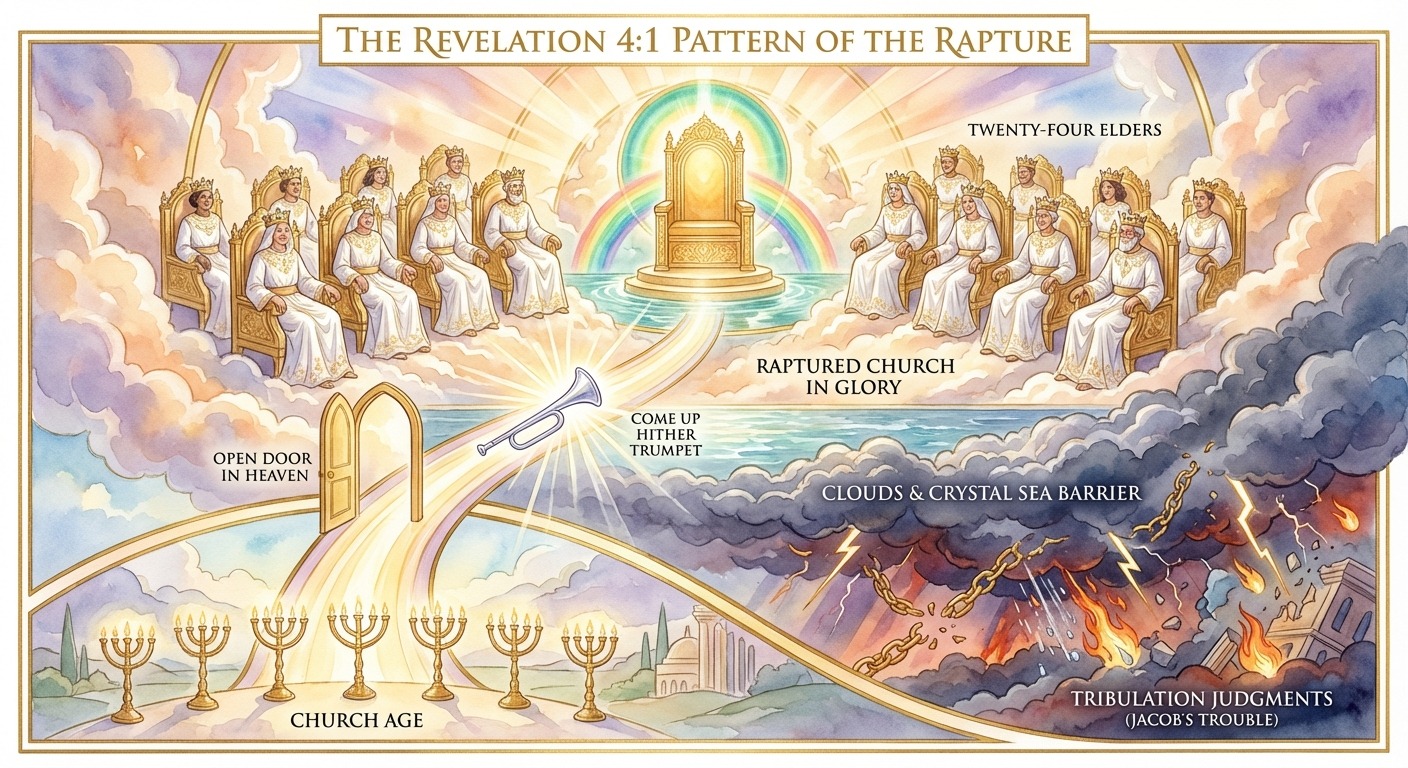
Click chart to view larger
From the teaching in: Grace to Glory
The Revelation 4:1 Pattern: "Come Up Hither"
The Revelation 4:1 Pattern
This chart shows the structure. What follows explains each part.
The types from Genesis are in place -- Enoch, Noah, Lot -- each one a facet of the same divine character. But Revelation 4:1 is not merely another Old Testament illustration; it is a New Testament prophetic moment that mirrors Paul's rapture passages with a precision that cannot be accidental. A voice like a trumpet. A command to come up. An immediate transition from earth to heaven. And immediately on the other side of that transition: twenty-four elders, already crowned, already enthroned, before the first seal of judgment is broken. This article reads that sequence as a coherent, intentional prophetic pattern -- and asks what it means that the Church's representative figure is in heaven before a single tribulation judgment has begun.
The Revelation 4:1 Pattern of the Rapture
The book of Revelation presents a profound prophetic pattern regarding the rapture of the Church, centering on the remarkable scene in Revelation 4:1-2. After the Lord addresses the seven churches in Revelation 2 and 3, John records:
After this I looked, and, behold, a door was opened in heaven: and the first voice which I heard was as it were of a trumpet talking with me; which said, Come up hither, and I will shew thee things which must be hereafter. And immediately I was in the spirit: and, behold, a throne was set in heaven, and one sat on the throne.
This moment is far more than a personal vision for John; it stands as a prophetic picture of the Church’s rapture—a pattern divinely orchestrated to reveal God’s plan for His people.
Parallels to the Rapture Event
Several striking parallels connect John’s experience to the rapture promised to the Church. First, John hears a voice “as it were of a trumpet,” which echoes Paul’s declaration that “the trumpet shall sound, and the dead shall be raised incorruptible, and we shall be changed” (1 Corinthians 15:52). The command “Come up hither” aligns precisely with the Church being “caught up to meet the Lord in the air” (1 Thessalonians 4:17). John’s transition is immediate—“immediately I was in the spirit”—mirroring the instantaneous transformation of believers at the rapture: “in a moment, in the twinkling of an eye” (1 Corinthians 15:52).
The Crucial Timing
The timing of this event in Revelation is crucial. John’s heavenly ascent occurs directly after the detailed messages to the churches and immediately before the unfolding of the tribulation judgments that begin in Revelation 6. This sequence is not coincidental; it is divinely arranged to demonstrate that the Church’s removal precedes God’s judgment on the earth. The Church is the central focus of Revelation 2 and 3, but following John’s ascent, there is a conspicuous absence of any mention of the Church on earth throughout the tribulation narrative in chapters 6 through 19. This silence is not accidental but is intended to teach that the Church is no longer present on earth during this period of wrath.
The Church Seen in Heaven
In contrast to the Church’s absence from the earth, Revelation 4 introduces the twenty-four elders in heaven:
And round about the throne were four and twenty seats: and upon the seats I saw four and twenty elders sitting, clothed in white raiment; and they had on their heads crowns of gold (Revelation 4:4).
These elders are not angelic beings but represent the raptured Church. Their description matches the promises given to believers—seated on thrones, clothed in white, and crowned with gold. Their song in Revelation 5:9-10 is unmistakable:
Thou wast slain, and hast redeemed us to God by thy blood out of every kindred, and tongue, and people, and nation; And hast made us unto our God kings and priests: and we shall reign on the earth.
This is the language of the redeemed, a company drawn from every nation, made kings and priests by the blood of Christ, just as Peter describes believers as “a chosen generation, a royal priesthood” (1 Peter 2:9).
Deliverance from Judgment
The heavenly setting is essential. While judgment is poured out on earth, the Church is in heaven, gathered around the throne, worshipping the Lamb. This is not deliverance through judgment, but deliverance from judgment, in keeping with God’s consistent pattern throughout Scripture. The Church is not a victim of the tribulation but a spectator, safely removed, as Enoch was before the flood.
This prophetic pattern is not simply an escape for the fearful; it is the consistent outworking of God’s character and His distinct program for the Church. The Church, as co-heirs with Christ, is seated with Him in the heavenlies as He opens the seals and initiates the events that will lead to “the kingdoms of this world becoming the Kingdom of God and of His Christ, and they will reign on the earth” (Revelation 5:10; Revelation 11:15).
Summary
In summary, the Revelation 4:1 pattern is a divinely crafted portrait of the rapture. It reveals that the Church is called up to heaven before the tribulation begins, is conspicuously absent from the judgments that follow, and is seen instead in the presence of the Lord, reigning as kings and priests. This pattern is not a theological novelty but the ultimate expression of God’s faithfulness to His heavenly people, securing their place with Him before the hour of trial comes upon the earth.
The Revelation 4:1 pattern has been established as the structural hinge of the book -- the Church exits, the elders appear, the seals open -- and the silence about the Church in chapters 6 through 18 is not accidental but deliberate. What has not yet been addressed is the mechanism of that removal from a different angle: not what the removal looks like prophetically, but what it releases -- what is currently holding back the full manifestation of lawlessness, and what happens when it is lifted.
Every chart in this series is free to explore online.
 Get the full chart set (PDF – $8)
Members get all PDFs included → Why Membership
Log in with an active membership to download printable PDFs on this site. Purchased on the shop? Access downloads from your shop account.
If you would like to help fund this work:
These charts are based on the following book:

Grace to Glory
Understanding the Rapture and What Happens Next - A vital restoration of this blessed hope doctrine with solid scriptural foundation.
View Related Book