
Visual Theology – Understanding the Rapture
The Visual Theology charts are designed to help you see the structure and movement of Scripture. They highlight patterns, contrasts, and developments that are often difficult to hold together when reading line by line.
These charts show the structure of the argument. The accompanying articles develop each part in full.
This approach follows a long tradition of visual teaching in the Church. The well-known charts of Clarence Larkin helped many grasp the broad outline of Scripture. In the same spirit, these charts aim to make visible what the Word of God is revealing.
Charts and teaching notes for the book of Understanding the Rapture. Select a chart below to view the image and article.
Click chart to view larger
From the teaching in: Grace to Glory
Sons, Not Slaves: The Bema as Celebration
Sons, Not Slaves: The Bema as Celebration
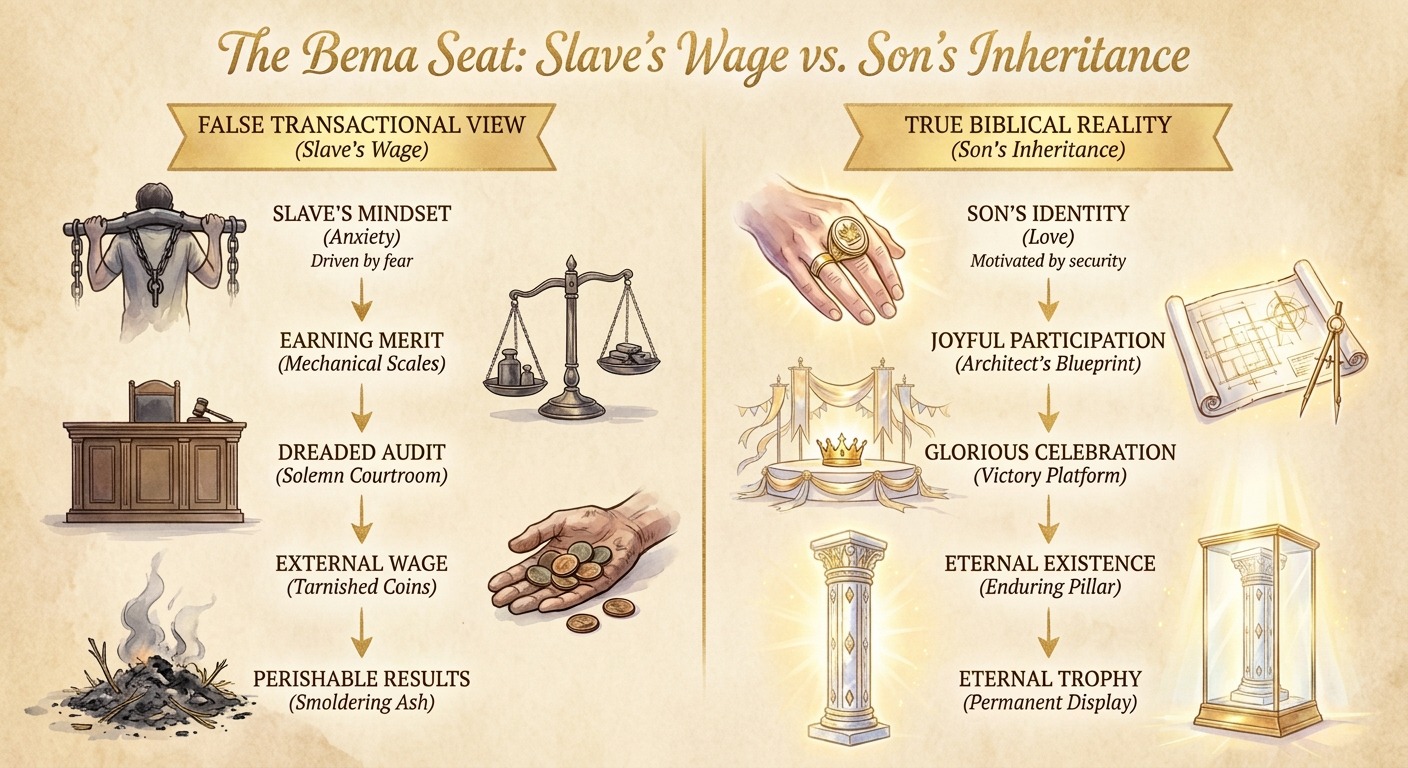
This chart shows the structure. What follows explains each part.
The eternal materials are defined: Christ formed in His people, the only work that will survive the Bema's testing. But beneath the question of what we build runs a more fundamental question about who we are when we build -- and Paul's answer, pressed in Galatians, is that we are not servants hired to earn a wage but sons participating in a family inheritance. This distinction is not a minor adjustment to the way we think about the Bema; it is a revolution. A servant works under the threat of a final audit; a son serves because he belongs, because the inheritance is already his, because the Father's house is already home. This article follows that distinction all the way into the Bema and shows what it means when the platform for the celebration is not a payroll office but the Father's own household.
From Wage Slave to Son: A Liberating View of the Bema Seat
A profound transformation in how we anticipate the Bema Seat comes when we move from the mentality of a wage slave to that of a son. The common, transactional view imagines the Bema as a place where God pays out wages for services rendered, keeping a ledger of deeds and dispensing rewards accordingly. This perspective is rooted in anxiety, as if our standing before God is always in question, and our labor for Him is an attempt to earn His approval or accumulate merit. Yet this is not the biblical picture at all. The Bema is not the scene of a nervous employee awaiting a final audit, but the celebration of sons who already belong in the Father's house.
The True Reward: God's Masterpiece
The true reward for faithful building is not an external prize handed out in exchange for effort. Rather, it is the eternal existence and display of the building itself—God's masterpiece, the Church. Just as a master architect's greatest joy is not the paycheck but the enduring beauty and legacy of the cathedral he designed, so the believer's reward is to see the fruit of Spirit-empowered labor woven into God's eternal house. The gold, silver, and precious stones—those moments where Christ's character was manifested in us, where ministry flowed from His redemption, where lives were touched for eternity—are not tokens to be traded for something else. They are the very substance of the reward. They are integrated into the Church, which will be on display for all ages as the testimony of what God's grace can accomplish.
An Inheritance, Not a Wage
This liberates us from the exhausting and unbiblical mindset of a servant striving for pay. Paul draws a sharp distinction: "Wherefore thou art no more a servant, but a son; and if a son, then an heir of God through Christ" (Galatians 4:7). We do not serve God to get into His family; we serve because we are already in His family. Our work is not a desperate attempt to earn a place, but a joyful participation in the family business, knowing that all the Father has is already ours. The reward is not a wage, but an inheritance. As Paul writes, "Knowing that of the Lord ye shall receive the reward of the inheritance: for ye serve the Lord Christ" (Colossians 3:24). The inheritance is the completed building, the Church in its glory, of which we are living stones.
The Purpose: God's Eternal Glory
The entire purpose of this building project is the eternal glory of God. The Church is God's trophy of grace, saved "That in the ages to come he might shew the exceeding riches of his grace in his kindness toward us through Christ Jesus" (Ephesians 2:7). At the Bema, our individual portion in that building will be revealed, not as our accomplishment, but as the evidence of what the grace of God has produced in a yielded life. The works of gold, silver, and precious stones are the record of Christ's life manifested in us, and their enduring value is that they will be forever on display as part of God's exhibition of grace.
The Practical Response
Understanding the Bema Seat as a celebration of God's masterpiece changes everything about our daily lives. It frees us from the fear of condemnation and the anxiety that every imperfect deed will be exposed and punished. It also delivers us from the tyranny of false ministry that would lure us into bondage and rob us of the joy of Christ. The practical response is clear: remain attached to the true ministry, do not be bewitched by those who glory in appearance and not in heart, and do not invest your life building someone else's empire of wood, hay, and stubble. Instead, remain in the simplicity that is in Christ.
A Day of Celebration
For the believer walking in fellowship with Christ, the Bema is not a day of dread, but a day of glorious celebration. It is the unveiling of what God has been building all along—a people for His name, a habitation for His glory, a body fitted together to display His wisdom and love. On that day, the empty, perishable works of false ministry will be shown for what they are, but the true work of Christ in and through His people will shine forth in eternal splendor. We labor not as slaves fearing punishment, but as sons eager to see the Father glorified. We serve "heartily, as to the Lord, and not unto men" (Colossians 3:23), knowing that one day we will stand with Him on the victory platform—not to be judged for our failures, but to celebrate the magnificent, enduring masterpiece that His grace has built through us.
This is the Bema: not a courtroom, but a coronation; not a reckoning, but a reunion; not condemnation, but commendation. This is the day we have been waiting for.
The Bema as celebration of sonship -- not a wage audit but the unveiling of what the Father has built through His children, the inheritance received rather than earned -- is the final word on the Judgment Seat of Christ. Part 4 is complete. The rapture is established, the Bema is rightly understood, and now the argument turns to its final movement: what it means to live now, in the present, in light of the blessed hope that ties all of this together.
Every chart in this series is free to explore online.
 Get the full chart set (PDF – $8)
Members get all PDFs included → Why Membership
Log in with an active membership to download printable PDFs on this site. Purchased on the shop? Access downloads from your shop account.
If you would like to help fund this work:
These charts are based on the following book:

Grace to Glory
Understanding the Rapture and What Happens Next - A vital restoration of this blessed hope doctrine with solid scriptural foundation.
View Related Book