
Visual Theology – Understanding the Rapture
The Visual Theology charts are designed to help you see the structure and movement of Scripture. They highlight patterns, contrasts, and developments that are often difficult to hold together when reading line by line.
These charts show the structure of the argument. The accompanying articles develop each part in full.
This approach follows a long tradition of visual teaching in the Church. The well-known charts of Clarence Larkin helped many grasp the broad outline of Scripture. In the same spirit, these charts aim to make visible what the Word of God is revealing.
Charts and teaching notes for the book of Understanding the Rapture. Select a chart below to view the image and article.
Click chart to view larger
From the teaching in: Grace to Glory
Living in Light of the Blessed Hope
Living in Light of the Blessed Hope
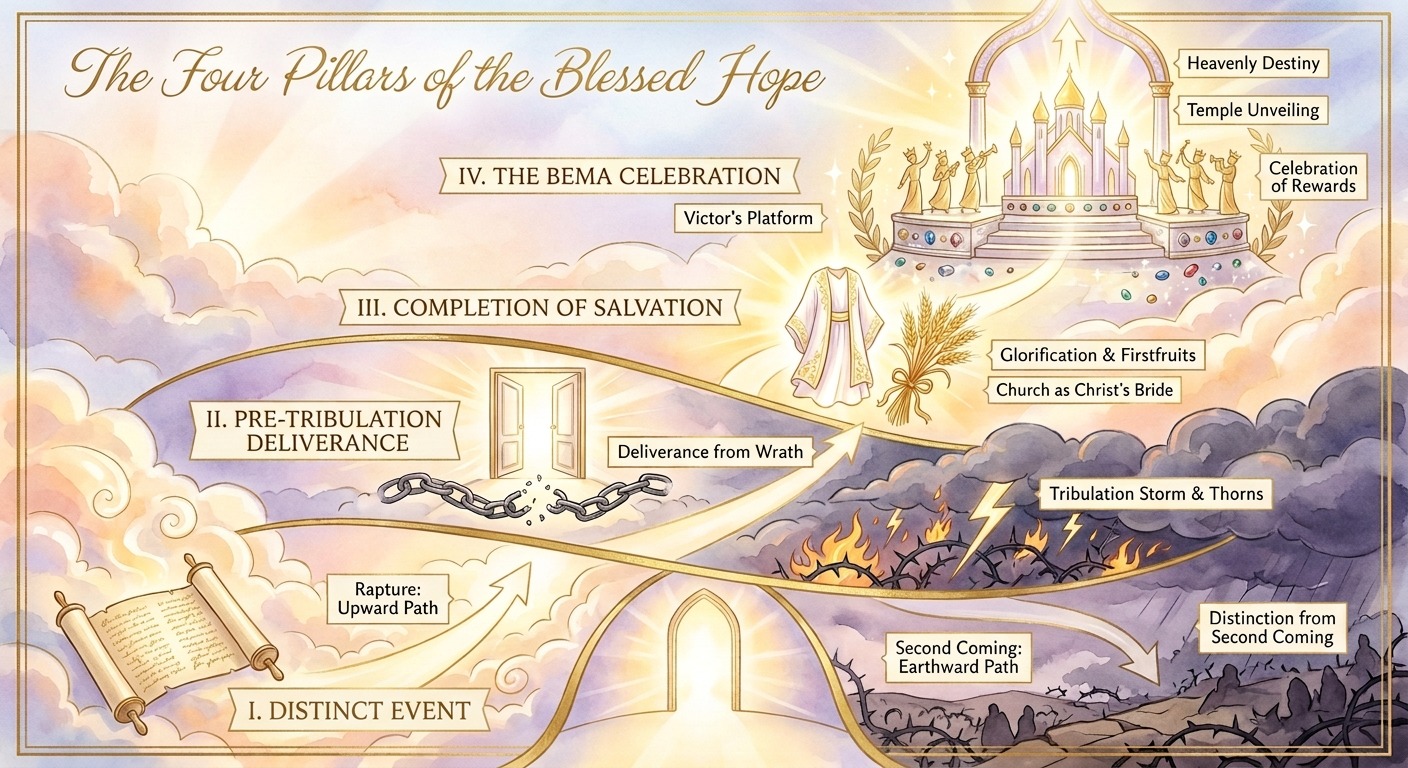
This chart shows the structure. What follows explains each part.
The rapture and the Bema have now been examined -- not as isolated doctrines but as two movements in a single coherent story that runs from justification through glorification. Part 5 opens with the question those two events generate when they are held together in the mind of a living believer: so what? What does this change about today? How does a hope that is real, that is coming, that is grounded in grace and not in performance -- how does that hope actually function in the ordinary texture of a life? This article is the pivot from the argument to the application, from the case to the consequence.
The Blessed Hope: More Than an Escape
The blessed hope is far more than an escape from tribulation; it is the glorious culmination of God's eternal purpose in Christ. At the heart of this hope lies the rapture, not merely as a doctrine to affirm, but as the moment when the divine Artist unveils His masterpiece—the Church—to a watching universe.
A Distinct Event: Rapture vs. Second Coming
The testimony of Scripture is explicit: the rapture is a distinct event, separate from Christ's Second Coming to earth. Paul’s teaching in 1 Thessalonians 4:13-18 and 1 Corinthians 15:51-52, John’s prophetic experience in Revelation 4:1, and the vision of the twenty-four elders in heaven before the tribulation, all establish that the rapture is the Church’s gathering to Christ in the air, while the Second Coming is Christ’s return to earth to judge and reign. These are not two phases of a single event, but two separate movements with different purposes, participants, and timing.
God's Pattern: Removal Before Judgment
God’s consistent pattern throughout Scripture is to remove His people before judgment falls. From Enoch’s translation before the flood to Lot’s removal from Sodom, the principle is clear: the people of God are delivered before wrath descends. This pattern is affirmed in the removal of the restrainer in 2 Thessalonians 2, the Church’s absence from the tribulation narrative in Revelation 6-19, and the promise in Revelation 3:10 to keep the faithful Church “from the hour of trial.” The pre-tribulational timing of the rapture is not wishful thinking; it is the consistent expression of God’s character and His distinct program for the Church as opposed to Israel.
The Rapture as the Completion of Salvation
The theological significance of the rapture reaches its peak in the recognition that it is the completion of salvation. Grace operates in three stages: justification, sanctification, and glorification. The rapture is the moment when God’s redemptive work reaches its fullness, when the Church is transformed into the image of Christ. Christ is the firstfruits, setting the pattern for our transformation, and in the rapture, the Church is revealed as His Body and Bride—the fullness of Him who fills all in all. This is not merely individual change, but the unveiling of a corporate masterpiece that will display God’s wisdom to the principalities and powers for all ages to come.
From Dread to Joy: The Judgment Seat of Christ
Yet, for many, the anticipation of the rapture is clouded by anxiety about what follows: the Judgment Seat of Christ (the Bema). The fear that the Bema is a courtroom for condemnation rather than a victor’s platform for celebration has cast a shadow over the blessed hope. But the truth is that the Bema is the grand unveiling of God’s masterpiece, where the incorruptible work wrought by Christ in and through His people is put on eternal display. It is not a day of wrath and judgment like the Day of the Lord, but a day of grace, reward, and the revelation of sons. The Bema completes the picture of the Day of Christ, transforming dread into joyful anticipation.
The Transformative Power of This Hope
Understanding the rapture as the blessed hope changes everything for the believer. It frees us from anxious striving and the tyranny of religious performance. We are not serving to earn a place in God’s family, but participating in the unveiling of the family’s inheritance. The rapture, as revealed in 1 Thessalonians 4 and 1 Corinthians 15, is the Church’s moment of glorification, when we are caught up to meet the Lord in the air and so shall we ever be with the Lord. The Church is not appointed to wrath, but to obtain salvation by our Lord Jesus Christ (1 Thessalonians 5:9). The Day of Christ is characterized by joy, not condemnation; by reward, not fear.
This hope is meant to be the animating force of the Christian life. It is the assurance that our destiny is heavenly, that our service is not in vain, and that our future is secured—not by our faithfulness, but by His. The rapture and the Bema together constitute the blessed hope: the rapture as the moment of transformation and gathering, the Bema as the immediate unveiling and celebration of what God has built. Both are entirely the work of grace, and both are the inheritance of every believer in Christ.
For those who have trusted Christ, this hope is not a distant or uncertain dream, but a present reality that transforms how we live. We are liberated from fear, protected from false ministry, and filled with eager anticipation. Our light afflictions are not worthy to be compared with the glory that shall be revealed in us (Romans 8:18). We wait, not as those who have no hope, but as those whose hope is sure and steadfast, knowing that the One who promised is faithful.
Our Comfort and Certainty
The blessed hope is the comfort with which we are to encourage one another. It is the certainty that, “when the Lord Himself shall descend from heaven with a shout, with the voice of the archangel, and with the trump of God, the dead in Christ shall rise first, and we which are alive and remain shall be caught up together with them in the clouds, to meet the Lord in the air” (1 Thessalonians 4:16-17). This is the hope that purifies, the hope that sustains, the hope that is secured by grace alone. Even so, come, Lord Jesus.
Living in light of the blessed hope -- freed from striving, protected from false ministry, grounded in the certainty of what is coming -- is now established as the posture the rapture creates in the believer. But the blessed hope rests on a distinction that, if blurred, can drain the joy from everything: the distinction between two days that sound similar but could not be more different in character.
Every chart in this series is free to explore online.
 Get the full chart set (PDF – $8)
Members get all PDFs included → Why Membership
Log in with an active membership to download printable PDFs on this site. Purchased on the shop? Access downloads from your shop account.
If you would like to help fund this work:
These charts are based on the following book:

Grace to Glory
Understanding the Rapture and What Happens Next - A vital restoration of this blessed hope doctrine with solid scriptural foundation.
View Related Book