
Visual Theology – Understanding the Rapture
The Visual Theology charts are designed to help you see the structure and movement of Scripture. They highlight patterns, contrasts, and developments that are often difficult to hold together when reading line by line.
These charts show the structure of the argument. The accompanying articles develop each part in full.
This approach follows a long tradition of visual teaching in the Church. The well-known charts of Clarence Larkin helped many grasp the broad outline of Scripture. In the same spirit, these charts aim to make visible what the Word of God is revealing.
Charts and teaching notes for the book of Understanding the Rapture. Select a chart below to view the image and article.
Click chart to view larger
From the teaching in: Grace to Glory
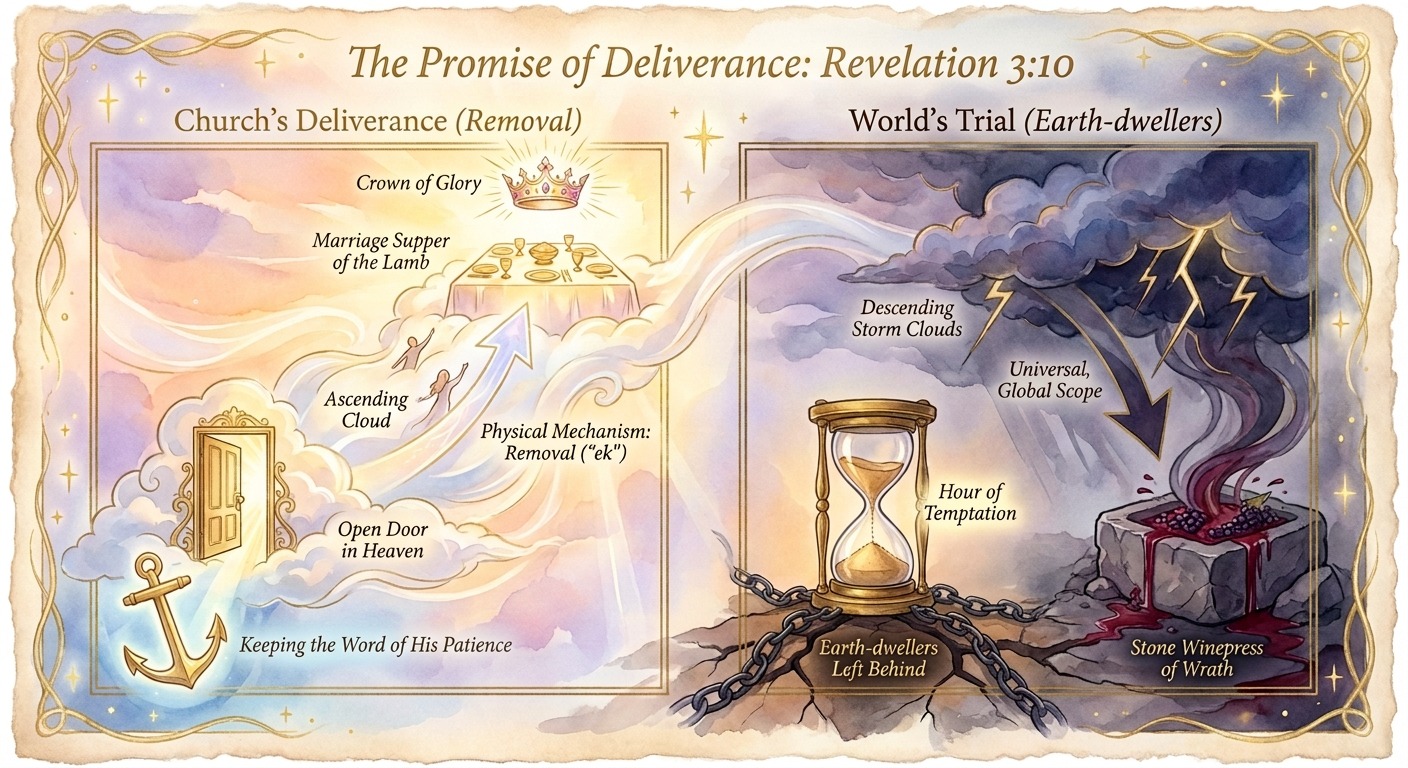
The Promise of Deliverance: Revelation 3:10
The Promise of Deliverance
This chart shows the structure. What follows explains each part.
The case for the rapture has been built on the explicit passages, the structural evidence of Revelation, and the biblical principle of harpazo -- and Part 1 closed with the critical distinction between the rapture and the Second Coming. Now Part 2 opens by pressing a harder question: is the pre-tribulation rapture not just supported by types and structures, but actually promised? Directly, by Christ Himself, in words that admit almost no other reading? The answer is yes -- and the specific promise is found in a single verse addressed to the church in Philadelphia, where the preposition used to describe the nature of the deliverance turns out to carry the entire weight of the argument.
The Promise of Deliverance in Revelation 3:10
Among the most direct promises given to the Church regarding its relationship to the coming tribulation is found in the words of Christ to the church in Philadelphia: “Because thou hast kept the word of my patience, I also will keep thee from the hour of temptation, which shall come upon all the world, to try them that dwell upon the earth” (Revelation 3:10). This statement is not merely a general assurance of protection, but a precise commitment rooted in the very language of the New Testament. The key lies in the Greek preposition “ek,” translated “from,” which Christ uses to describe the nature of this deliverance. He does not promise to keep the Church “through” (dia) the hour of trial, as though she would be preserved within it, but “from” (ek) it—indicating removal out of, rather than preservation amid.
This distinction is not trivial. The same preposition appears in John 17:15, where the Lord prays, “I pray not that thou shouldest take them out of the world, but that thou shouldest keep them from the evil.” Here, “from” (ek) means protection by removal from the sphere of the evil one, not endurance within his domain. In Revelation 3:10, then, the promise is not for the Church to be sustained under judgment, but to be kept out of the very time period in which that judgment falls.
The Scope of the Deliverance
The scope of this promised deliverance is equally significant. The “hour of temptation” is described as coming “upon all the world, to try them that dwell upon the earth.” This is not a localized persecution or a mere season of difficulty, but a global tribulation that encompasses every earth-dweller. Since the trial is universal, the only way to be kept “from” it is to be removed from the earth itself before it begins. The Church’s deliverance, therefore, is not a matter of surviving through wrath, but of being taken out before wrath descends.
The Character of the Philadelphia Church
Philadelphia, the church addressed in this promise, is characterized by having “kept the word of my patience.” This patience is the long-suffering of Christ toward a rebellious world, His restraint in executing judgment while grace is still extended. The Church that shares in His patient heart toward the lost is assured of being spared from the hour when patience gives way to righteous judgment. The reward for holding fast to Christ’s word is not simply preservation, but deliverance from the very time and sphere of coming wrath.
Harmony with New Testament Teaching
This promise is perfectly aligned with Paul’s declaration in 1 Thessalonians 5:9: “For God hath not appointed us to wrath, but to obtain salvation by our Lord Jesus Christ.” The destiny of the Church is salvation, not wrath; glory, not judgment. We are not appointed to the wine press of God’s fury, but to the marriage supper of the Lamb. The Church’s portion is to be with Christ in glory, not to endure the outpouring of judgment that will fall upon the earth.
The Church's Absence in Revelation's Tribulation Narrative
A further confirmation of this deliverance is found in the narrative structure of Revelation itself. The word “church” (ekklesia) appears nineteen times in chapters 1-3, but is absent from chapters 4-18, which detail the tribulation period. Instead, we encounter “saints” who “keep the commandments of God, and have the testimony of Jesus Christ” (Revelation 12:17). These are not the Church, but tribulation saints whose moral character stands in contrast to those aligned with the antichrist system. The absence of the Church from the tribulation narrative underscores that she has been removed, not preserved within.
Summary
In summary, the promise of Revelation 3:10 is not a vague assurance of spiritual strength, but a specific guarantee of removal from the coming hour of global trial. The Church’s deliverance is grounded in Christ’s own word, rooted in the language of Scripture, and harmonized with the broader testimony of the New Testament. We are not called to endure God’s wrath, but to be kept from it—removed before the hour of temptation descends upon the world. This is the blessed hope and the anchor for our endurance: Christ Himself has promised to keep us from the hour that shall try all who dwell upon the earth.
The promise of Revelation 3:10 is established: the Church is to be kept 'out of' the hour, not merely sustained through it -- a distinction of prepositions that points to a distinction of location. The deliverance is from the very time sphere in which the trial falls, not from the discomfort of enduring it. But this raises the obvious next question: what, precisely, is that hour? What makes it the kind of event from which the Church must be removed rather than preserved through?
Every chart in this series is free to explore online.
 Get the full chart set (PDF – $8)
Members get all PDFs included → Why Membership
Log in with an active membership to download printable PDFs on this site. Purchased on the shop? Access downloads from your shop account.
If you would like to help fund this work:
These charts are based on the following book:

Grace to Glory
Understanding the Rapture and What Happens Next - A vital restoration of this blessed hope doctrine with solid scriptural foundation.
View Related Book