
Visual Theology – Understanding the Rapture
The Visual Theology charts are designed to help you see the structure and movement of Scripture. They highlight patterns, contrasts, and developments that are often difficult to hold together when reading line by line.
These charts show the structure of the argument. The accompanying articles develop each part in full.
This approach follows a long tradition of visual teaching in the Church. The well-known charts of Clarence Larkin helped many grasp the broad outline of Scripture. In the same spirit, these charts aim to make visible what the Word of God is revealing.
Charts and teaching notes for the book of Understanding the Rapture. Select a chart below to view the image and article.
Click chart to view larger
From the teaching in: Grace to Glory
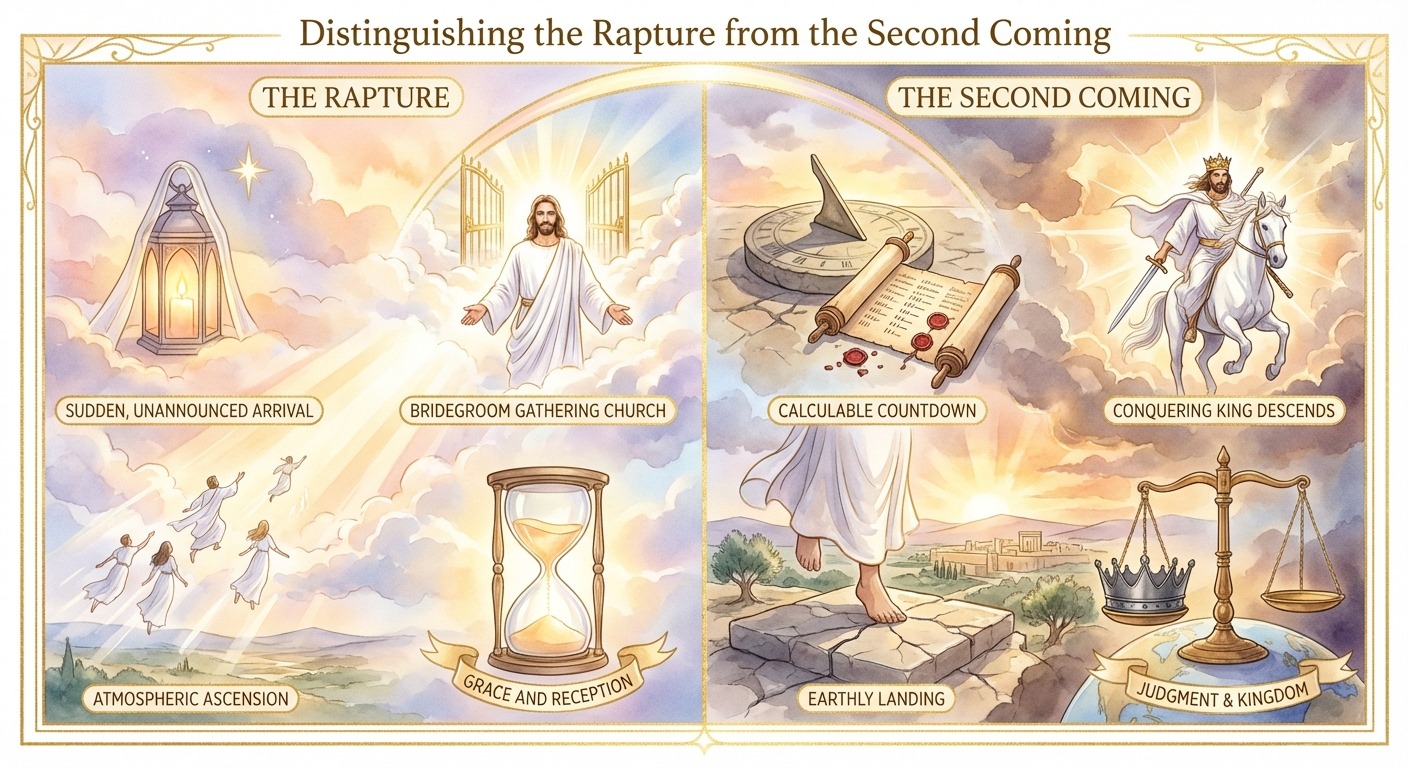
Distinguishing the Rapture from the Second Coming
Rapture vs. Second Coming
This chart shows the structure. What follows explains each part.
The biblical evidence for the rapture has been building across six articles -- from Paul's explicit passages to John's type to the twenty-four elders to the missing lampstands to the harpazo principle in Scripture. But there is a source of confusion that, if it is not addressed, can quietly undermine everything: the assumption that every reference to Christ's return in the Bible is referring to the same event. It is not. The rapture and the Second Coming are separated in Scripture by purpose, by manner, by location, and by timing -- and collapsing them together produces a reading of prophecy that assigns the Church to a program she was never part of. This article exists to make the distinction unavoidable.
Distinguishing the Rapture from the Second Coming
One of the most persistent sources of confusion in prophetic study is the tendency to conflate the rapture of the Church with Christ’s Second Coming to earth. While both events are future manifestations of the Lord’s return, the Scriptures carefully distinguish them by purpose, manner, location, and timing.
Purpose: Gathering vs. Judgment
The rapture is presented as the moment when Christ comes for His saints, gathering the Church to Himself. Paul describes it in 1 Thessalonians 4:17: “Then we which are alive and remain shall be caught up together with them in the clouds, to meet the Lord in the air: and so shall we ever be with the Lord.” The emphasis here is on reunion and reception—Christ Himself gathers His own to Himself. This is not a scene of judgment but of grace, where the Church is brought into the presence of her Bridegroom. The rapture is the fulfillment of the blessed hope, the culmination of God’s purpose for the Church in this age.
In contrast, the Second Coming centers on judgment and the establishment of Christ’s kingdom on earth. Revelation 19:11, 15 declares, “And I saw heaven opened, and behold a white horse; and he that sat upon him was called Faithful and True, and in righteousness he doth judge and make war… And out of his mouth goeth a sharp sword, that with it he should smite the nations: and he shall rule them with a rod of iron.” Here, Christ appears not as the gathering Bridegroom, but as the conquering King, coming with armies to execute judgment and establish His rule. The contrast could not be more striking: the rapture is characterized by grace and gathering, while the Second Coming is marked by retribution and conquest.
Manner: Secret vs. Public
The manner of these two events is likewise distinct. The rapture is a secret, instantaneous event—a “mystery” revealed to Paul. “Behold, I shew you a mystery; We shall not all sleep, but we shall all be changed, In a moment, in the twinkling of an eye, at the last trump” (1 Corinthians 15:51-52). The world at large will not see this event; to the unbelieving world, His coming is “as a thief in the night” (1 Thessalonians 5:2). It is a sudden, unseen removal, not a public spectacle.
The Second Coming, on the other hand, is the most public and visible event in human history. Revelation 1:7 states, “Behold, he cometh with clouds; and every eye shall see him, and they also which pierced him: and all kindreds of the earth shall wail because of him.” This is not a silent coming but a glorious, visible manifestation that no one on earth will miss.
Location: In the Air vs. On the Earth
Location further distinguishes these two events. At the rapture, believers are caught up to meet the Lord “in the air” (1 Thessalonians 4:17). There is no mention of Christ’s feet touching the earth; the Church’s gathering is heavenly in character. The focus is on our translation from earth to the presence of the Lord above.
The Second Coming, however, involves Christ’s physical return to earth, fulfilling the ancient hope of Israel and the prophets. Zechariah 14:4 declares, “And his feet shall stand in that day upon the mount of Olives, which is before Jerusalem on the east…” This is a literal descent to the very soil of Israel, in fulfillment of God’s covenant promises. The Psalms and prophets repeatedly anticipate this visible manifestation of God’s Anointed One on earth—Psalm 2 speaks of the King set upon Zion, Isaiah 9:7 promises unending government upon the throne of David, and Daniel 7:13-14 foresees the Son of man coming with the clouds of heaven to receive an everlasting kingdom. The Second Coming is the answer to these prophecies: Christ returns bodily to inaugurate the Messianic kingdom.
Timing: Imminent vs. Calculable
The timing of these events also stands in contrast. The rapture is presented as imminent—meaning it could occur at any moment, without prerequisite signs or events. Paul includes himself among those who might be alive at Christ’s coming: “we which are alive and remain” (1 Thessalonians 4:17). No prophetic countdown precedes the rapture; it is the blessed hope, always at hand, requiring no calculation.
The Second Coming, in contrast, follows specific tribulation events and is preceded by identifiable signs and precise time markers. Jesus places His return “after the tribulation” (Matthew 24:29-30) and identifies a specific trigger at the midpoint—the abomination of desolation (Matthew 24:15-16, 21). From that point, Daniel and Revelation provide exact countdowns: 1,260 days, 42 months, or “a time, times, and half a time” (Daniel 12:11-12). Those living in that period can calculate, down to the day, when Christ will return. The Second Coming is not imminent but calculable, in sharp contrast to the rapture’s ever-present possibility.
The Vital Importance of Distinction
Recognizing these distinctions is vital for understanding God’s prophetic program. The rapture is the glorious gathering of the Church, a heavenly event marked by grace, secrecy, and imminence. The Second Coming is the public return of Christ to earth in judgment and kingdom power, fulfilling the promises made to Israel and the nations. To conflate these is to blur the lines between grace and judgment, between the Church’s heavenly calling and Israel’s earthly hope. Instead, we rejoice in the blessed hope of being caught up to meet the Lord in the air, even as we await the day when every eye shall see Him and every promise will be fulfilled.
The rapture -- imminent, for the Church, a gathering in the air -- is now clearly distinguished from the Second Coming -- visible, calculable, to the earth, in power and judgment. Part 1 of this book's argument is complete: the rapture is real, it is pre-tribulational, it is for the whole Body, and it is distinct from everything else in prophetic history. Part 2 moves to the supporting evidence -- starting with a promise Christ made to a specific church, using specific language that turns out to be exactly the language needed.
Every chart in this series is free to explore online.
 Get the full chart set (PDF – $8)
Members get all PDFs included → Why Membership
Log in with an active membership to download printable PDFs on this site. Purchased on the shop? Access downloads from your shop account.
If you would like to help fund this work:
These charts are based on the following book:

Grace to Glory
Understanding the Rapture and What Happens Next - A vital restoration of this blessed hope doctrine with solid scriptural foundation.
View Related Book