
Visual Theology – Understanding the Rapture
The Visual Theology charts are designed to help you see the structure and movement of Scripture. They highlight patterns, contrasts, and developments that are often difficult to hold together when reading line by line.
These charts show the structure of the argument. The accompanying articles develop each part in full.
This approach follows a long tradition of visual teaching in the Church. The well-known charts of Clarence Larkin helped many grasp the broad outline of Scripture. In the same spirit, these charts aim to make visible what the Word of God is revealing.
Charts and teaching notes for the book of Understanding the Rapture. Select a chart below to view the image and article.
Click chart to view larger
From the teaching in: Grace to Glory
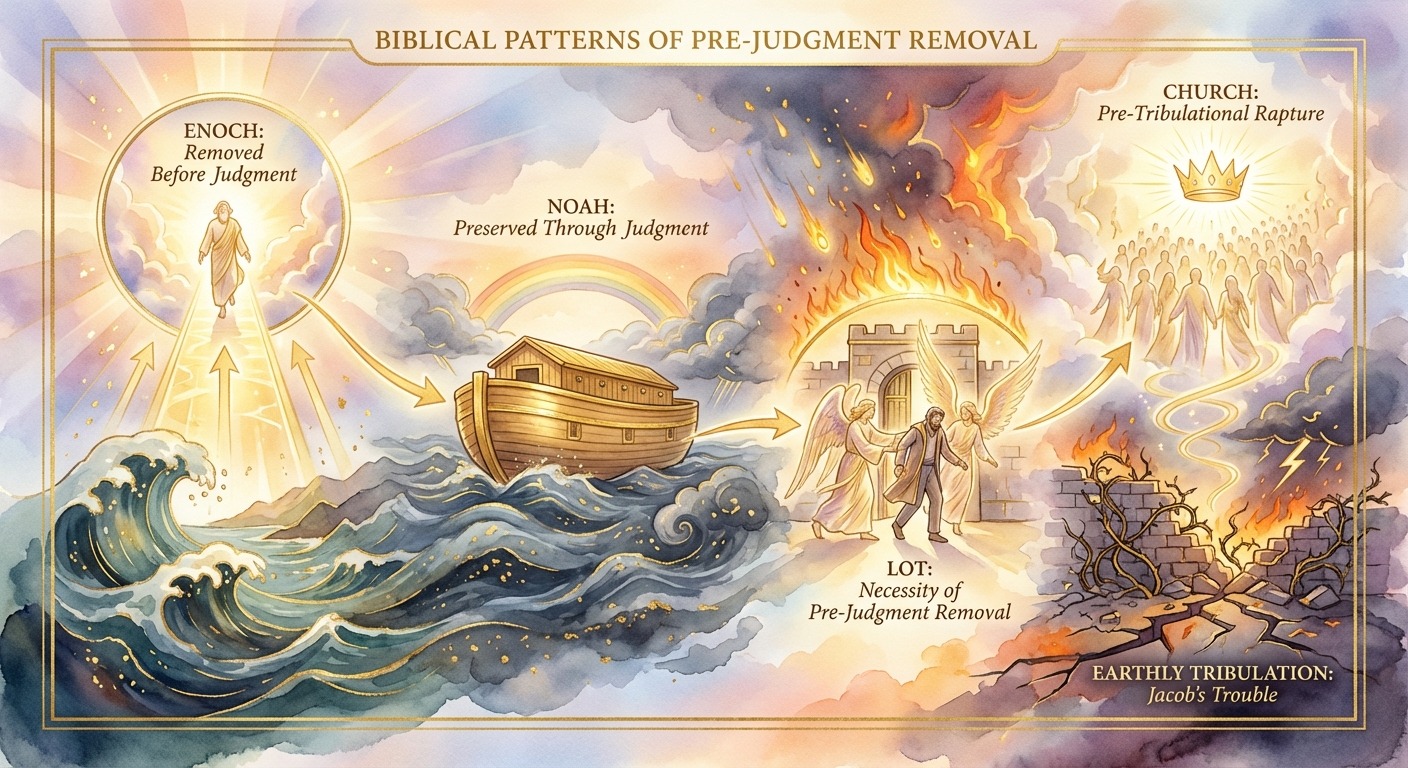
Biblical Types of Pre-Judgment Removal
Biblical Types of Pre-Judgment Removal
This chart shows the structure. What follows explains each part.
Scripture does not simply assert that God will remove His people before judgment falls -- it shows it, repeatedly, in historical events that function as divinely placed illustrations. Enoch translated before the flood. Lot removed before Sodom's destruction. Both cases share the same structure: judgment is held back, or held off, until the righteous are out of the way. Peter makes this a principle, not merely an anecdote: the Lord knows how to deliver the godly. This article works through these types carefully, not to collapse the distinctions between them, but to show what they collectively reveal about the character of God -- and why the Church's pre-tribulation removal is the natural expression of that character in the present age.
A Pattern of Deliverance: God’s Provision Before Judgment
Throughout Scripture, God has demonstrated a consistent pattern in how He deals with His people in relation to judgment. This pattern is not an isolated quirk but a revelation of His heart and character, showing how He makes provision for His own. The principle of removal before judgment is seen again and again, and it finds its culmination in the promise of the Church’s deliverance before the coming tribulation.
The Testimony of Enoch and Noah
Consider first the testimony of Enoch, a man who walked with God in a world racing toward destruction. The record is simple but profound: “And Enoch walked with God: and he was not; for God took him” (Genesis 5:24). Enoch’s translation took place before the flood, at a time when “the wickedness of man was great in the earth, and that every imagination of the thoughts of his heart was only evil continually” (Genesis 6:5). Enoch did not taste a drop of the judgment that swept over the world. The book of Hebrews adds, “By faith Enoch was translated that he should not see death; and was not found, because God had translated him: for before his translation he had this testimony, that he pleased God” (Hebrews 11:5). Enoch’s removal was not an accident or a footnote, but a deliberate act of grace. He was delivered from judgment entirely, not merely preserved through it.
Noah, by contrast, presents a different but complementary example. “But Noah found grace in the eyes of the LORD” (Genesis 6:8). While the floodwaters of judgment covered the earth, Noah and his family were lifted above them, preserved through the storm inside the ark. The same waters that brought destruction to the world carried the ark to safety. This is a picture of being in Christ during tribulation—preserved in the midst of judgment, but not removed from it. Together, Enoch and Noah provide two sides of God’s provision: removal before judgment and preservation through judgment.
The Vivid Example of Lot
The pattern of pre-judgment removal is perhaps most vividly illustrated in the story of Lot. When God purposed to destroy Sodom and Gomorrah, He first sent angels to remove Lot and his family. The angels declared, “Haste thee, escape thither; for I cannot do any thing till thou be come thither” (Genesis 19:22). Judgment was restrained; it could not fall until Lot was safely out of harm’s way. Abraham, in his intercession, appealed to God’s character: “Far be it from You to destroy the righteous with the wicked!” (Genesis 18:25). Peter reflects on this event, writing, “And turning the cities of Sodom and Gomorrha into ashes condemned them with an overthrow, making them an ensample unto those that after should live ungodly; And delivered just Lot, vexed with the filthy conversation of the wicked... The Lord knoweth how to deliver the godly out of temptations, and to reserve the unjust unto the day of judgment to be punished” (2 Peter 2:6-9). Peter’s conclusion is not merely a historical observation—it is a prophetic insight into God’s ways: the Lord knows how to deliver His own before judgment falls.
The Church’s Distinct Place and Promise
These patterns are not incidental. They reveal God’s consistent character in making provision for His people. The Church, according to the revelation given to Paul, occupies a unique place in God’s program. Unlike Israel, whose promises are earthly and whose covenant includes a physical land, the Church is a heavenly people with a heavenly calling. Paul teaches that God “hath blessed us with all spiritual blessings in heavenly places in Christ” (Ephesians 1:3), and that “our conversation is in heaven” (Philippians 3:20). The Church is not an extension of Israel, but a new creation entirely, with a distinct purpose and destiny rooted in the mystery revealed to the apostles and prophets (Ephesians 3:1-11).
This distinction is crucial in understanding God’s end-time dealings. The tribulation period, described in Revelation 6-19, is “the time of Jacob’s trouble” (Jeremiah 30:7)—a time when God’s focus returns to Israel to fulfill His covenant promises. The Church, as a heavenly people, has no place in this earthly judgment designed to bring Israel to repentance. Just as Enoch was removed before the flood and Lot before Sodom’s destruction, so the Church will be removed before the tribulation begins. This is not special pleading, but the consistent pattern of God’s dealings with His people throughout Scripture—a divine testimony to His faithfulness and grace.
Enoch, Noah, and Lot together establish the principle with three distinct variations -- pre-judgment translation, preservation through judgment, and urgent removal before fire falls -- and Peter's summary judgment is that this is how God operates: He knows how to deliver the godly. But the New Testament does more than point to these types; in Revelation 4, it gives us a prophetic picture that crystallizes the entire pattern into a single, structured moment.
Every chart in this series is free to explore online.
 Get the full chart set (PDF – $8)
Members get all PDFs included → Why Membership
Log in with an active membership to download printable PDFs on this site. Purchased on the shop? Access downloads from your shop account.
If you would like to help fund this work:
These charts are based on the following book:

Grace to Glory
Understanding the Rapture and What Happens Next - A vital restoration of this blessed hope doctrine with solid scriptural foundation.
View Related Book