
Visual Theology – Understanding the Rapture
The Visual Theology charts are designed to help you see the structure and movement of Scripture. They highlight patterns, contrasts, and developments that are often difficult to hold together when reading line by line.
These charts show the structure of the argument. The accompanying articles develop each part in full.
This approach follows a long tradition of visual teaching in the Church. The well-known charts of Clarence Larkin helped many grasp the broad outline of Scripture. In the same spirit, these charts aim to make visible what the Word of God is revealing.
Charts and teaching notes for the book of Understanding the Rapture. Select a chart below to view the image and article.
Click chart to view larger
From the teaching in: Grace to Glory
A Victory Platform, Not a Courtroom
A Victory Platform, Not a Courtroom
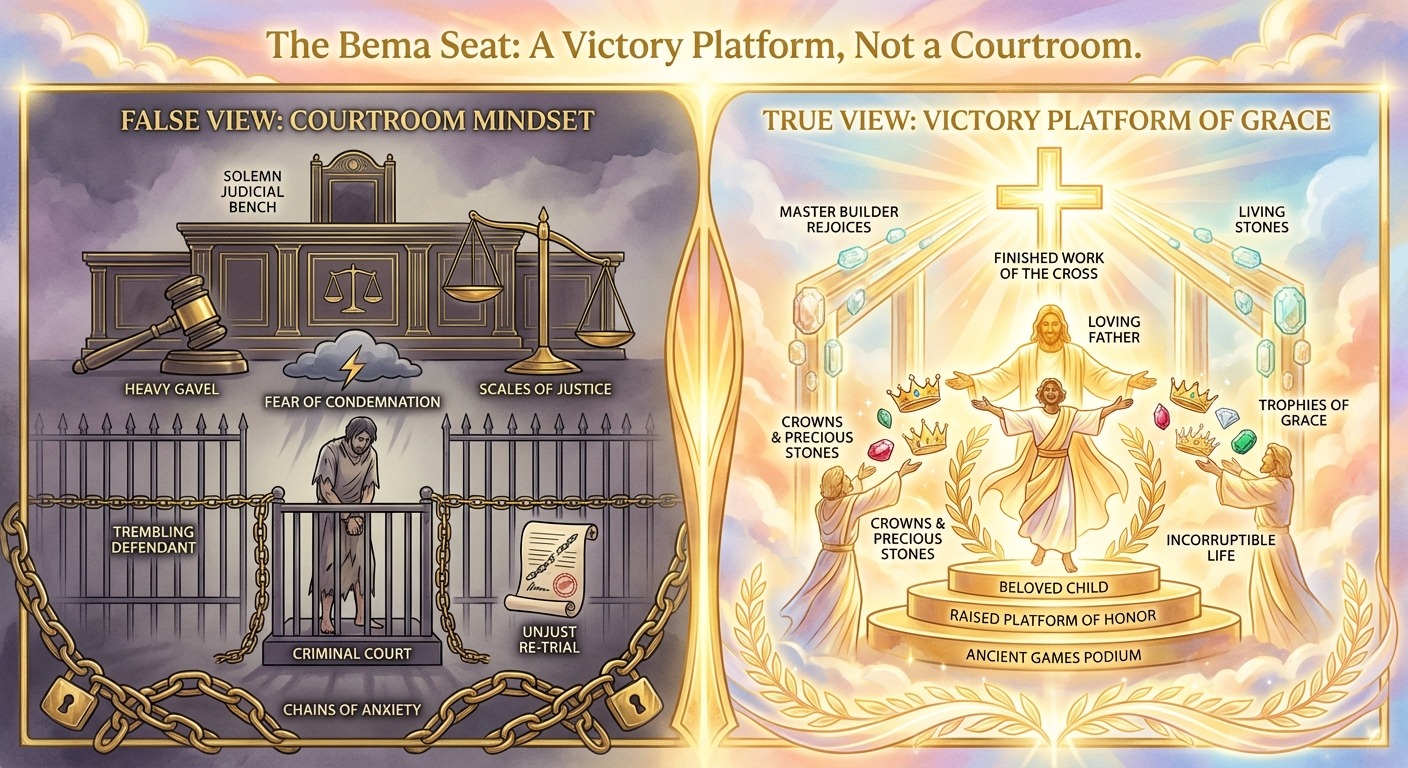
This chart shows the structure. What follows explains each part.
The rapture brings the Church into heaven -- glorified, complete, the masterpiece unveiled. And immediately, Scripture places another event before the believer: the Bema Seat of Christ, where every believer 'must appear.' For many, that phrase lands with a weight that contradicts everything the gospel has said about grace and acceptance -- a sense that the courtroom has simply been relocated to the heavens, and that a reckoning is coming after all. This article exists to dismantle that fear from the foundation. The Bema is not a courtroom. It never was. And understanding what the word actually meant in the ancient world -- and what Paul actually meant when he used it -- changes the entire atmosphere of what the believer has to look forward to.
A Shift in Understanding
A proper understanding of the Bema Seat of Christ requires a decisive shift from the language of law and fear to the language of grace and celebration. For many, the thought of appearing before Christ has been clouded by the image of a stern judicial bench, a solemn courtroom where every failure will be revisited and the believer stands as a trembling defendant. This view, however, is not rooted in the apostolic testimony, but rather obscures the very heart of the gospel and the character of God’s dealings with His children in this age.
The Bema is Not a Judgment for Sin
The Bema Seat, as revealed in passages such as 2 Corinthians 5:10 and 1 Corinthians 3:13-15, is not a general judgment for all humanity, nor is it a final accounting for sin. The single most transformative truth about the Bema is its complete separation from the issue of sin. The believer in Christ will never again face judgment for their sins. To suggest otherwise is to undermine the finished work of Jesus Christ. The Lord Himself declared, “Verily, verily, I say unto you, He that heareth my word, and believeth on him that sent me, hath everlasting life, and shall not come into condemnation; but is passed from death unto life” (John 5:24). “Condemnation” here is the Greek word for judgment; the believer does not come into judgment for sin.
The Apostle Paul builds on this foundation with unwavering clarity: “Who shall lay any thing to the charge of God's elect? It is God that justifieth. Who is he that condemneth? It is Christ that died, yea rather, that is risen again” (Romans 8:33-34). The case is closed. The verdict is rendered on the basis of Christ’s substitutionary atonement, not the believer’s performance. For God to judge the believer for sins already paid for would be to deny the efficacy of Christ’s blood. Therefore, Paul can proclaim, “There is therefore now no condemnation to them which are in Christ Jesus” (Romans 8:1). The Bema Seat cannot be a re-trial of a case already settled at Calvary. Hebrews confirms: “So Christ was once offered to bear the sins of many; and unto them that look for him shall he appear the second time without sin unto salvation” (Hebrews 9:28).
The True Character of the Bema: A Victory Platform
If the Bema is not a judgment for sin, what then is its character? The very term “bema” in the ancient world referred not primarily to a judicial bench, but to the raised platform from which rulers made pronouncements and, most notably, where victorious athletes were awarded crowns and honors. When Paul wrote, “For we must all appear before the judgment seat of Christ” (2 Corinthians 5:10), he was not describing a criminal court for believers, but a place of public honor and reward for a race run by looking to Jesus, “the author and finisher of our faith” (Hebrews 12:2).
This victory platform is Christ’s own celebration for His Church. It is a forward-looking event, focused not on the failures of the past, but on the incorruptible materials of God’s building—Christ’s own life wrought into His people, who are themselves the building and co-laborers with God. Their part in producing this masterpiece will be memorialized for eternity. The Bema is both public and profoundly personal, an intimate encounter where the believer looks into the face of the One who loved him and gave Himself for him, and Christ acknowledges the work He accomplished in and through His members.
When Paul writes that “every one may receive the things done in his body, according to that he hath done, whether it be good or bad” (2 Corinthians 5:10), the context is the Corinthian church’s crisis, where false teachers had infiltrated. “Good” and “bad” here refer to valuable versus worthless—true ministry in Christ that builds the Church, versus the empty programs of false teachers. The Bema Seat is not about dredging up every failure, but about the revelation of Christ’s workmanship and the celebration of what is eternal.
The Material of God’s Building
All the building work in the Church is the life of Christ in us, accomplished as we grow in the knowledge of His person and work (Colossians 1:27), in fellowship with the Son (1 John 1:3), and as we turn to Him in faith (Romans 10:17), even in our weakness and groaning (Romans 8:23; 2 Corinthians 5:2). This is the material of God’s building (1 Peter 2:5), produced as we walk by faith (2 Corinthians 5:7), depending on Him despite our situations (Philippians 4:13). Every act of faith, every encouragement offered from the comfort we have received (2 Corinthians 1:4), every unseen fellowship with Christ—He remembers it all and will reward it openly.
A Celebration of Intimacy and Victory
The Bema is, in its essence, a celebration where heaven rejoices over the work that has gone into producing the Body of Christ, now put on display in its glorification. The encounter is not that of a trembling defendant before a stern judge, but of a beloved child presented to a loving Father. “Behold, I and the children which God hath given me” (Hebrews 2:13). We are the trophies of Christ’s work, and the Bema is His victory ceremony, a moment of unparalleled intimacy where His approval and rejoicing over us will be the greatest reward of all.
The Bema as victory platform -- not a courtroom, not a reckoning for sin, but a celebration of what Christ has wrought -- is established on exegetical, theological, and historical grounds. The case is closed at Calvary; the Bema cannot be a retrial. But Paul's Corinthian correspondence does include a warning -- there is something that can be lost at the Bema, something that burns -- and understanding what that actually means, in context, is the work of the next article.
Every chart in this series is free to explore online.
 Get the full chart set (PDF – $8)
Members get all PDFs included → Why Membership
Log in with an active membership to download printable PDFs on this site. Purchased on the shop? Access downloads from your shop account.
If you would like to help fund this work:
These charts are based on the following book:

Grace to Glory
Understanding the Rapture and What Happens Next - A vital restoration of this blessed hope doctrine with solid scriptural foundation.
View Related Book