
Visual Theology – Understanding the Rapture
The Visual Theology charts are designed to help you see the structure and movement of Scripture. They highlight patterns, contrasts, and developments that are often difficult to hold together when reading line by line.
These charts show the structure of the argument. The accompanying articles develop each part in full.
This approach follows a long tradition of visual teaching in the Church. The well-known charts of Clarence Larkin helped many grasp the broad outline of Scripture. In the same spirit, these charts aim to make visible what the Word of God is revealing.
Charts and teaching notes for the book of Understanding the Rapture. Select a chart below to view the image and article.
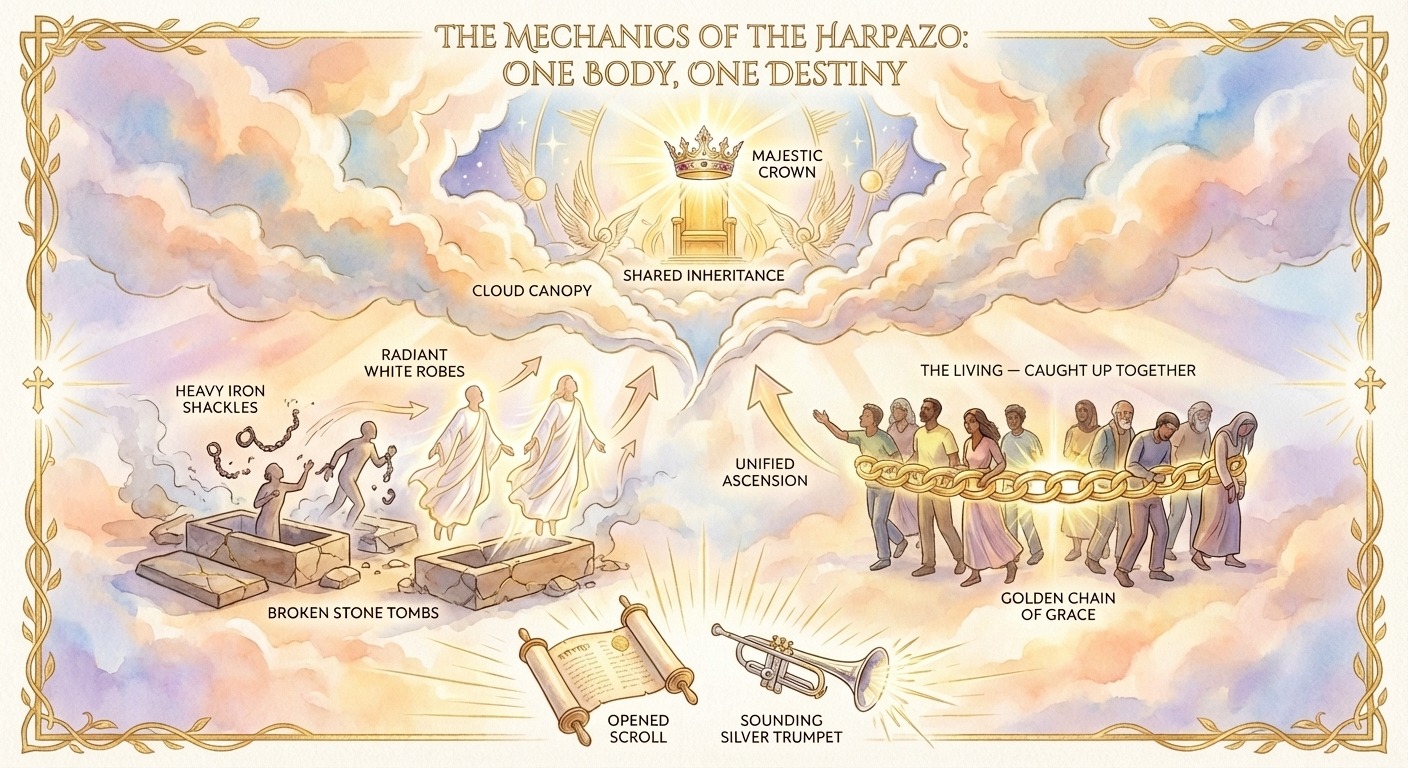
Click chart to view larger
From the teaching in: Grace to Glory
The Explicit Rapture Passages: Clear Scriptural Testimony
The Explicit Rapture Passages
This chart shows the structure. What follows explains each part.
There is a doctrine that has the power to change how you see everything -- your past, your present, and your future -- and yet it is one of the most misunderstood and, in some circles, most avoided truths in the New Testament. This book is about the rapture: not the sensationalism that surrounds it, not the calendar-watching or the political speculation, but the actual biblical testimony about what God has promised to do for His people at the end of this age. Before we can talk about why it matters or when it happens or how it is distinct from every other event in prophetic history, we have to start where Scripture starts -- with the plain, clear, undeniable words of the apostle Paul, addressed to real people in real grief, telling them what the Lord Himself will do. The question this article puts on the table is deceptively simple: what does the Bible actually say about the rapture, in its own words and on its own terms? Everything that follows in this book depends on the answer.
The Clear Testimony of Scripture
When considering the rapture, it is essential to begin with the clear, explicit testimony of Scripture. Paul addresses the Thessalonian believers, who were grieving over loved ones who had died in Christ and were troubled by false teaching. Into this confusion and sorrow, Paul delivers one of the most direct revelations concerning what we now call the rapture:
“For the Lord himself shall descend from heaven with a shout, with the voice of the archangel, and with the trump of God: and the dead in Christ shall rise first: Then we which are alive and remain shall be caught up together with them in the clouds, to meet the Lord in the air: and so shall we ever be with the Lord. Wherefore comfort one another with these words” (1 Thessalonians 4:16-18).
The term “caught up” in verse 17 is translated from the Greek “harpazo,” meaning to seize, snatch away, or carry off suddenly by force. When the New Testament was rendered into Latin, “harpazo” became “rapiemur”—the root of our English term “rapture.” While the word “rapture” does not appear in most English Bibles, it directly transliterates the Latin translation of the Greek word used in this passage.
A Literal and Instantaneous Event
This event is not symbolic or metaphorical. Paul describes the actual, bodily descent of Jesus from heaven. The sequence unfolds with divine precision: first, the resurrection of those who have died in Christ; then, the transformation of living believers; finally, our collective ascent to meet the Lord in the air. The use of “harpazo” underscores the suddenness and power of this event—a dramatic, instantaneous snatching away by God’s authority, not a gradual process but a momentary transformation.
Paul’s purpose in revealing this truth is not mere theological curiosity, but comfort. “Wherefore comfort one another with these words.” The rapture is not simply a doctrinal position to defend, but a living hope that soothes grief and anchors expectation. Paul does not present the rapture as a possibility or a metaphor, but as a guaranteed future reality. The details are specific, sequential, and presented as literal future events. This is not allegory or poetic flourish, but prophetic declaration.
The Mystery Revealed
Paul expands on the nature of this event in 1 Corinthians 15:
“Behold, I shew you a mystery; We shall not all sleep, but we shall all be changed, In a moment, in the twinkling of an eye, at the last trump: for the trumpet shall sound, and the dead shall be raised incorruptible, and we shall be changed. For this corruptible must put on incorruption, and this mortal must put on immortality” (1 Corinthians 15:51-53).
Here, Paul introduces the rapture as a “mystery”—not something puzzling, but a divine truth previously unrevealed, now disclosed to the Church. This mystery concerns the Church as a distinct entity from Israel, with a unique destiny: to be united with Christ in the heavenlies, apart from Israel’s earthly promises.
The rapture is presented as an instantaneous event for the entirety of the Body of Christ—both the dead in Christ and those who are “alive and remain.” It is not merely a catching away, but an instant transformation from mortal and corruptible to immortal and incorruptible, as the Church is transfigured by the power of God into the likeness of Christ’s heavenly glory. “In a moment, in the twinkling of an eye” describes the fastest human action imaginable. There is no process, no gradual evolution, but an immediate metamorphosis.
For the Entire Body of Christ
Crucially, this event is for the whole Body of Christ. Membership in this body is not determined by spiritual maturity, personal holiness, or diligent watchfulness, but solely by being “in Christ,” a position secured the moment we believe the gospel. For this reason, the idea of a “partial rapture” is contrary to the very nature of the Church. Paul makes this clear in 1 Thessalonians 5:
“For God hath not appointed us to wrath, but to obtain salvation by our Lord Jesus Christ, Who died for us, that, whether we wake or sleep, we should live together with him” (1 Thessalonians 5:9-10).
Whether spiritually “awake” and watchful or “asleep” and carnal, every believer’s destiny is to be with Him. The rapture is not a reward for the vigilant, but the glorious completion of God’s purpose for His body—an event that gathers every member without exception.
Paul’s own dealings with the Corinthians further confirms this. Despite their divisions and carnality, he reminds them not of the possibility of being “left behind,” but of their incredible, unchangeable position in Christ: “Do ye not know that the saints shall judge the world? … Know ye not that we shall judge angels?” (1 Corinthians 6:2-3). This destiny is not reserved for the most spiritual, but for all who are washed, sanctified, and justified (1 Corinthians 6:11). Our future reign is not a wage earned by performance, but an inheritance secured by union with Christ.
A Collective Glorification
The Body of Christ is one. When one member is glorified, all are glorified together. Our shared destiny is to reign with Christ, not because we are worthy, but because He is worthy, and we are in Him. Every believer—weak or strong, foolish or wise—shares in the common portion of the saints: Christ Himself as our inheritance and reward. As Paul declares, “We shall all be changed.” There are no exceptions, no partial transformations, no believers left behind. Every member of Christ’s body participates in this glorious event. The rapture unites the entire Church—past and present, living and dead—in a single moment of collective glorification.
The Foundation of Our Hope
This doctrine rests on the special revelation given to Paul concerning the Church as a unique entity in God’s program, distinct from Israel. As he writes,
“For this cause I Paul, the prisoner of Jesus Christ for you Gentiles, If ye have heard of the dispensation of the grace of God which is given me to you-ward: How that by revelation he made known unto me the mystery...Which in other ages was not made known unto the sons of men, as it is now revealed unto his holy apostles and prophets by the Spirit” (Ephesians 3:1-5).
The rapture is not merely a matter of prophetic timing, but of understanding the Church’s identity and destiny in God’s eternal purpose. The more we see the distinction between Israel and the Church, and the fullness of our position in Christ, the clearer this doctrine becomes. The explicit rapture passages are not isolated or obscure, but form the bedrock of our hope, offering certainty, comfort, and the assurance of a glorious future together with the Lord.
What has been established here is a foundation -- the rapture is a literal, bodily, instantaneous event for the entire Body of Christ, grounded in Paul's own revelation of a divine mystery, and its purpose is comfort, not mere doctrine. But Scripture does not leave the case resting on Paul's letters alone -- the book of Revelation, it turns out, opens with a moment that looks remarkably like a preview of everything Paul described, and the question of who that preview is meant for sits at the heart of the next stop in this argument.
Every chart in this series is free to explore online.
 Get the full chart set (PDF – $8)
Members get all PDFs included → Why Membership
Log in with an active membership to download printable PDFs on this site. Purchased on the shop? Access downloads from your shop account.
If you would like to help fund this work:
These charts are based on the following book:

Grace to Glory
Understanding the Rapture and What Happens Next - A vital restoration of this blessed hope doctrine with solid scriptural foundation.
View Related Book