
Visual Theology – Understanding the Rapture
The Visual Theology charts are designed to help you see the structure and movement of Scripture. They highlight patterns, contrasts, and developments that are often difficult to hold together when reading line by line.
These charts show the structure of the argument. The accompanying articles develop each part in full.
This approach follows a long tradition of visual teaching in the Church. The well-known charts of Clarence Larkin helped many grasp the broad outline of Scripture. In the same spirit, these charts aim to make visible what the Word of God is revealing.
Charts and teaching notes for the book of Understanding the Rapture. Select a chart below to view the image and article.
Click chart to view larger
From the teaching in: Grace to Glory
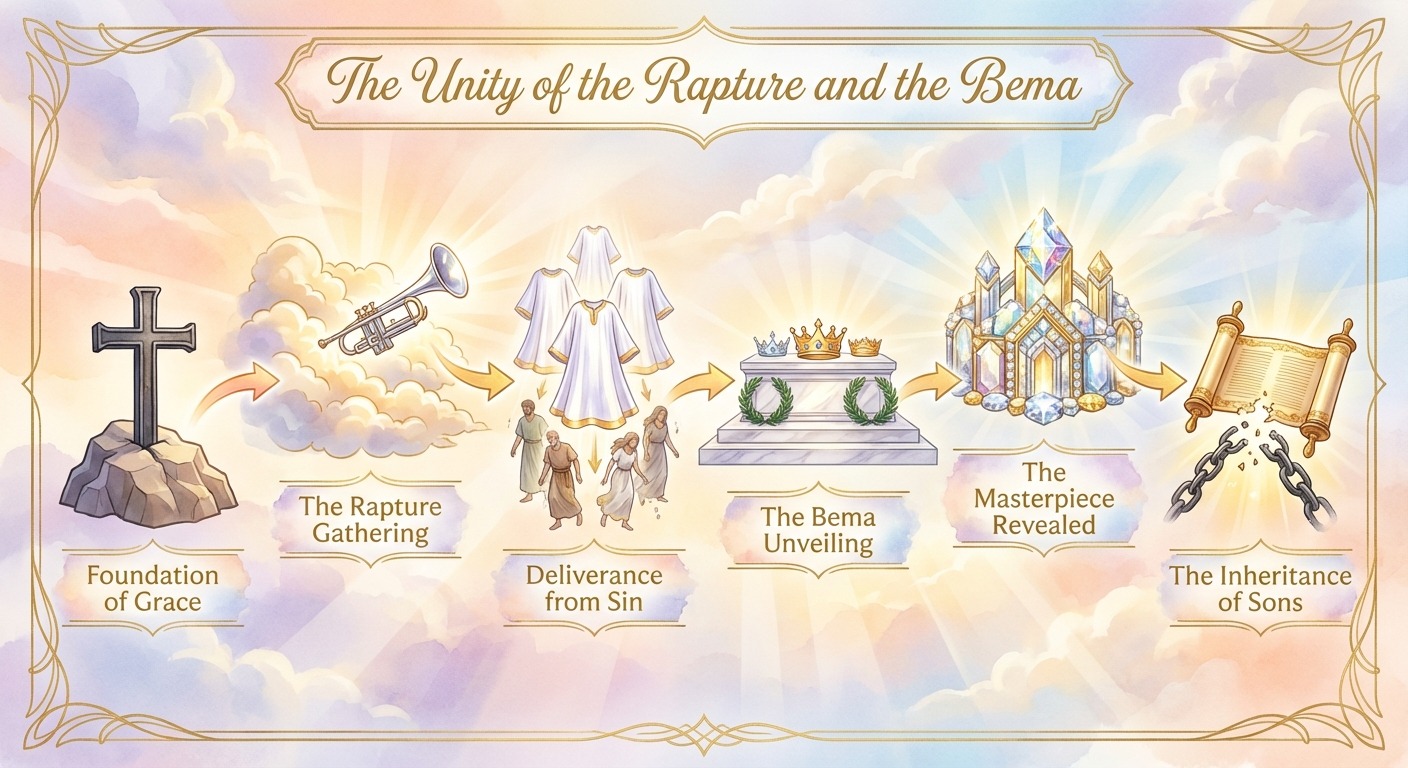
The Unity of the Rapture and the Bema
The Unified Day of Christ
This chart shows the structure. What follows explains each part.
The Day of the Lord and the Day of Christ are distinguished, and the Church's destiny is now clearly assigned to the Day of Christ -- grace, not wrath; celebration, not condemnation. But there is a further insight into the Day of Christ that is easy to miss: the rapture and the Bema are not simply two events that happen to occur in the same general era. They are two inseparable aspects of a single unified moment in God's program -- and the unity of that day has consequences for how we feel about both events. If the Bema is feared, the rapture loses its joy; if the rapture is rightly understood as grace, the Bema must be understood the same way. This article presses that unity until the two events stand clearly as one.
The Unity of the Rapture and the Bema Seat
The unity of the rapture and the Bema Seat lies at the heart of the blessed hope for every believer in Christ. These are not two disconnected events, but two inseparable aspects of the same glorious reality—the Day of Christ in its fullness. The rapture is the moment when salvation is completed by glorifying our bodies and delivering us forever from the presence of sin. As Paul writes, “For the Lord himself shall descend from heaven with a shout… and the dead in Christ shall rise first: then we which are alive and remain shall be caught up together with them in the clouds, to meet the Lord in the air: and so shall we ever be with the Lord” (1 Thessalonians 4:16-17). This is the gathering of the Church to Christ, the transformation described in 1 Corinthians 15:51-52: “We shall not all sleep, but we shall all be changed, in a moment, in the twinkling of an eye, at the last trump.”
Yet the Day of Christ does not end with the rapture. Immediately following this gathering and transformation is the Bema—the Judgment Seat of Christ (2 Corinthians 5:10). But this is not a tribunal for condemnation; it is the grand unveiling and celebration of what God has been building throughout this age: the eternal masterpiece of the Church. At the rapture, we become like Christ in resurrection. At the Bema, what Christ has accomplished through our earthly pilgrimage is revealed and put on display. Both events are entirely the work of grace, from beginning to end.
Understanding the Bema Properly
It is vital to understand the Bema properly, for if we fear it, we will inevitably dread the rapture itself. Many have been taught to view the Bema as a fearful reckoning, a day of condemnation or loss, but this perspective undermines the very foundation of the gospel. The Lord Jesus Himself promised, “He that heareth my word, and believeth on him that sent me, hath everlasting life, and shall not come into condemnation; but is passed from death unto life” (John 5:24). The apostle Paul declares, “There is therefore now no condemnation to them which are in Christ Jesus” (Romans 8:1). The Bema is not a day of retribution for sin, which was settled once and for all at the cross, but a victory ceremony for Christ and His Church.
The Blessed Hope: Transformation and Celebration
The rapture and the Bema together constitute the blessed hope. The rapture is the moment of our deliverance and glorification; the Bema is the immediate celebration, the unveiling of the divine workmanship—“For we are his workmanship, created in Christ Jesus unto good works, which God hath before ordained that we should walk in them” (Ephesians 2:10). The Bema is not a wage-earning session for servants, but the inheritance received by sons. “Wherefore thou art no more a servant, but a son; and if a son, then an heir of God through Christ” (Galatians 4:7). Our reward is not primarily something external, but the eternal existence and display of the building itself—the Church, the Body of Christ, perfected and glorified.
Day of Christ vs. Day of the Lord
This is why the Day of Christ stands in stark contrast to the Day of the Lord. The Day of the Lord is a time of wrath and judgment upon the earth, but the Day of Christ is characterized by grace, joy, and celebration. Paul writes, “For God hath not appointed us to wrath, but to obtain salvation by our Lord Jesus Christ” (1 Thessalonians 5:9). The Church is not destined for tribulation but for glorification; not for condemnation but for display as God’s masterpiece.
When we grasp that the Bema is Christ’s victory platform for His Church, and that He is looking for the fruit of His own Spirit in us, our perspective is transformed. The Day of Christ is not a day to shrink from in fear, but the very hope that animates our lives. It is the assurance that our salvation, from beginning to end, is the work of grace. Both the rapture and the Bema are secured by Christ’s finished work, and together they reveal the fullness of what it means to be “accepted in the beloved” (Ephesians 1:6).
Thus, the unity of the rapture and the Bema is the unity of transformation and celebration, of glorification and revelation, all secured by the grace of God. This is the blessed hope: that we will be gathered to Him, transformed into His likeness, and put on display as the eternal testimony to the riches of His grace. “And every man that hath this hope in him purifieth himself, even as he is pure” (1 John 3:3). The Day of Christ is not a day of dread, but a day of unspeakable joy and eternal glory.
The Day of Christ as a unified event -- rapture and Bema as two aspects of a single gracious day, entirely the work of grace, accepted in the Beloved -- is now established. The transformation is real, the celebration is certain, and the dread is dissolved. Which brings the argument to its most personal and practical dimension: not just what the blessed hope means theologically, but what it actually does to a person when it is genuinely believed.
Every chart in this series is free to explore online.
 Get the full chart set (PDF – $8)
Members get all PDFs included → Why Membership
Log in with an active membership to download printable PDFs on this site. Purchased on the shop? Access downloads from your shop account.
If you would like to help fund this work:
These charts are based on the following book:

Grace to Glory
Understanding the Rapture and What Happens Next - A vital restoration of this blessed hope doctrine with solid scriptural foundation.
View Related Book