Visual Theology – The Everlasting Covenant
The Visual Theology charts are designed to help you see the structure and movement of Scripture. They highlight patterns, contrasts, and developments that are often difficult to hold together when reading line by line.
These charts show the structure of the argument. The accompanying articles develop each part in full.
This approach follows a long tradition of visual teaching in the Church. The well-known charts of Clarence Larkin helped many grasp the broad outline of Scripture. In the same spirit, these charts aim to make visible what the Word of God is revealing.
Charts and teaching notes for the book of The Everlasting Covenant. Select a chart below to view the image and article.
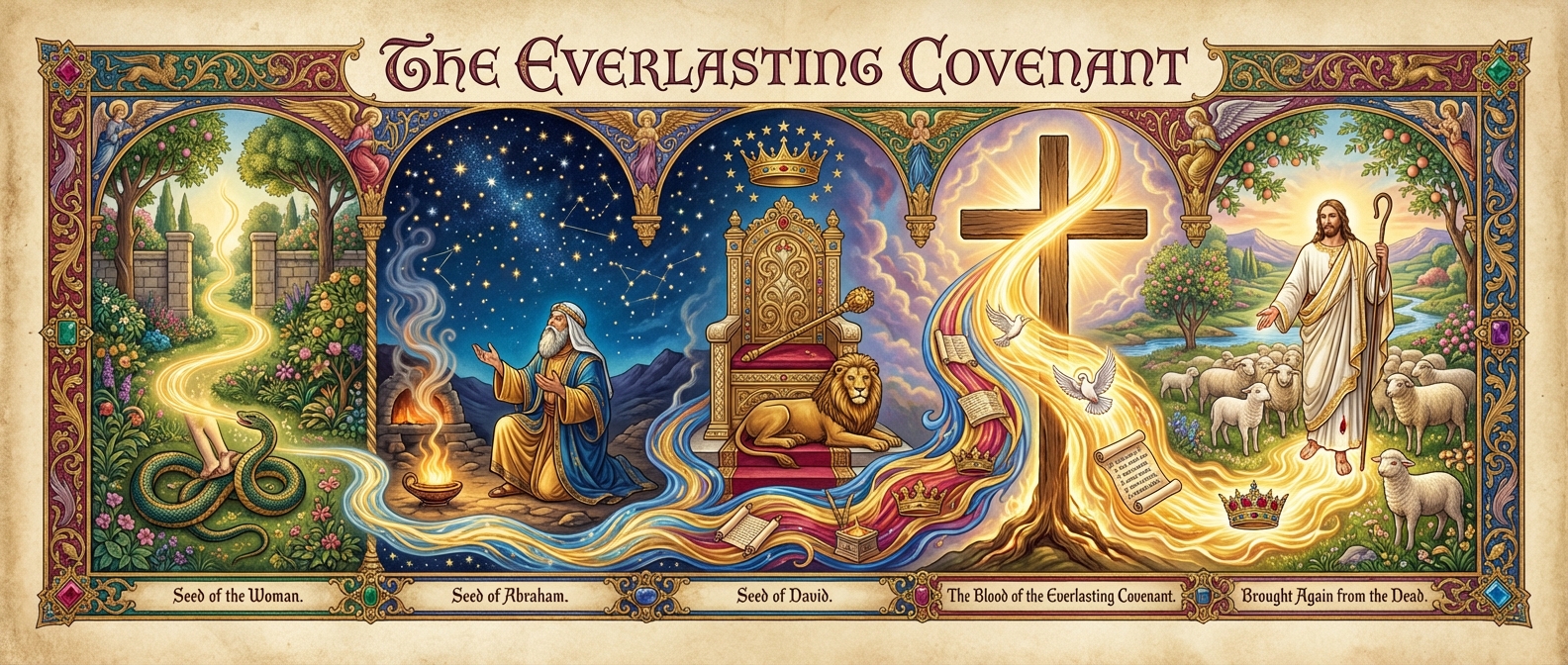
Click chart to view larger
From the teaching in: The Everlasting Covenant
Genesis to Hebrews
The Everlasting Covenant
Genesis to Hebrews -- The Everlasting Covenant
This chart shows the structure. What follows explains each part.
The Everlasting Covenant
What the Everlasting Covenant Is
The everlasting covenant is the totality of promises God made to the Seed — the singular offspring of Abraham and David, identified by the Apostle Paul as Christ — ratified unilaterally by God in Genesis 15 and encompassing everything from redemption to the inheritance of the world to come. It is not the old covenant given at Sinai, and it is not the new covenant prophesied in Jeremiah 31. It is a prior and superior reality that runs beneath both — the covenantal ground on which individual salvation has rested in every age, from the garden to the present dispensation. Scripture reveals it progressively, accumulating substance at every stage of redemptive history, and it is only when the full trajectory is traced that the everlasting covenant emerges as the distinct and necessary category it is.
The Seed of the Woman
The first disclosure appears in Genesis 3:15, spoken not to Adam but to the serpent: "I will put enmity between thee and the woman, and between thy seed and her seed; it shall bruise thy head, and thou shalt bruise his heel." This is the protoevangelium — the first announcement of the gospel — and it establishes the pattern that governs everything that follows: redemption will come through a Seed, and that Seed will be bruised in the process of securing it.
The Seed of Abraham and the Unilateral Confirmation
The promise narrows in Genesis 12 when God calls Abraham and declares, "I will bless thee, and make thy name great; and thou shalt be a blessing: and I will bless them that bless thee, and curse him that curseth thee: and in thee shall all families of the earth be blessed" (Gen. 12:2–3). The blessing is not yet specified in full — but the trajectory is set. God is going to bless the world through one man's line, through his seed: "And in thy seed shall all the nations of the earth be blessed" (Gen. 22:18). And then in Genesis 15, something extraordinary happens. God confirms these promises in a covenant ceremony. He instructs Abraham to prepare a sacrifice, to divide the animals. Abraham does so — and falls into a deep sleep. While he sleeps, God alone passes between the pieces. In ancient covenant practice, to walk the path of blood was to take upon yourself the obligation and the curse. God walked it alone. Abraham contributed nothing. The covenant was confirmed unilaterally, by God, to the Seed: "In the same day the LORD made a covenant with Abram, saying, Unto thy seed have I given this land" (Gen. 15:18).
Paul tells us plainly that what God declared to Abraham in Genesis 12 was the gospel itself: "And the scripture, foreseeing that God would justify the heathen through faith, preached before the gospel unto Abraham, saying, In thee shall all nations be blessed" (Gal. 3:8). The gospel was preached to Abraham — not in shadow or in figure, but as a direct promise. And then Paul identifies who that promise was actually made to. It was not made to Abraham's descendants generically. It was made to one person: "Now to Abraham and his seed were the promises made. He saith not, And to seeds, as of many; but as of one, And to thy seed, which is Christ" (Gal. 3:16). The seed to whom the blessing was promised — the seed through whom all nations would be blessed — is Christ. The gospel was preached to Abraham, and the gospel belongs to the Seed. The blessing is for Him, and through Him it reaches all who are in Him by faith.
The covenant confirmed "before of God in Christ" (Gal. 3:17) cannot be disannulled by the law, which came 430 years later. No conditions can be added after ratification. The inheritance "is not of the law" but "of promise" (Gal. 3:18). And what is that inheritance? Paul tells us in Romans 4:13: "For the promise, that he should be the heir of the world, was not to Abraham, or to his seed, through the law, but through the righteousness of faith." The inheritance promised to the Seed is not a parcel of land in Canaan. It is the world — the kosmos, the totality of the age to come. The land was real, but it was the seed form of something far larger, and Paul reveals what was always implicit in the original promise. What God confirmed with the Seed in Genesis 15 stands as a self-contained covenantal reality — prior to, independent of, and untouchable by any national arrangement with Israel.
The Abrahamic promise also contains in seed form the blessing that Paul identifies as the Spirit of life. "Christ hath redeemed us from the curse of the law, being made a curse for us... that the blessing of Abraham might come on the Gentiles through Jesus Christ; that we might receive the promise of the Spirit through faith" (Gal. 3:13–14). The blessing of Abraham is the Spirit. And the mechanism of that blessing is multiplication through death — "Except a corn of wheat fall into the ground and die, it abideth alone: but if it die, it bringeth forth much fruit" (John 12:24). God promised Abraham that his seed would be multiplied as the stars of heaven, and the fulfillment of that promise runs through the death and resurrection of Christ. Through the cross the Seed who abode alone became "a quickening spirit" (1 Cor. 15:45) — able to multiply Himself, to breathe Himself into His people, to impart His own life. This is the Abrahamic blessing fulfilled: God Himself as the believer's portion, the Spirit of life distributed through the risen Heir. It is not a provision of the new covenant made with Israel. It is the promise to the Seed, carried in the everlasting covenant from the beginning.
The Seed of David and the Specification of the Promise
The Davidic covenant in 2 Samuel 7 extends and specifies what was promised to Abraham's Seed in three critical directions.
First, the framework for substitutionary atonement: "If he commit iniquity, I will chasten him with the rod of men, and with the stripes of the children of men: but my mercy shall not depart away from him" (2 Sam. 7:14–15). The King bears the chastisement that belongs to His people. Because Christ bore that chastisement sinlessly, death could not hold Him — the "sure mercies of David" (Isa. 55:3) demanded His resurrection.
Second, the promise of sonship: "I will be his father, and he shall be my son" (2 Sam. 7:14). This is the Davidic root of the filial relationship — the promise that the Seed would stand as Son before the Father, and that those united to Him would share in that standing.
Third, the unbreakable guarantee: unlike the Mosaic covenant, the Davidic promise contains no termination clause. God contrasts it explicitly with His treatment of Saul: "My mercy shall not depart away from him, as I took it from Saul" (2 Sam. 7:15). The Mosaic covenant could be broken. The Davidic promise cannot.
But the Davidic promises do not stop at 2 Samuel 7. They unfold into a full arc of exaltation. The Seed of David is promised an everlasting throne — "thy throne shall be established for ever" (2 Sam. 7:16). This throne expands in scope through the royal Psalms. In Psalm 2, the Father addresses the risen Son: "Ask of me, and I shall give thee the heathen for thine inheritance, and the uttermost parts of the earth for thy possession" (Ps. 2:8). The scepter extends from Israel to all nations. And then in Psalm 110, the exaltation reaches its full height: "The LORD said unto my Lord, Sit thou at my right hand, until I make thine enemies thy footstool" (Ps. 110:1). The Seed of David is not merely a king on an earthly throne — He is seated at the right hand of God in the heavens, revealed as God Himself. This is the complete arc of the glorification of Christ: from David's house, to the nations, to the right hand of the Majesty on high. And this is where the Church's heavenly position is grounded — "raised us up together, and made us sit together in heavenly places in Christ Jesus" (Eph. 2:6). The Church is seated in the heavens because the Seed of David is seated in the heavens, and those who are in Him share His position.
The Spirit of sonship — the relational cry of "Abba, Father" (Gal. 4:6; Rom. 8:15) — flows from this exalted Davidic-Melchizedekian reality, and the connection is not an inference we are drawing from the outside. Hebrews makes it explicitly. In Hebrews 2, the author identifies Christ as the one who sanctifies and those who are sanctified as sharing one origin — "for which cause he is not ashamed to call them brethren" (Heb. 2:11) — and then places in Christ's mouth the words of Psalm 22:22: "I will declare thy name unto my brethren, in the midst of the church will I sing praise unto thee" (Heb. 2:12). This is the exalted Son, the Melchizedek priest appointed by the Father's oath in Psalm 110:4, declaring the Father's name in the assembly. Hebrews is telling us that Christ's priestly ministry includes making the Father known to those who are His brethren — and this is the ground on which "God hath sent forth the Spirit of his Son into your hearts, crying, Abba, Father" (Gal. 4:6). The Davidic promise established that the Seed would be Son. The Melchizedek priest, appointed by the Father's oath, is the one who makes that sonship experiential — who declares the Father's name so that the Spirit of His Son enters the hearts of those who are in Him. The promise belongs to the Davidic stream. The administration of it belongs to the priesthood established by oath. And the text that ties them together is Hebrews 2.
At each stage the content of the everlasting covenant grows. The seed of the woman promises redemption. The seed of Abraham promises blessing, the Spirit of life, inheritance, and the world (Rom. 4:13). The seed of David promises atonement, sonship, an everlasting throne exalted to the right hand of God, and a guarantee that rests entirely on God's faithfulness. The Melchizedek priesthood administers what was promised — including the Spirit of sonship that makes the Father known. And all of it belongs to one person — the Seed, Christ — and through Him to all who are in Him by faith.
Why One Covenant, and Why Everlasting
A question naturally arises: if these promises appear across different passages, different periods, and what look like different covenants — Abrahamic, Davidic, the oath of Psalm 110 — why do we call them one covenant, and why do we call it everlasting?
Because they are one set of promises, made to one person, fulfilled by one act. Paul establishes this in Galatians 3:16 — the promises were made to the Seed, singular, which is Christ. Not to seeds, as of many. To one. The Abrahamic promise, the Davidic specification, the Melchizedek oath — these are not separate covenants competing for attention. They are successive revelations of the same covenantal reality, addressed to the same recipient, accumulating content as the revelation unfolds. What binds them into one covenant is the identity of the party to whom they were made.
And the Seed was given one commandment: to lay down His life. "Therefore doth my Father love me, because I lay down my life, that I might take it again. No man taketh it from me, but I lay it down of myself. I have power to lay it down, and I have power to take it again. This commandment have I received of my Father" (John 10:17–18). This is the commandment of the everlasting covenant — not a legal code, not a system of obligations, but a single charge given by the Father to the Son: lay down your life for the sheep, and take it again. It is this commandment that makes Him the good Shepherd who gives His life for the sheep (John 10:11). It is this commandment that activates the testament through His death. And it is the fulfillment of this commandment that makes Him the great Shepherd of the sheep, brought again from the dead through the blood of the everlasting covenant (Heb. 13:20).
We call it everlasting because the promises it contains have no expiration. They were made before the law, they cannot be altered by the law, and they outlast every administration that came after them. The old covenant was breakable and was broken. The new covenant governs a millennial arrangement for mortal Israel. But the everlasting covenant pertains to the Seed's inheritance — the world to come — and has no terminus. It is everlasting not merely because it lasts a long time, but because its terms are secured entirely by the faithfulness of the One who made them and the One who fulfilled them.
And the totality of what this covenant secures — redemption, blessing, the Spirit, sonship, atonement, the heavenly position, the inheritance of all things — is what Hebrews calls "so great salvation" (Heb. 2:3). It is not a small thing, and it is not a scattered collection of benefits assembled from different sources. It is one salvation, flowing from one covenant, accomplished by one Seed who received one commandment from His Father and fulfilled it perfectly. "How shall we escape, if we neglect so great salvation; which at the first began to be spoken by the Lord, and was confirmed unto us by them that heard him" (Heb. 2:3). The great salvation began to be spoken by the Lord Himself and was confirmed by the apostles. It is the everlasting covenant in its fullness — everything God promised to the Seed, now distributed to the heirs.
The Blood of the Everlasting Covenant
The cross is where the everlasting covenant crosses its decisive threshold. When Christ died, the covenant that had operated as a living agreement between the Father and the Son became a testament — a will in force. "For where a testament is, there must also of necessity be the death of the testator. For a testament is of force after men are dead" (Heb. 9:16–17). The resurrection, which was itself a legal obligation arising from the sure mercies of David, constituted the Heir's entry into His inheritance. The risen Christ is both the Testator whose death activated the will and the living Heir who administers it — the great Shepherd of the sheep, "brought again from the dead through the blood of the everlasting covenant" (Heb. 13:20).
Brought Again from the Dead
And this is where the whole program arrives. The Seed who was promised in the garden, confirmed to Abraham, specified through David, exalted to the right hand of the Father, and vindicated through resurrection — He now stands as the Shepherd of the sheep, distributing the riches of an inheritance that was secured before any nation existed, before any law was given, before any covenant could be broken. The Spirit of life, the Spirit of sonship, forgiveness, justification, eternal security, the heavenly position, the inheritance of the world to come — all of it flows from the everlasting covenant, from the promises to the Seed, activated by His death and administered by His risen life. It does not depend on a national covenant being in force. It does not require a temple, a feast, or a law to sustain it. It rests on nothing but the faithfulness of the One who walked the path of blood while the human beneficiary slept.
Every chart in this series is free to explore online.
 Get the full chart set (PDF – $8)
Members get all PDFs included → Why Membership
Log in with an active membership to download printable PDFs on this site. Purchased on the shop? Access downloads from your shop account.
If you would like to help fund this work:
Based on the article:
The Everlasting Covenant
A Distinct Covenantal Category in Pauline Dispensational Theology. The full theological foundation paper is available to read online in Writings.
Read it free online