
Visual Theology – The Everlasting Covenant
The Visual Theology charts are designed to help you see the structure and movement of Scripture. They highlight patterns, contrasts, and developments that are often difficult to hold together when reading line by line.
These charts show the structure of the argument. The accompanying articles develop each part in full.
This approach follows a long tradition of visual teaching in the Church. The well-known charts of Clarence Larkin helped many grasp the broad outline of Scripture. In the same spirit, these charts aim to make visible what the Word of God is revealing.
Charts and teaching notes for the book of The Everlasting Covenant. Select a chart below to view the image and article.
Click chart to view larger
From the teaching in: The Everlasting Covenant
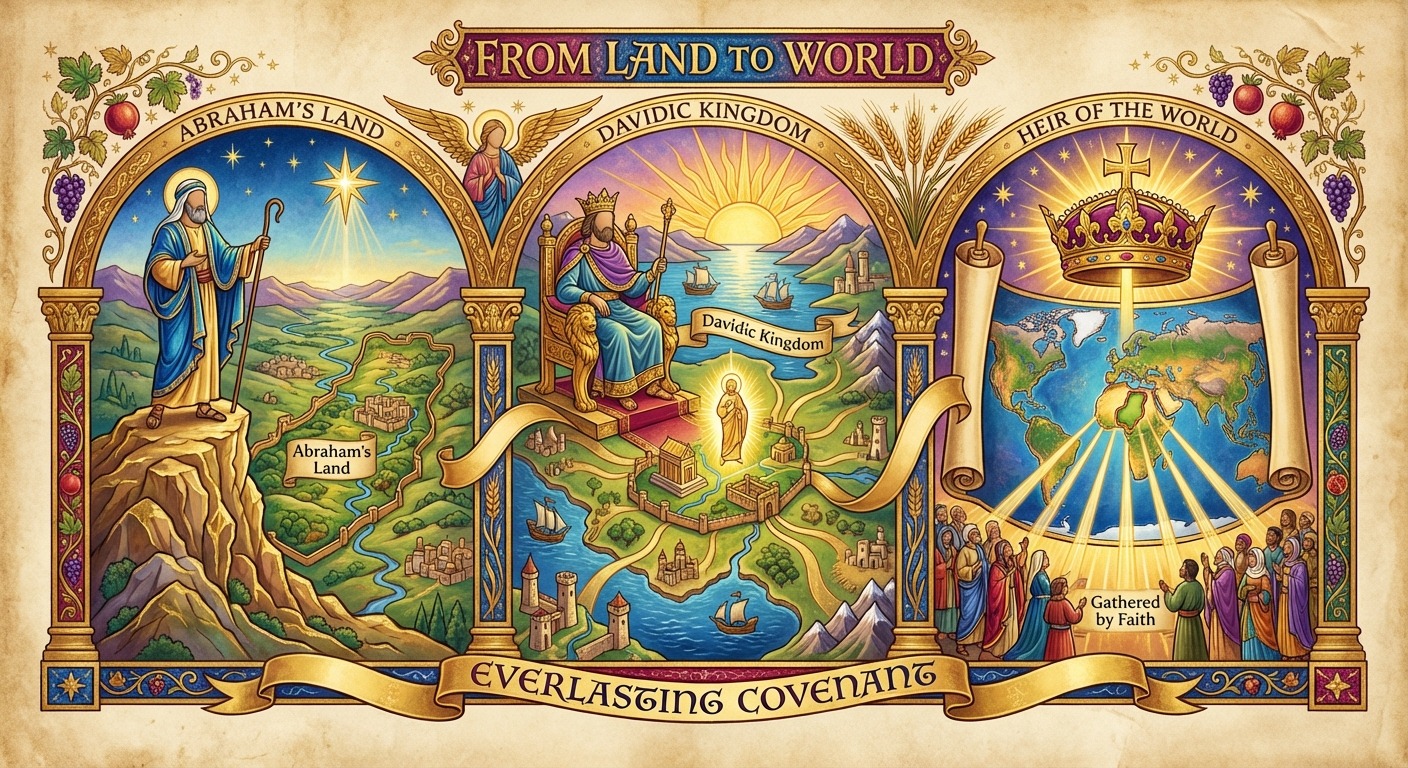
2. The Scope of the Promise: From Land to World
From Land to World
This chart shows the structure. What follows explains each part.
The Expanding Inheritance: From Land to World
The promise to Abraham in Genesis 13:15 is often read as a straightforward territorial grant: “All the land which thou seest, to thee will I give it, and to thy seed for ever.” At first glance, this appears to confine the inheritance to the visible boundaries of Canaan, a specific land with geographical limits. Yet the trajectory of Scripture reveals that this promise, while genuine in its initial form, was never meant to be static or restricted to one territory. Rather, it serves as the seed form of a far greater inheritance, one that unfolds in scope through the progress of revelation.
The Davidic Expansion
The Davidic covenant marks the next decisive development in this trajectory. The promise made to David’s Seed is not limited to the land of Israel. In Psalm 2:8, the Father declares to the royal Son, “Ask of me, and I shall give thee the heathen for thine inheritance, and the uttermost parts of the earth for thy possession.” Here, the Seed of David—who is also the Seed of Abraham—receives not merely Canaan but the nations, the very ends of the earth. This is not a replacement of the original land promise but its subsumption within a larger, more comprehensive reality. The dominion of the Seed extends beyond the borders of Israel to encompass the whole earth.
The Pauline Fulfillment
Paul’s testimony in Romans 4 brings the canonical trajectory to its fullness. He writes, “For the promise, that he should be the heir of the world, was not to Abraham, or to his seed, through the law, but through the righteousness of faith” (Romans 4:13). The term employed is “world” (Greek: kosmos)—a scope that far surpasses any mere territorial or national allotment. Paul makes explicit what was always implicit in Genesis 13:15: the inheritance granted to the Seed is not confined to the land, nor to the nations in a merely political sense, but embraces the totality of the world to come. This inheritance is “sure to all the seed” (Romans 4:16), and it is secured not by law but by faith.
The Unfolding Promise
This expansion from land to world is not a reinterpretation of the original promise but its unfolding. The Abrahamic promise, in its earliest form, contained within itself the germ of what the Davidic covenant would articulate and what Pauline revelation would make fully visible. The inheritance carried by the everlasting covenant is not restricted to any national arrangement, millennial administration, or particular territory. It is total. It is the world to come. And it belongs to the Seed and all who are in Him. The canonical trajectory demonstrates that all who are united to the Seed by faith are heirs of this comprehensive promise, which finds its ground and guarantee in the everlasting covenant, apart from the law.
Every chart in this series is free to explore online.
 Get the full chart set (PDF – $8)
Members get all PDFs included → Why Membership
Log in with an active membership to download printable PDFs on this site. Purchased on the shop? Access downloads from your shop account.
If you would like to help fund this work:
Based on the article:
The Everlasting Covenant
A Distinct Covenantal Category in Pauline Dispensational Theology. The full theological foundation paper is available to read online in Writings.
Read it free online