Visual Theology – The Everlasting Covenant
The Visual Theology charts are designed to help you see the structure and movement of Scripture. They highlight patterns, contrasts, and developments that are often difficult to hold together when reading line by line.
These charts show the structure of the argument. The accompanying articles develop each part in full.
This approach follows a long tradition of visual teaching in the Church. The well-known charts of Clarence Larkin helped many grasp the broad outline of Scripture. In the same spirit, these charts aim to make visible what the Word of God is revealing.
Charts and teaching notes for the book of The Everlasting Covenant. Select a chart below to view the image and article.
Click chart to view larger
From the teaching in: The Everlasting Covenant
10. The Nature of New Covenant Holiness
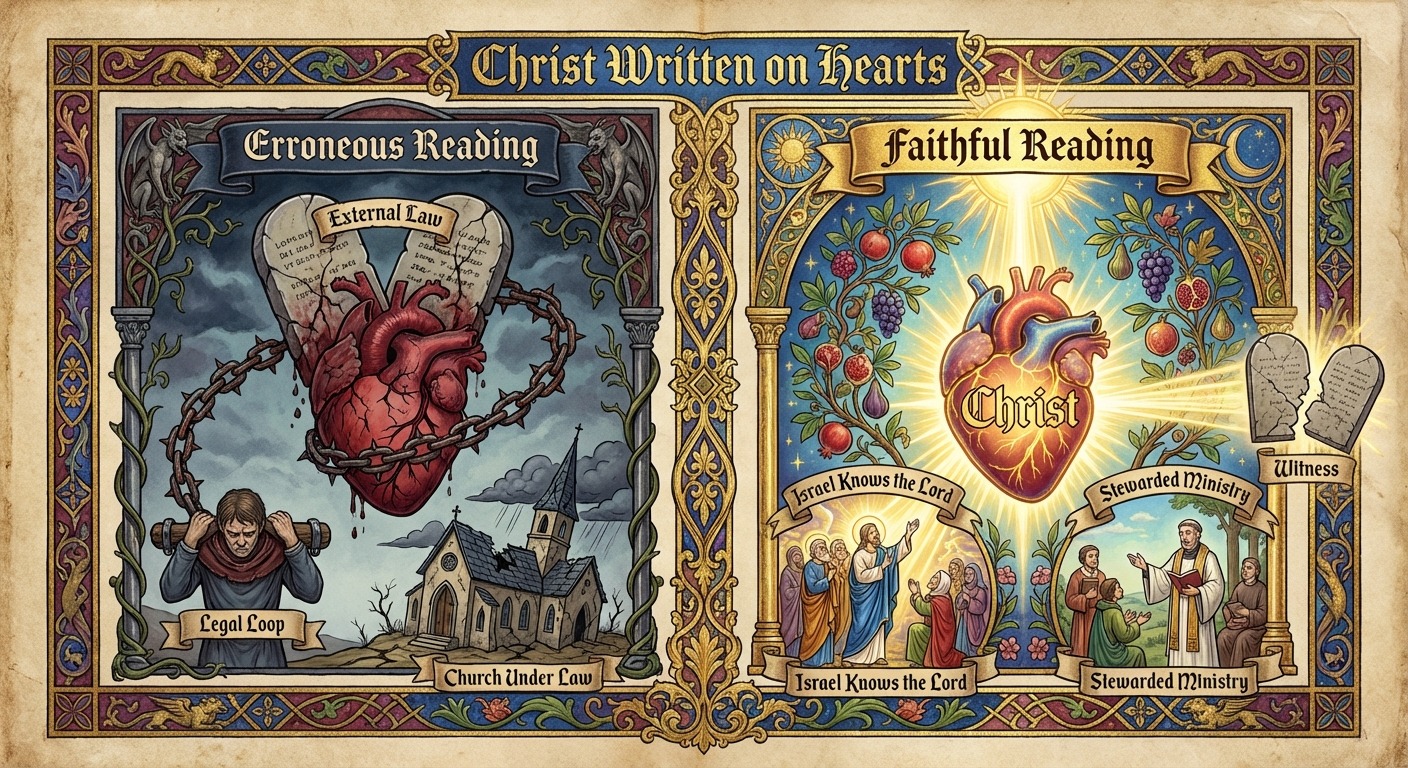
Christ Written on Hearts
This chart shows the structure. What follows explains each part.
Christ Written on Hearts
We've been establishing that the new covenant is a bilateral arrangement for Israel — a restored national relationship, with Christ guaranteeing the terms from within. Now the question is: what does holiness actually look like under that arrangement? Jeremiah says God will write "my law" on their hearts — but if Paul is our interpreter, that phrase means something that Jeremiah himself couldn't have fully articulated. And getting this right matters for the Church, because if you misread what the new covenant writes, you end up putting the Church under law.
Christ Written on Hearts
The Question of Holiness Under the New Covenant
The question of what constitutes holiness under the new covenant is not merely academic but decisive for the entire structure of biblical theology. Jeremiah prophesied that God would write His law in the inward parts of Israel, promising, "I will put my law in their inward parts, and write it in their hearts" (Jeremiah 31:33). Ezekiel echoed this, declaring, "I will cause you to walk in my statutes" (Ezekiel 36:27). Mainstream dispensational thought has often taken these promises to mean the Mosaic code would be supernaturally inscribed on the heart, with the Spirit enabling a kind of vicarious Torah-compliance. The assumption is that the law persists as the operative framework, and that the Spirit's role is to empower obedience to the same statutes, now internalized. Yet this reading cannot withstand the interpretive authority of the Apostle Paul, nor does it preserve the distinction between covenant and testament that guards the Church against legalism.
Not Torah Relocated
Jeremiah, writing within the vocabulary available to an Old Testament prophet, described the new covenant's effect as God writing "my law" on the hearts of His people. Read in Jeremiah's context alone, "my law" can only mean Torah — there was no other referent available. But progressive revelation means that later and fuller revelation interprets earlier and less complete revelation. Paul is not silent on this question, and where the apostolic interpreter has spoken, the student of Scripture cannot go back behind him and read the Old Testament as though he never wrote.
Paul's interpretation in 2 Corinthians 3 draws a sustained contrast between the ministry of the letter, "engraven in stones," which "killeth," and the ministry of the Spirit, which "giveth life" (2 Corinthians 3:6–7). He is emphatic that the old covenant ministry is "done away" and "passing away" (2 Corinthians 3:11) — not upgraded or relocated. Romans 8:2 further clarifies: "the law of the Spirit of life in Christ Jesus hath made me free from the law of sin and death." Here, "law" does not refer to Torah but to a new operating principle — an entirely different reality, not merely an improvement of the old. Whatever "my law" means in Jeremiah, it cannot mean Torah supernaturally maintained, because Paul has told us that the ministry engraved on stones is the very thing being done away.
A Precedent, Not a Blueprint
Now, Paul in 2 Corinthians 3 is describing the new testament ministry — his own apostolic work among the churches. He says believers are "the epistle of Christ... written not with ink, but with the Spirit of the living God; not in tables of stone, but in fleshy tables of the heart" (2 Corinthians 3:3). This gives us an authoritative precedent: when God writes on hearts, the content is Christ Himself — His nature, His knowledge, His life — not a legal code relocated from stone to flesh. This precedent tells us decisively what the new covenant writing is not. It is not Torah. It is not vicarious law-keeping. It is the knowledge and life of a Person.
However, the new covenant operation in Israel and the new testament ministry in the Church are not identical, and we must be careful not to map one directly onto the other. The most striking difference is the necessity of a teacher. Under the new testament ministry, the body of Christ is built up through gifted stewards — apostles, prophets, evangelists, pastors, and teachers (Ephesians 4:11) — who distribute the knowledge of Christ as the riches of the inheritance. This writing is mediated, progressive, and requires the renewing of the mind (Romans 12:2). It produces a weight of glory carried in earthen vessels today and revealed in resurrection (2 Corinthians 4:7, 17).
But of the new covenant, Jeremiah says something remarkably different: "they shall teach no more every man his neighbour, and every man his brother, saying, Know the LORD: for they shall all know me, from the least of them unto the greatest of them" (Jeremiah 31:34). There is no teacher. There is no intermediary distributing knowledge. The knowledge of God is immediate, intuitive, sovereign — a direct act of God upon the nation. This is not incremental. It is not progressive application through the renewing of the mind. It is unmediated knowledge of Christ that surpasses in directness anything the Church presently experiences in this dispensation.
We have, then, a precedent from the new testament ministry for what "Christ written on hearts" means in its essential character — it is Christ, not Torah. But the instrument and method are not the same. The new testament ministry operates through stewards and the Word, producing epistles of Christ in earthen vessels. The new covenant operates directly, without a teacher, producing the knowledge of God in sinless vessels under the terms of that covenant. What exactly that looks like in its full expression is not ours to map in detail from where we stand — any more than John the Baptist could have understood what it means to be "crucified with Christ." That reality did not belong to his time, and the inner workings of the new covenant's direct operation do not fully belong to ours.
The Prototype: The 144,000
What we can see is the firstfruits. The 144,000 described in Revelation 14:1–5 are called "the firstfruits unto God and to the Lamb" (Revelation 14:4), serving as the prototype for what reconstituted Israel will be under the new covenant. Their distinguishing features are not Torah-compliance but the direct reproduction of Christ's nature: "in their mouth was found no guile" (Revelation 14:5), and they sing a new song that no other can learn (Revelation 14:3). They follow the Lamb wherever He goes (Revelation 14:4). There is no mention of law-keeping, even by supernatural enablement. There is Christ — His life and character written directly on their hearts. The firstfruits tell you what the harvest will be, and the harvest does not look like upgraded Sinai.
The Law and God's House
The claim that the law constitutes the "character of God's house" in the millennium faces a further contradiction. The Church is explicitly called God's house: "Christ as a son over his own house; whose house are we" (Hebrews 3:6). If law is the intrinsic character of that house, then the Church is necessarily under law, which is contrary to the testamentary standing of the Church as revealed by Paul. The law is a diagnostic instrument — "the law was added because of transgressions, till the seed should come to whom the promise was made" (Galatians 3:19). It identifies sin and witnesses against it, but it does not produce holiness. Its function is temporary and preparatory, not permanent or constitutive of God's dwelling.
Holiness as Christ's Nature Reproduced
In the millennium, the law will continue to serve as a witness and memorial where needed, but it is entirely surpassed by the life of Christ in those who are His. The Ezekiel temple's memorial offerings, notably lacking a sin offering, testify to worship and dedication, not to a legal framework for producing holiness. The holiness of new covenant Israel is not law supernaturally enabled, but the direct reproduction of Christ's nature — a reality Jeremiah could only describe as "my law" because he did not yet possess the vocabulary of Paul's fuller revelation.
Preserving the Distinction
Preserving the distinction between the everlasting covenant and the new covenant is therefore essential. The Church's blessings derive from the everlasting covenant, which is testamentary and unconditional — an inheritance shared with Christ, the Heir who died and rose. The new covenant governs mortal Israel's national life in the land, characterized not by Torah-compliance but by Christ written on the heart through a direct operation we can identify in character but not fully describe in mechanism.
Any confusion of these categories inevitably leads to legal drift and the loss of the Church's testamentary standing. If the new covenant is collapsed into the everlasting covenant, and the new covenant is said to be oriented around law as "the character of God's house," then the Church is inescapably brought under law. The new covenant is a new thing: not Sinai upgraded, but the life of the Son of God manifest in a people, written not with ink or on stone, but by the Spirit of the living God on hearts made new.
New covenant holiness is Christ's nature reproduced, not Torah relocated. But one further implication must now be faced directly. If Jeremiah's new covenant says, “they shall teach no more every man his neighbour,” then the Church's present ministry of apostles, prophets, evangelists, pastors, and teachers cannot simply be the new covenant in operation under another name. That distinction deserves to be seen in its own right before we turn to the question of the blood. That's the next chart.
Every chart in this series is free to explore online.
 Get the full chart set (PDF – $8)
Members get all PDFs included → Why Membership
Log in with an active membership to download printable PDFs on this site. Purchased on the shop? Access downloads from your shop account.
If you would like to help fund this work:
Based on the article:
The Everlasting Covenant
A Distinct Covenantal Category in Pauline Dispensational Theology. The full theological foundation paper is available to read online in Writings.
Read it free online