Visual Theology – The Everlasting Covenant
The Visual Theology charts are designed to help you see the structure and movement of Scripture. They highlight patterns, contrasts, and developments that are often difficult to hold together when reading line by line.
These charts show the structure of the argument. The accompanying articles develop each part in full.
This approach follows a long tradition of visual teaching in the Church. The well-known charts of Clarence Larkin helped many grasp the broad outline of Scripture. In the same spirit, these charts aim to make visible what the Word of God is revealing.
Charts and teaching notes for the book of The Everlasting Covenant. Select a chart below to view the image and article.
Click chart to view larger
From the teaching in: The Everlasting Covenant
17. The New Jerusalem: Convergence and Memorial
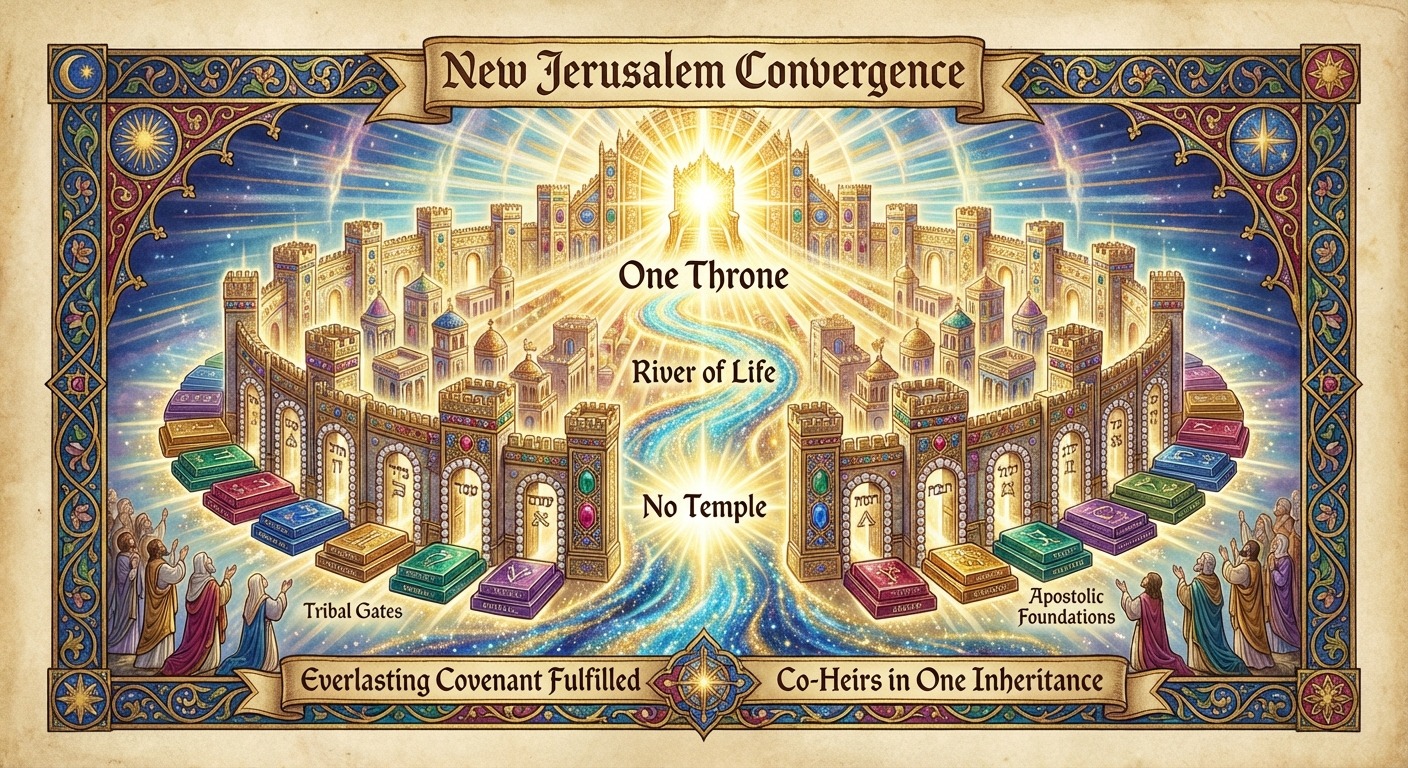
New Jerusalem Convergence
This chart shows the structure. What follows explains each part.
The Vision of the New Jerusalem
The vision of the New Jerusalem in Revelation 21 stands as the convergence of the entire divine program. The city descends from heaven, its features bearing deliberate and layered symbolism. The gates of the city are inscribed with the names of the twelve tribes of Israel, while its foundations are marked by the names of the twelve apostles of the Lamb. From the throne flows the river of life, and God Himself dwells with man. Significantly, there is no temple in the city, for, as it is written, “the Lord God Almighty and the Lamb are the temple of it” (Revelation 21:22).
Architectural Symbolism
This architectural symbolism is not incidental but precise. The tribal names on the gates serve as a memorial of Israel’s role in God’s earthly program. Israel, as the nation called and covenanted through Abraham, Isaac, and Jacob, is honored for its unique function in the outworking of divine purpose. The apostolic names in the foundations memorialize the Church’s role as the body through which the mystery of Christ was revealed and administered. The Church, constituted through the apostles’ witness and the dispensation of grace, occupies a foundational place in the city’s eternal structure.
Both Israel and the Church are present, both are honored, and neither is erased from the divine memory. Yet the structures they represent—the new covenant administration for mortal Israel and the dispensation of grace for the Church—have completed their respective works.
The Everlasting Covenant Realized
What remains, therefore, is the everlasting covenant in its full realization. The Heir, Christ, possesses everything. The co-heirs, those united to Him, share in this inheritance. God is all in all. This is not the continuation of the old or new covenant administrations but the arrival at their intended goal. The everlasting covenant, promised to Abraham in Genesis 15 while he slept, finds its destination in the New Jerusalem. The Seed possesses the world; the families of the earth are blessed; the unity of heaven and earth is achieved. Ephesians 1:10 speaks of this as “the dispensation of the fullness of times,” in which God gathers together “all things in Christ, both which are in heaven, and which are on earth.”
Convergence and Culmination
In the New Jerusalem, the covenantal diversity of the ages—old covenant, new covenant, the dispensation of grace—is resolved into the unity of the everlasting covenant’s fulfillment. The city itself is a memorial to the completed purposes of God: Israel’s history and calling, the Church’s mystery and administration, all gathered up in Christ, the one Head. The vision does not dissolve the distinctions but honors them, even as the temporal structures give way to the eternal reality.
God dwells with man in unmediated fellowship, and the inheritance promised from the beginning is fully possessed. The New Jerusalem thus stands as the convergence and culmination of God’s redemptive program, the everlasting covenant realized in its fullness.
Every chart in this series is free to explore online.
 Get the full chart set (PDF – $8)
Members get all PDFs included → Why Membership
Log in with an active membership to download printable PDFs on this site. Purchased on the shop? Access downloads from your shop account.
If you would like to help fund this work:
Based on the article:
The Everlasting Covenant
A Distinct Covenantal Category in Pauline Dispensational Theology. The full theological foundation paper is available to read online in Writings.
Read it free online