
Visual Theology – The Everlasting Covenant
The Visual Theology charts are designed to help you see the structure and movement of Scripture. They highlight patterns, contrasts, and developments that are often difficult to hold together when reading line by line.
These charts show the structure of the argument. The accompanying articles develop each part in full.
This approach follows a long tradition of visual teaching in the Church. The well-known charts of Clarence Larkin helped many grasp the broad outline of Scripture. In the same spirit, these charts aim to make visible what the Word of God is revealing.
Charts and teaching notes for the book of The Everlasting Covenant. Select a chart below to view the image and article.
Click chart to view larger
From the teaching in: The Everlasting Covenant
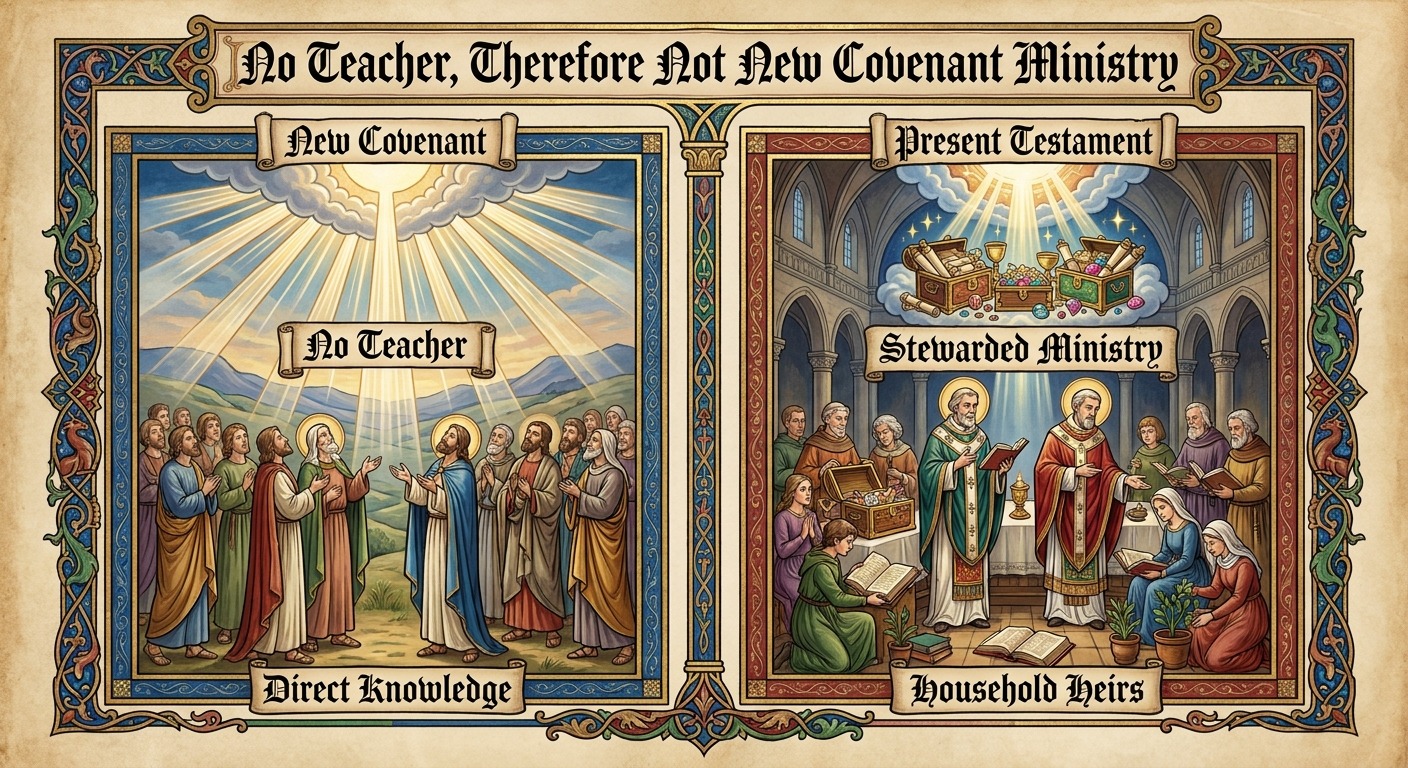
10a. No Teacher, Therefore Not New Covenant Ministry
No Teacher, Therefore Not New Covenant Ministry
This chart shows the structure. What follows explains each part.
No Teacher, Therefore Not New Covenant Ministry
We've just seen that new-covenant holiness is Christ written on the heart, not Torah relocated. But Jeremiah's prophecy contains another feature just as decisive: under that covenant, the knowledge of God is direct and unmediated. That means the Church's present ministry, however spiritual and however rich, cannot simply be the new covenant in operation. If ministers are still necessary, we are dealing with a different administration.
Jeremiah's Defining Mark
Jeremiah 31:34 states the matter with unusual force: "they shall teach no more every man his neighbour, and every man his brother, saying, Know the LORD: for they shall all know me, from the least of them unto the greatest of them." This is not an incidental flourish. It is one of the defining marks of the new covenant. The old covenant required mediators — priests, prophets, teachers, ordinances, repeated instruction. The new covenant, by contrast, is described as an arrangement in which the knowledge of God is direct, immediate, and universal within the nation under that covenant.
If that text is allowed to stand in its own force, then one conclusion follows at once: a continuing ministerial structure that distributes the knowledge of Christ through appointed stewards cannot be identical with the new covenant administration promised in Jeremiah. The presence of ministers does not merely modify the prophecy. It identifies a different mode of operation.
Paul's Ministry Is Real Ministry
Paul openly describes his work in ministerial terms. In 2 Corinthians 3:6 he says that God "hath made us able ministers of the new testament." In Ephesians 4:11 the ascended Christ gives apostles, prophets, evangelists, pastors, and teachers for the edifying of the body. Romans 12:2 speaks of the renewing of the mind. Colossians speaks of believers growing in the knowledge of God. Everywhere in the present dispensation, the riches of Christ are made known through stewards, through preaching, through teaching, through the written word, through the distribution of revealed truth into the saints.
That is not Jeremiah 31:34. It is not unmediated national knowledge. It is mediated household administration. It is progressive, not immediate; stewarded, not direct; distributed, not simply infused. The Church does not now inhabit an order in which no man says to his brother, "Know the Lord." The Church inhabits an order in which such instruction is itself one of the appointed means by which the risen Christ makes His riches known.
Testament Ministry, Not New-Covenant Party Status
This is why Paul must be understood as a minister of the new testament, not as evidence that the Church is under the new covenant as a covenantal party. The testament requires ministers because a will, once activated by the death of the testator, must have its contents made known to the heirs. The Church is not a nation in the land, reconstituted under a bilateral covenant guaranteed from within. The Church is a household of heirs, and the ascended Heir uses ministers to distribute the knowledge of what is theirs in Him.
The distinction is not verbal but structural. Under the new covenant, God writes Christ directly upon the nation so that no teaching intermediary is needed. Under the present testament ministry, Christ still writes Himself upon His people, but He does so through stewarded means proper to this dispensation. The content is Christ in both cases. The instrument is not the same.
Why the Distinction Matters
If the Church is simply placed under the new covenant, then Jeremiah's "no teacher" promise must either be denied, postponed without theological consequence, or dissolved into a vague generality. But once that clause is taken seriously, the confusion clears. The Church participates in the everlasting covenant as testament heirs. Israel, in the coming age, will stand under the new covenant as a nation directly known of God. The one does not erase the other, but neither are they the same arrangement.
This distinction preserves both the Church's present ministry and Israel's future promise. It also prevents the flattening move by which every gracious operation of the Spirit is simply labeled "new covenant" and thereby made to swallow the Church's testamentary standing. The ministry of the Church is real, spiritual, and glorious. Precisely for that reason, it must be identified correctly.
The Church's present knowledge of Christ is stewarded testament ministry, not Jeremiah's no-teacher new covenant. With that distinction in place, we can now return to the question that seems to blur the categories most of all: how the one blood of Christ is identified with both the everlasting covenant and the new covenant without making the two the same thing. That's the next chart.
Every chart in this series is free to explore online.
 Get the full chart set (PDF – $8)
Members get all PDFs included → Why Membership
Log in with an active membership to download printable PDFs on this site. Purchased on the shop? Access downloads from your shop account.
If you would like to help fund this work:
Based on the article:
The Everlasting Covenant
A Distinct Covenantal Category in Pauline Dispensational Theology. The full theological foundation paper is available to read online in Writings.
Read it free online