
Visual Theology – The Everlasting Covenant
The Visual Theology charts are designed to help you see the structure and movement of Scripture. They highlight patterns, contrasts, and developments that are often difficult to hold together when reading line by line.
These charts show the structure of the argument. The accompanying articles develop each part in full.
This approach follows a long tradition of visual teaching in the Church. The well-known charts of Clarence Larkin helped many grasp the broad outline of Scripture. In the same spirit, these charts aim to make visible what the Word of God is revealing.
Charts and teaching notes for the book of The Everlasting Covenant. Select a chart below to view the image and article.
Click chart to view larger
From the teaching in: The Everlasting Covenant
13a. Millennial Tribal Reconstitution
Millennial Tribal Reconstitution
This chart shows the structure. What follows explains each part.
Millennial Tribal Reconstitution
We've distinguished between the testament estate of the risen Heir and the tribal allotments of millennial Israel. But the tribal side of that distinction must now be traced concretely. If it is not, people tend to imagine one of two false alternatives: either the millennial arrangement is nothing more than Joshua repeated, or it is a permanent second inheritance structure alongside the bride's eternal portion. Scripture allows neither conclusion.
Tribal Order in Four Stages
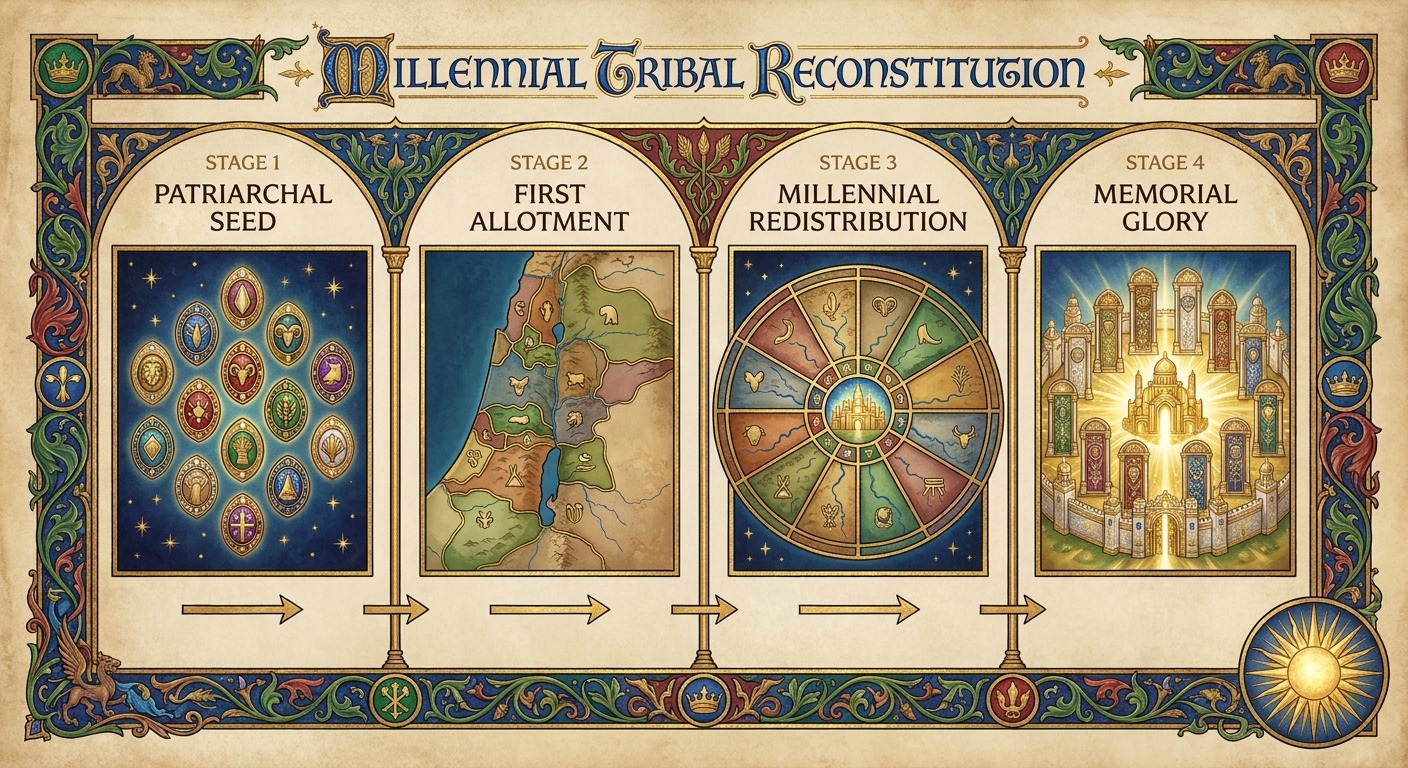
The scriptural data is best understood in four distinguishable stages.
First, Genesis 49 gives tribal destiny in seed form. Jacob distributes prophetic character, prominence, and future significance among the tribes, but not yet territorial maps. The tribes are named and differentiated, but the land is not yet parceled out in operative form.
Second, Joshua 13–21 gives the first historical territorialization of that tribal identity. Here the nation, under the old-covenant administration, enters the land and receives actual tribal allotments. This is the first full land-structure, and it belongs to Israel's national life under the Mosaic order.
Third, Ezekiel 47–48 gives a millennial redistribution. This is not simply Joshua restated. The land is divided anew under the conditions of the restored nation and the new-covenant administration. The arrangement is real, terrestrial, and functional, but it belongs to a reconstituted mortal order in which covenant life in the land is being maintained by Christ from within His people.
Fourth, Revelation shows both the sealing and the resolution of that order. Revelation 7 preserves the tribal structure in a reconfigured roster, while Revelation 21 carries the tribes forward into memorial form in the architecture of the New Jerusalem. The order remains recognizable, but not in the same operative mode.
Why Revelation 7 Is Decisive
The reconfigured character of the millennial order is made especially clear in Revelation 7. Under Joshua, Levi received no territorial inheritance because the Lord Himself was the priestly tribe's portion, while Dan did receive land. In Revelation 7, Levi is included in the roster and Dan is omitted. This is not a random irregularity. It is structural evidence that the future tribal arrangement is not a mere replay of the Mosaic order. The same patriarchal identities remain in view, but their function is redistributed under a different administration.
That matters because it shows that Ezekiel's tribal order belongs to the new-covenant millennial phase, not to an eternal second system running alongside the bride's inheritance forever. The tribal structure is real; it is not illusory or "spiritualized away." But it is also reconfigured; it is not Joshua simply resumed. Scripture itself marks the difference.
Millennial, Not Eternal
Once that point is seen, the wider eschatological structure becomes clearer. The tribal allotments belong to the phase in which mortality, land, temple, priestly nationhood, and covenant administration still have operative significance. They belong to the millennial kingdom. They are distributional structures for a mortal people in a restored earth under the reigning Heir.
But they do not constitute the final form of inheritance. Revelation 21 does not depict eternal life as a perpetually administered map of tribal parcels. It depicts the New Jerusalem descending, the gates bearing tribal names and the foundations bearing apostolic names, and no temple in the city. What remains is memorial and honor, not continuing distributional management. The tribal names endure. The allotment-structure does not.
Why This Preserves the Distinction
This four-stage arc preserves both sides of the biblical witness. It preserves the reality of Israel's millennial inheritance against any attempt to dissolve it into mere symbolism. And it preserves the supremacy of the everlasting covenant inheritance against the notion of a permanent two-tier order in which the bride has one kind of eternal portion and Israel another. The tribal allotments are genuine, but they are millennial. The inheritance of the Heir is universal, everlasting, and final.
So the tribal question is not whether Israel has a real future land order. It is whether that land order belongs to the final eternal form of things. Scripture's answer is no. It belongs to the millennial administration, and then yields to the consummated inheritance in which all things are gathered in Christ.
The millennial tribal order is therefore a real but temporary reconstitution: rooted in patriarchal identity, first territorialized under Joshua, redistributed under Ezekiel's millennial administration, marked as reconfigured in Revelation 7, and finally preserved only as memorial honor in Revelation 21. With that in place, we can now return to the other major distinction that runs beside it: the difference between the redemption of individuals and the redemption of the nation. That's the next chart.
Every chart in this series is free to explore online.
 Get the full chart set (PDF – $8)
Members get all PDFs included → Why Membership
Log in with an active membership to download printable PDFs on this site. Purchased on the shop? Access downloads from your shop account.
If you would like to help fund this work:
Based on the article:
The Everlasting Covenant
A Distinct Covenantal Category in Pauline Dispensational Theology. The full theological foundation paper is available to read online in Writings.
Read it free online