
Visual Theology – The Everlasting Covenant
The Visual Theology charts are designed to help you see the structure and movement of Scripture. They highlight patterns, contrasts, and developments that are often difficult to hold together when reading line by line.
These charts show the structure of the argument. The accompanying articles develop each part in full.
This approach follows a long tradition of visual teaching in the Church. The well-known charts of Clarence Larkin helped many grasp the broad outline of Scripture. In the same spirit, these charts aim to make visible what the Word of God is revealing.
Charts and teaching notes for the book of The Everlasting Covenant. Select a chart below to view the image and article.
Click chart to view larger
From the teaching in: The Everlasting Covenant
5. The Death of the Testator
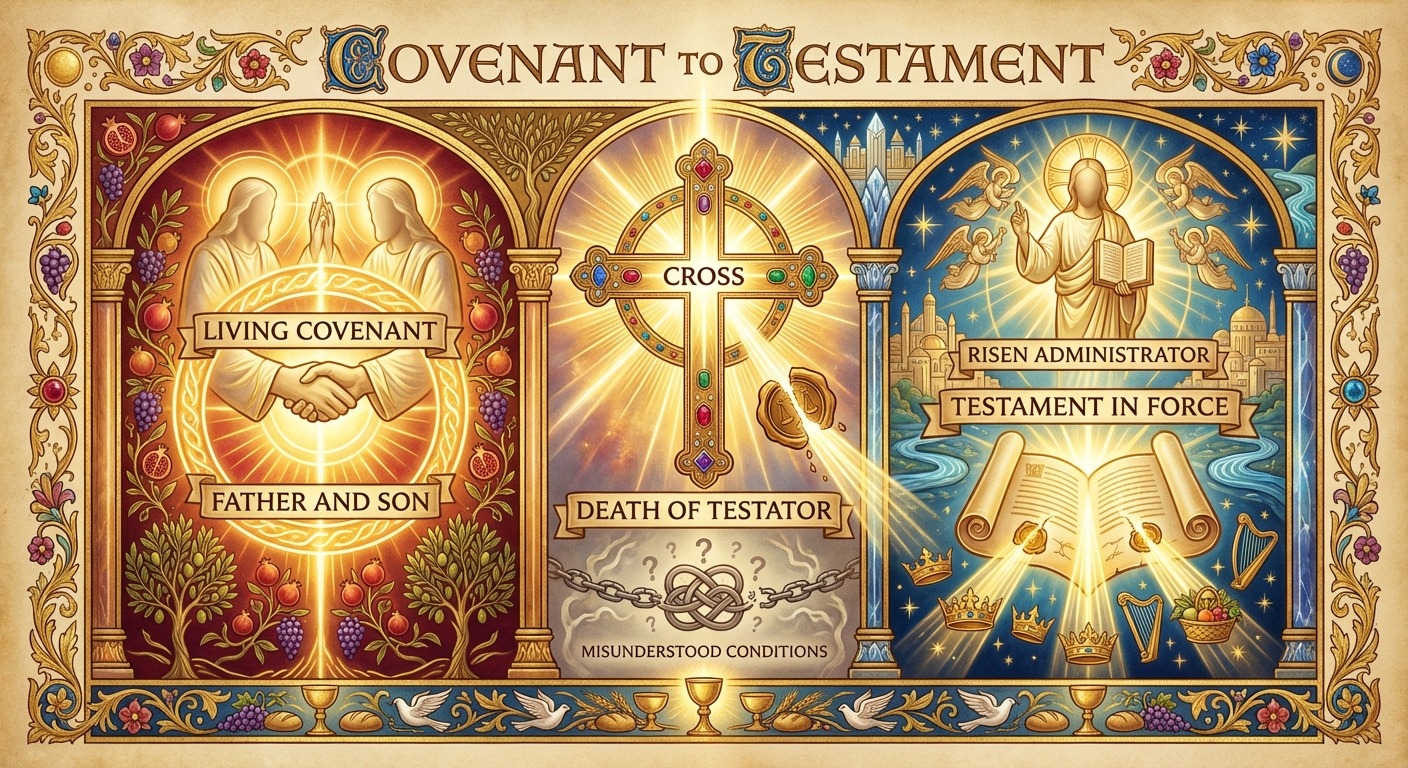
Covenant to Testament
This chart shows the structure. What follows explains each part.
Covenant to Testament
We've traced the everlasting covenant from Genesis 15 through the Davidic specification and the Melchizedek oath. All of it was building toward one event. The cross is not just where sin was atoned for — it's where the legal structure of everything we've been tracing crossed a threshold that changed the mode of operation. The covenant between the Father and the Son became something else. And that transition is what makes the inheritance distributable to you.
The Transition from Covenant to Testament
The transition from covenant to testament forms the hinge of the entire redemptive framework. The argument in Hebrews is decisive: “For where a testament is, there must also of necessity be the death of the testator. For a testament is of force after men are dead: otherwise it is of no strength at all while the testator liveth” (Hebrews 9:16–17). The Greek term diatheke operates in both registers—covenant and testament—and the author of Hebrews explicitly exploits this dual sense. The everlasting covenant, entered into between the Father and the Son, required the Son’s active participation as a living covenant party. As long as the Son lived, the arrangement functioned as a covenant, a living agreement in which the parties were engaged.
This living-covenant phase must be stated clearly. Before the cross, the everlasting covenant was not yet operating as a will distributed to passive beneficiaries. It was the Father’s promise to the Seed, and the Son stood within it as the living party charged to fulfill what the Father had given Him to do. “This commandment have I received of my Father” (John 10:18) belongs to this covenantal phase. The covenant was real before the cross, but its mode was not yet testamentary distribution. It was promise, obligation, and filial obedience moving toward a decisive legal threshold.
The Decisive Event at the Cross
The decisive event comes at the cross. When Christ declared, “It is finished” (John 19:30), the everlasting covenant crossed a legal threshold: it became a testament. A will. This is not a shift from a false arrangement to a true one, but a legal transition within the same unshakeable structure. The difference lies in the mode of operation.
A covenant is bilateral; it requires performance from both parties. Each must fulfill their respective obligations for the arrangement to stand. By contrast, a testament is unilateral in its distribution. It requires only the death of the one who made it. The beneficiaries of a testament do not perform, do not meet conditions, do not maintain the relationship by faithfulness. They simply receive. The lawyer does not inquire whether the heir has kept terms; he checks whether the name appears in the will.
The Church’s Testament Inheritance
This legal structure defines what the Church possesses in Christ. The Church does not stand in a covenant relationship with God, in which terms must be kept, conditions met, or faithfulness maintained to secure standing. Rather, the Church stands as heir to a testament inheritance, distributed by the One who both died and rose again. The cross marks the transition: the death of the Testator activates the will. The resurrection, grounded in the sure mercies of David, constitutes the Heir’s entry into His inheritance.
The Dual Status of the Risen Christ
The risen Christ holds a unique dual status. He is both the Testator whose death put the testament in force and the living Heir who administers the inheritance. This is possible only because the resurrection intervened between the death that activated the testament and the ongoing distribution of its contents. The testament is not in force while the Testator lives, but once He has died, and then risen, He alone can distribute the estate to those named in Him.
This distinction is not a matter of moral or theological inferiority of the covenant phase, but a recognition of the legal mechanics that govern God’s dealings with humanity in Christ. The everlasting covenant secured the right; the cross and resurrection activated the distribution. The Church’s inheritance is not a matter of bilateral performance, but of testamentary bequest. The heirs receive, not by fulfilling conditions, but by being named in the will—by inclusion in Christ, the Heir.
Thus, the transition from covenant to testament at the cross is the legal and theological axis upon which the Church’s standing turns. The finished work of Christ is not merely the fulfillment of covenant terms, but the opening of the testament estate—an inheritance secured and administered by the risen Heir, to all who are found in Him.
The death of the Testator activated the will. That's the everlasting covenant structure — and the Church stands as testament heirs of it right now. But there's a covenant that most people assume the Church is under — the new covenant — and it operates on an entirely different legal basis. Understanding why the new covenant is not a testament, and what it actually is, is essential for keeping these categories straight. That's where we turn next.
Every chart in this series is free to explore online.
 Get the full chart set (PDF – $8)
Members get all PDFs included → Why Membership
Log in with an active membership to download printable PDFs on this site. Purchased on the shop? Access downloads from your shop account.
If you would like to help fund this work:
Based on the article:
The Everlasting Covenant
A Distinct Covenantal Category in Pauline Dispensational Theology. The full theological foundation paper is available to read online in Writings.
Read it free online