
Visual Theology – The Everlasting Covenant
The Visual Theology charts are designed to help you see the structure and movement of Scripture. They highlight patterns, contrasts, and developments that are often difficult to hold together when reading line by line.
These charts show the structure of the argument. The accompanying articles develop each part in full.
This approach follows a long tradition of visual teaching in the Church. The well-known charts of Clarence Larkin helped many grasp the broad outline of Scripture. In the same spirit, these charts aim to make visible what the Word of God is revealing.
Charts and teaching notes for the book of The Everlasting Covenant. Select a chart below to view the image and article.
Click chart to view larger
From the teaching in: The Everlasting Covenant
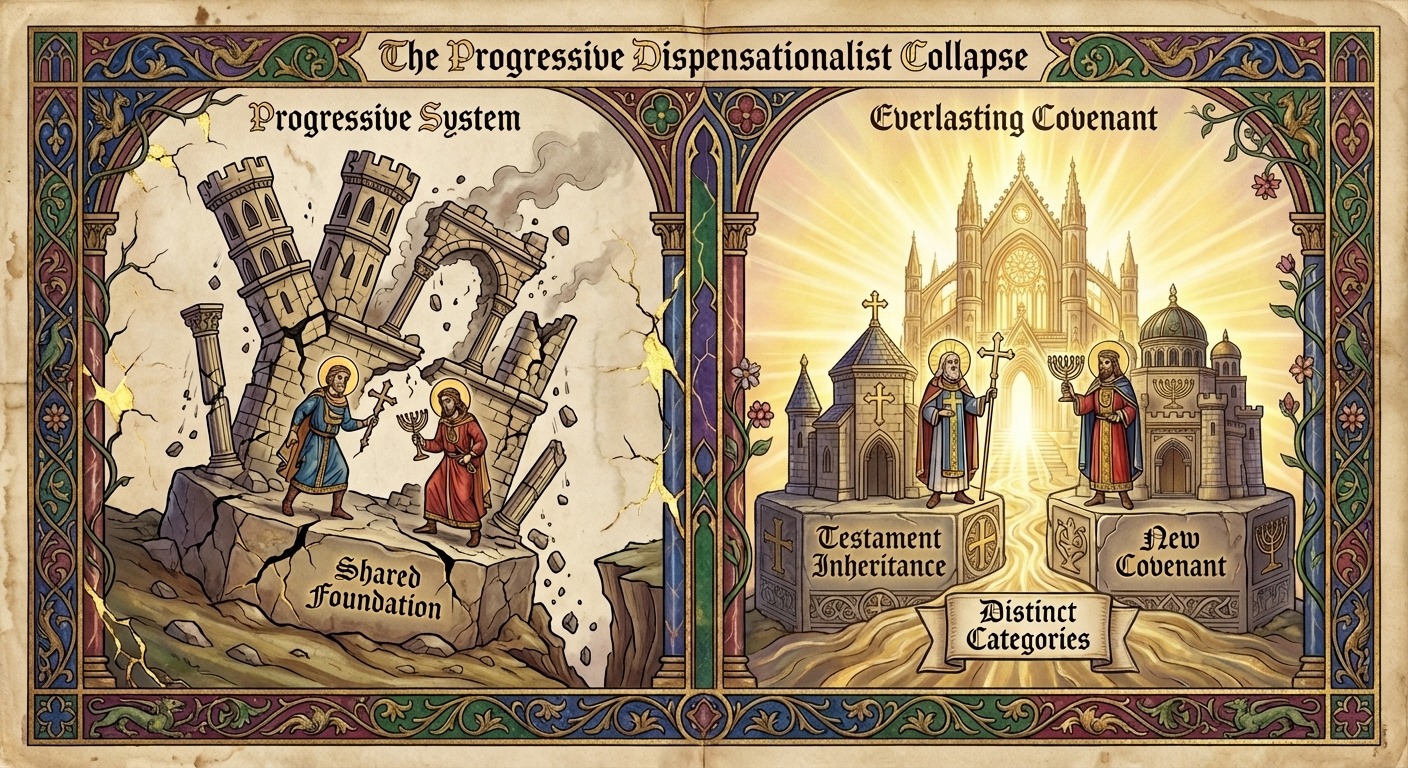
18. The Progressive Dispensationalist Collapse
The Progressive Dispensationalist Collapse
This chart shows the structure. What follows explains each part.
The Progressive Dispensationalist Approach
The progressive dispensationalist approach arises when the everlasting covenant is not maintained as a distinct theological category. Instead, the contents of the everlasting covenant—atonement, sonship, the Spirit, and the inheritance—are attributed to the new covenant. This leads to the crucial question: how does the Church, which clearly possesses these blessings, relate to the new covenant as described in Jeremiah 31?
The Proposed Distinction
Progressive dispensationalism answers by asserting that the Church participates in the new covenant, but in a manner distinct from Israel. According to this view, the Church receives the so-called "spiritual blessings" of the new covenant, such as forgiveness, the Spirit, and the new heart, while Israel is to receive both the spiritual and the national-political blessings in the coming millennial age. This distinction is intended to preserve a difference between Israel and the Church, suggesting that the Church enjoys a present, spiritual phase of covenantal blessings, whereas Israel awaits a future, fuller realization.
A Nominal Solution
However, this solution is only nominal. If both Israel and the Church are under the same covenantal arrangement—differing merely in the scope or timing of blessings received—then the fundamental covenantal ground is shared. The distinction between Israel and the Church, which is essential to a dispensational framework, becomes a matter of degree rather than of kind. The Church and Israel are seen as beneficiaries of a single covenant, with the Church experiencing spiritual benefits now and Israel receiving additional national and political benefits in the future. Yet, the question of degree—spiritual now, political later—cannot sustain a genuine dispensational distinction.
The Drift Toward Covenant Theology
Over time, this position tends toward a de facto covenant theology. The Church is effectively treated as the current beneficiary of a covenant that was made with Israel. This is precisely the error that classical dispensationalism was formulated to avoid. By placing the Church under the new covenant, progressive dispensationalism collapses the theological categories that distinguish the Church from Israel, undermining the legal and covenantal structure that Scripture maintains.
The Root of the Collapse
The root of this collapse lies in the failure to recognize the everlasting covenant as a distinct and prior category. The everlasting covenant, ratified with the Seed in Genesis 15, is the true source of the Church's blessings—atonement, sonship, the Spirit, and the inheritance. These are not derived from the new covenant, which is made with the house of Israel and the house of Judah (Jeremiah 31:31). When this distinction is not preserved, the unique position of the Church as joint-heir with Christ is obscured, and the dispensational structure of Scripture is compromised.
Conclusion: A Theological Erosion
Thus, the progressive dispensationalist collapse is not merely a technical misstep but a theological erosion. It conflates the arrangements God has set in place, reducing the robust Pauline distinction between Israel and the Church to a question of timing and degree, rather than of covenantal substance. Only by maintaining the everlasting covenant as a distinct category can the integrity of dispensational theology and the unique inheritance of the Church in Christ be preserved.
Every chart in this series is free to explore online.
 Get the full chart set (PDF – $8)
Members get all PDFs included → Why Membership
Log in with an active membership to download printable PDFs on this site. Purchased on the shop? Access downloads from your shop account.
If you would like to help fund this work:
Based on the article:
The Everlasting Covenant
A Distinct Covenantal Category in Pauline Dispensational Theology. The full theological foundation paper is available to read online in Writings.
Read it free online