Visual Theology – The Everlasting Covenant
The Visual Theology charts are designed to help you see the structure and movement of Scripture. They highlight patterns, contrasts, and developments that are often difficult to hold together when reading line by line.
These charts show the structure of the argument. The accompanying articles develop each part in full.
This approach follows a long tradition of visual teaching in the Church. The well-known charts of Clarence Larkin helped many grasp the broad outline of Scripture. In the same spirit, these charts aim to make visible what the Word of God is revealing.
Charts and teaching notes for the book of The Everlasting Covenant. Select a chart below to view the image and article.
Click chart to view larger
From the teaching in: The Everlasting Covenant
3. The Davidic Covenant as Extension and Specification
Davidic Covenant Mechanism
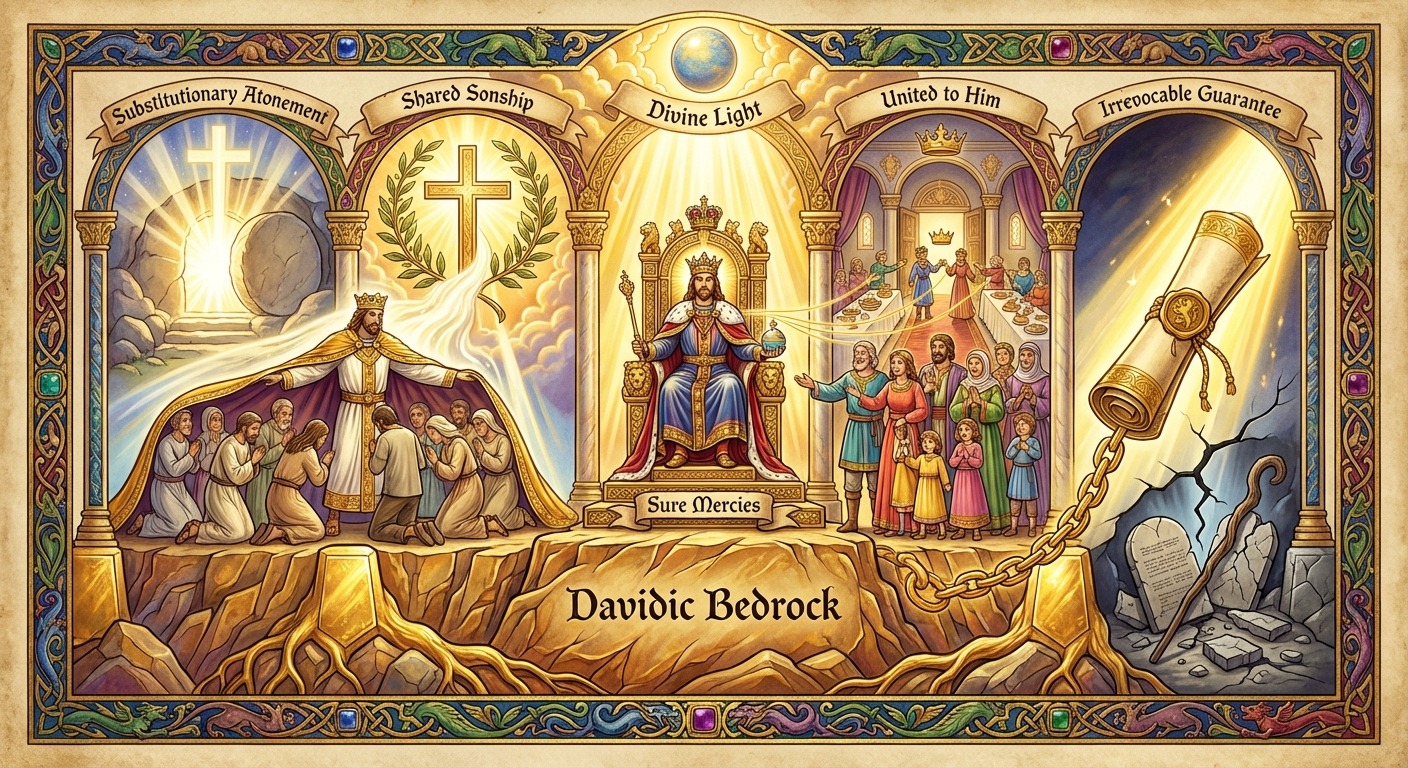
This chart shows the structure. What follows explains each part.
Davidic Covenant Mechanism
We've established the scope of the inheritance — the world, promised to the Seed. But the question is: how does the Seed actually secure it? What's the legal mechanism that makes substitutionary atonement possible, that grounds sonship in something covenantal rather than arbitrary, and that makes the whole arrangement irrevocable? The answer is the Davidic covenant — and it's doing more work than most readers realize.
The Davidic Covenant: Mechanism of the Everlasting Covenant
The Davidic covenant, as recorded in 2 Samuel 7:12–16, stands as the extension and specification of the Abrahamic covenant, not merely repeating earlier promises but advancing them in three decisive directions: substitutionary atonement, sonship, and an unbreakable guarantee. These elements are not incidental; they constitute the very mechanism by which the everlasting covenant operates.
The Legal Ground of Substitutionary Atonement
First, the substitutionary framework is established in God's declaration to David concerning his Seed: “If he commit iniquity, I will chasten him with the rod of men, and with the stripes of the children of men: but my mercy shall not depart away from him” (2 Samuel 7:14–15). This is the legal ground of substitutionary atonement. The King—David’s Seed—bears the chastisement that belongs to the people He represents. While Christ Himself committed no iniquity, He bore the iniquity of those who are His. The chastisement falls upon the sinless One, and because death has no rightful claim over Him, the “sure mercies of David” (Isaiah 55:3) demand His resurrection. Isaiah explicitly identifies these mercies as the substance of the everlasting covenant: “I will make an everlasting covenant with you, even the sure mercies of David” (Isaiah 55:3). The logic is unmistakable: the King is struck so that the people are counted as judged; the sinless substitute is released by justice because the mercy of God cannot depart from Him. This is not new covenant territory. It is the Davidic covenant that secures the legal and covenantal foundation for substitutionary atonement.
Clarifying the Distinction from the New Covenant
It is commonly assumed that substitutionary atonement belongs to the new covenant, often drawn from passages such as Hebrews 9:15, which speaks of Christ’s death “for the redemption of the transgressions that were under the first covenant.” Yet this describes a specific application of His death—namely, the legal redemption of sins committed under the Mosaic covenant—not the origin of substitutionary atonement itself. The ground of substitution is earlier and deeper. The Davidic covenant establishes the legal framework in which the King bears chastisement on behalf of His people, and this extends beyond Israel to the full scope of Christ’s work as “the propitiation… for the sins of the whole world” (1 John 2:2). The new covenant administers and manifests these realities in a national and historical context, but it does not originate them. The substitutionary work of Christ rests on the prior, unbreakable word spoken to David’s Seed.
The Source of Sonship
Second, the Davidic covenant is the source of sonship. God’s word, “I will be his father, and he shall be my son” (2 Samuel 7:14), grounds the Spirit of sonship—the relational reality of being children of God, able to cry “Abba, Father.” This sonship is Christ’s by right as the Son, and it is shared with those who are in Him. While new covenant texts such as Jeremiah 31:33—“I will be their God, and they shall be my people”—and the restoration prophets employ sonship and filial language, their use does not establish the new covenant as the origin of this reality. The sonship is Davidic, established centuries before the new covenant was promised. The new covenant provides the occasion and national arrangement through which these everlasting covenant realities become visible for reconstituted Israel. When sonship language appears in new covenant contexts, it is the underlying Davidic foundation showing through, not a product of the new covenant itself. The common theological move to assign the Spirit of sonship to the new covenant, often on the basis of Ezekiel’s promise, “I will put my Spirit in them” (Ezekiel 36:27), misreads the text: in the new covenant, the Spirit’s role is the equipping of the nation for covenant faithfulness—an outpouring for service, not the Spirit of adoption. The Spirit of sonship belongs to the Davidic-Abrahamic stream, given to Christ and shared with His people by union with Him.
This distinction matters because the texts are doing different work. Ezekiel 36 concerns the reconstitution of a mortal nation in the land: “I will cause you to walk in my statutes.” That is covenant maintenance language. Romans 8 and Galatians 4 concern filial consciousness: “Abba, Father.” That is inheritance language. To collapse the two is to flatten national equipping into adoption, and to move the ground of sonship out of the Davidic promise into a covenant whose function is altogether different. The new covenant secures Israel’s obedience from within; it does not originate the Son’s relation to the Father, nor the Church’s participation in that relation.
An Unbreakable Guarantee
Third, the Davidic covenant provides an unbreakable guarantee. In contrast to the Mosaic covenant, which could be broken and was, the Davidic promise contains no termination clause. God explicitly distinguishes it from His dealings with Saul: “My mercy shall not depart away from him, as I took it from Saul” (2 Samuel 7:15). The everlasting character of the everlasting covenant is not simply its duration, but the fact that its terms are secured entirely by the faithfulness of the One who made them. The Davidic covenant cannot be broken; its guarantee is absolute.
Conclusion
In sum, the Davidic covenant is not a mere historical footnote or a subordinate arrangement. It is the mechanism by which the everlasting covenant operates, extending and specifying the Abrahamic promise in the decisive realities of substitution, sonship, and irrevocable security. These are not gifts of the new covenant, but of the prior, deeper arrangement God made with the Seed. The believer’s atonement, adoption, and eternal security rest not on national or temporal arrangements, but on the unbreakable word spoken to David’s Son.
The Davidic covenant establishes the mechanism: substitution, sonship, an unbreakable guarantee. But the mechanism still needs an administrator — someone to dispense what the covenant secured. That office is established not by the Davidic promises themselves but by a sworn oath of the Father, and it's the subject of the next chart.
Every chart in this series is free to explore online.
 Get the full chart set (PDF – $8)
Members get all PDFs included → Why Membership
Log in with an active membership to download printable PDFs on this site. Purchased on the shop? Access downloads from your shop account.
If you would like to help fund this work:
Based on the article:
The Everlasting Covenant
A Distinct Covenantal Category in Pauline Dispensational Theology. The full theological foundation paper is available to read online in Writings.
Read it free online