
Visual Theology – The Everlasting Covenant
The Visual Theology charts are designed to help you see the structure and movement of Scripture. They highlight patterns, contrasts, and developments that are often difficult to hold together when reading line by line.
These charts show the structure of the argument. The accompanying articles develop each part in full.
This approach follows a long tradition of visual teaching in the Church. The well-known charts of Clarence Larkin helped many grasp the broad outline of Scripture. In the same spirit, these charts aim to make visible what the Word of God is revealing.
Charts and teaching notes for the book of The Everlasting Covenant. Select a chart below to view the image and article.
Click chart to view larger
From the teaching in: The Everlasting Covenant
8. The Old Covenant: National, Conditional, and Terminable
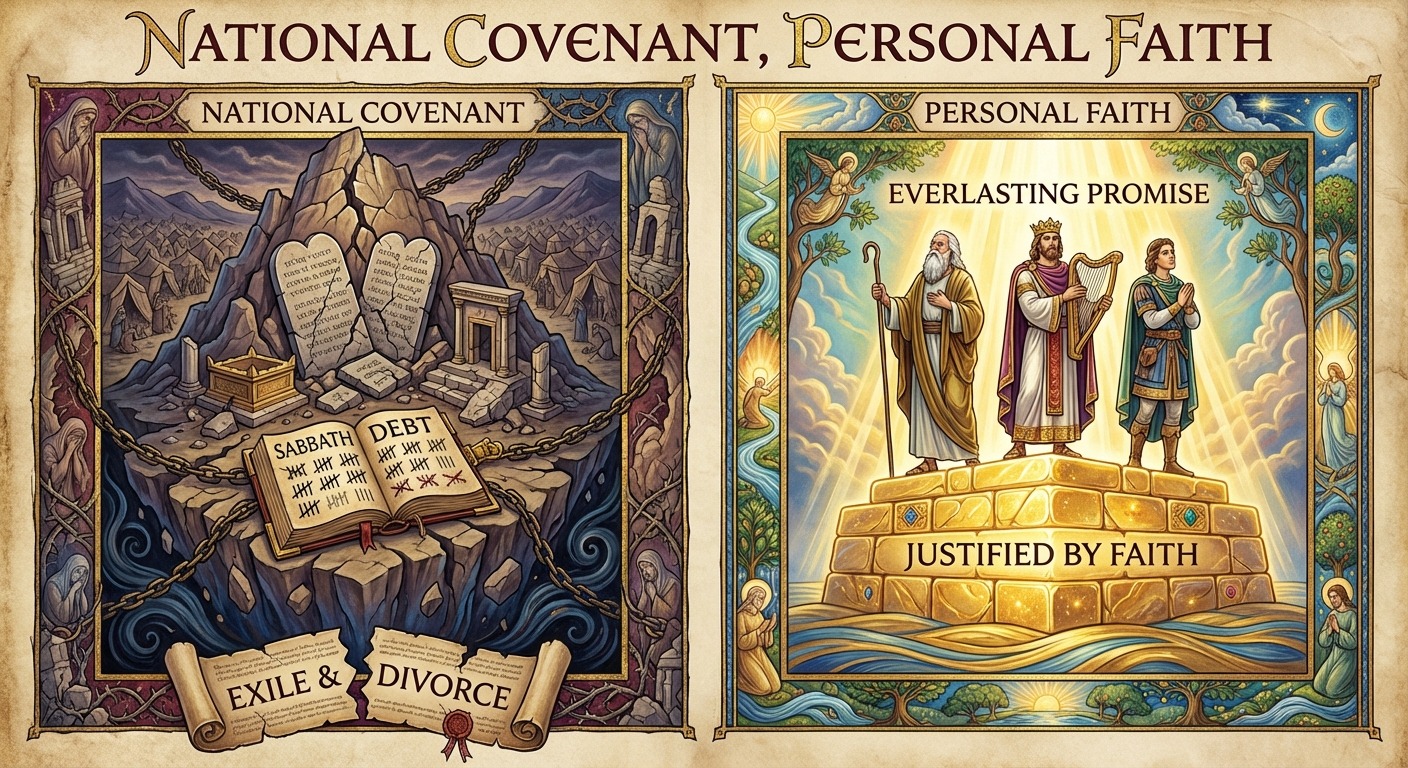
National Covenant, Personal Faith
This chart shows the structure. What follows explains each part.
The Nature of the Old Covenant
The old covenant, established at Sinai, was never intended as an unbreakable or everlasting arrangement for the nation of Israel. Rather, it was a conditional, national covenant—an arrangement for mortals, governing the corporate life of the nation in the land. Its structure encompassed feasts, sacrifices, priesthood, and law, all directed to the nation as a collective entity. The blessings and curses detailed in Deuteronomy 28 were not for individuals severally, but for Israel as a whole, contingent upon the nation’s collective obedience or disobedience.
National Conditionality vs. Individual Justification
A key theological distinction must be made: the conditionality of the old covenant was national, not individual. The law was given to the nation; the feasts were for the nation; the sacrificial system regulated the nation's worship. Yet personal standing before God—justification—was never grounded in law-keeping.
Abraham was justified by faith long before circumcision and centuries before Sinai: “How was it then reckoned? when he was in circumcision, or in uncircumcision? Not in circumcision, but in uncircumcision” (Romans 4:10). Paul further insists that the law, coming 430 years after the promise, could not annul the prior justification of Abraham (Galatians 3:17). David, despite grievous personal sin, was declared blessed: “Blessed is the man to whom the Lord will not impute sin” (Romans 4:8).
Even Daniel, living under the consequences of the nation's failure and enduring Babylonian captivity, was beloved of God and received extraordinary revelation. The captives in Babylon were instructed, “Build ye houses, and dwell in them; and plant gardens, and eat the fruit of them... seek the peace of the city whither I have caused you to be carried away captives, and pray unto the LORD for it: for in the peace thereof shall ye have peace” (Jeremiah 29:5–7). Thus, individual saints were blessed and secure in their standing by faith, even when the nation as a whole suffered chastisement.
National Consequences and Individual Security
The national consequences for covenant failure are starkly illustrated in Israel’s exile. The nation was carried into captivity for seventy years because it had failed to observe the sabbatical rests of the land over a period of 490 years, amounting to seventy sabbaths owed to God (2 Chronicles 36:21). This was a national covenant consequence for a national failure, entirely apart from the faith or justification of individuals within the nation. Daniel was as justified in Babylon as Abraham was in Canaan, because individual righteousness before God was never conditioned on national obedience to the old covenant.
The Terminable Nature of the Covenant
The terminable nature of the old covenant is made explicit in Scripture. God could—and did—divorce Israel: “And I saw, when for all the causes whereby backsliding Israel committed adultery I had put her away, and given her a bill of divorce” (Jeremiah 3:8). This divorce is not a mere metaphor, but a covenantal act: the relationship between God and the nation was legally and actually severed.
Such termination is impossible to comprehend if the old covenant is confused with the everlasting covenant. God cannot and will not divorce Himself from His own promises to the Seed; those promises are irrevocable. But He can, and did, terminate a national arrangement that was always conditional on the nation's faithfulness.
Conclusion
In sum, the old covenant was a national, conditional, and terminable arrangement, governing Israel’s corporate life in the land. Its blessings and curses operated at the level of the nation, not the individual. Individual justification—standing before God—was, and remains, by faith alone, grounded in the everlasting covenant of promise, which cannot be annulled by national failure or terminated by divine divorce. This distinction is essential for understanding the relationship between Israel, the law, and the unbreakable ground of personal salvation.
Every chart in this series is free to explore online.
 Get the full chart set (PDF – $8)
Members get all PDFs included → Why Membership
Log in with an active membership to download printable PDFs on this site. Purchased on the shop? Access downloads from your shop account.
If you would like to help fund this work:
Based on the article:
The Everlasting Covenant
A Distinct Covenantal Category in Pauline Dispensational Theology. The full theological foundation paper is available to read online in Writings.
Read it free online