
Visual Theology – The Everlasting Covenant
The Visual Theology charts are designed to help you see the structure and movement of Scripture. They highlight patterns, contrasts, and developments that are often difficult to hold together when reading line by line.
These charts show the structure of the argument. The accompanying articles develop each part in full.
This approach follows a long tradition of visual teaching in the Church. The well-known charts of Clarence Larkin helped many grasp the broad outline of Scripture. In the same spirit, these charts aim to make visible what the Word of God is revealing.
Charts and teaching notes for the book of The Everlasting Covenant. Select a chart below to view the image and article.
Click chart to view larger
From the teaching in: The Everlasting Covenant
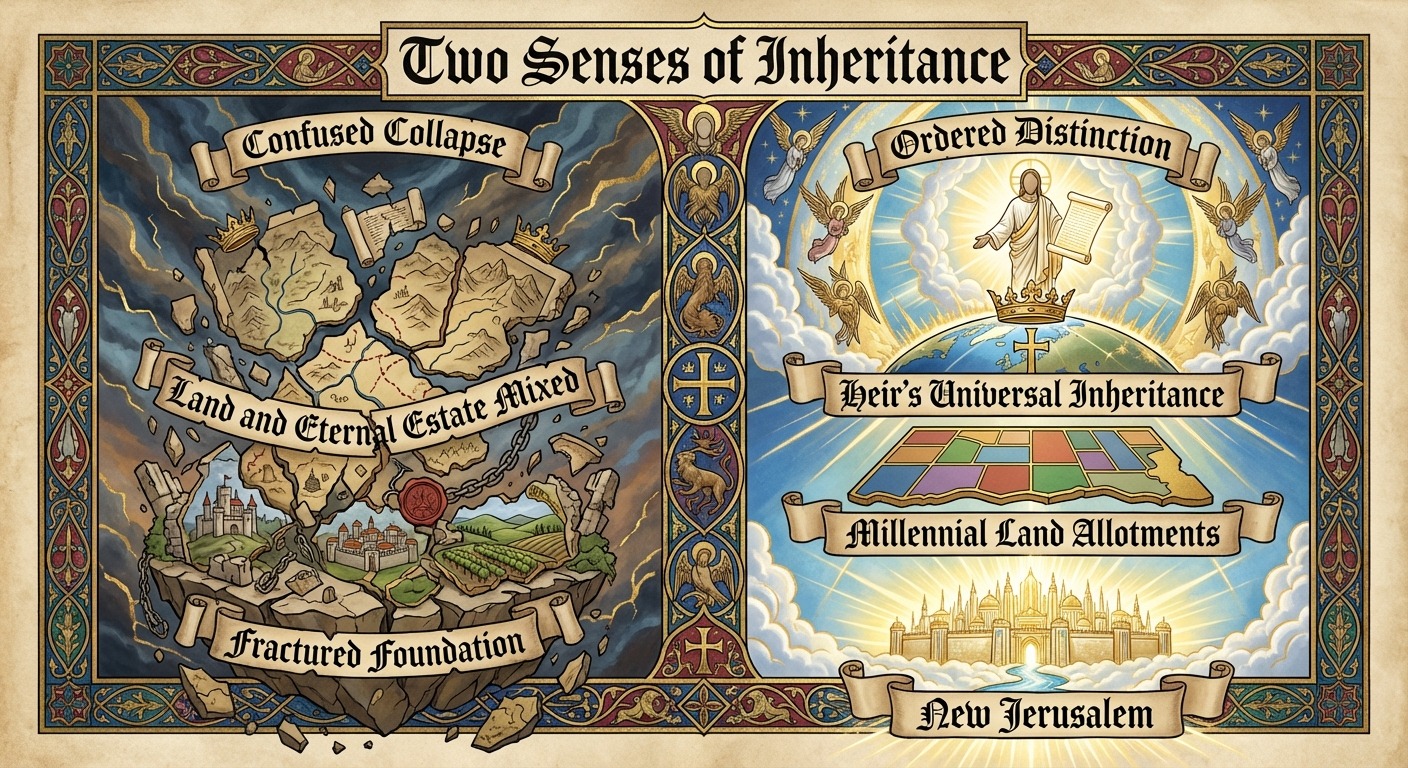
13. Two Senses of Inheritance
Two Senses of Inheritance
This chart shows the structure. What follows explains each part.
Two Senses of Inheritance
We've worked through one blood operating on two legal bases, and four dimensions of the Spirit's work. The same kind of distinction applies to inheritance — and this one matters practically, because when someone asks "what do I inherit?" the answer looks very different depending on whether you're talking about the testament estate of the risen Heir or the tribal allotments of millennial Israel. These are not the same category, and mixing them up has been a source of confusion in dispensational theology for a long time.
Two Senses of Inheritance in Scripture
The concept of inheritance in Scripture operates in two distinct senses, and the failure to distinguish between them has led to significant theological confusion.
The Everlasting Covenant Inheritance
In its first and fullest sense, inheritance refers to the testament estate of the risen Heir, Christ. Having died and risen, Christ has entered into the inheritance promised to the Seed—the promise articulated in Romans 4:13, that Abraham should be "the heir of the world," and confirmed in Hebrews 1:2, where the Son is appointed "heir of all things." This inheritance encompasses "the world," "all things," and everything the Father has given to the Son. It is shared with co-heirs—those who are "in Christ" by faith. This inheritance is unconditional to the recipient and encompasses the totality of the age to come. Here, we are on everlasting covenant territory: the inheritance flows from the promises to the Seed, ratified and distributed through the death and resurrection of Christ.
The Millennial Tribal Inheritance
In the second and narrower sense, inheritance pertains to the tribal allotments of the land of Israel during the millennial kingdom, as described in Ezekiel 47–48. These allotments are tangible and significant, but their operation is within the framework of the national covenant administration for Israel.
The distinction must be maintained between Jacob's prophetic blessings in Genesis 49, which distributed destinies and prominence among the tribes, and the actual territorial allotments, which were assigned only when Israel entered the land under Joshua (Joshua 13–21). The tribal identities are rooted in the patriarchal period, but the territorial inheritance traces to the national covenant. In the millennium, Ezekiel's redistribution of land represents a new arrangement under the new covenant, with boundaries different from those in Joshua's time. These allotments remain national covenant administration material. They are conditional, as all covenant arrangements for mortals require conditions—but under the new covenant, those conditions are kept by Christ within the people. The everlasting covenant does not parcel out land; it gives the Seed the world.
A Reconfigured Tribal Order
This reconstitution of the tribal order is structurally evident in the shift between the tribal roster in Ezekiel and that in Revelation 7. Under Joshua, Levi received no territorial inheritance because the priestly tribe's portion was the Lord Himself; Dan received land. In Revelation 7, Levi is included in the tribal roster, and Dan is omitted. This is not a mere anomaly but structural evidence that the millennial tribal arrangement is not a restoration of the Mosaic system, but a reconfiguration under new covenant administration.
The principle of the priesthood as a landless tribe no longer applies, for under the new covenant, the nation itself is constituted as a kingdom of priests—the very calling given to Israel at Sinai and forfeited. Dan's exclusion further confirms that the millennial roster is not simply an extension of the Joshua system, but a new covenant tribal order, working through the same patriarchal identities but reorganizing their function and inheritance. Genesis 49 imparts tribal character; Joshua assigns the first territory; Ezekiel reconstitutes the arrangement under new covenant terms; and Revelation 7 seals that reconstitution by its altered list. The everlasting covenant does not operate at the level of managing tribal registers or distributing land. It gives the Seed the heavens, the earth, the nations—and from that, all other arrangements, including the millennial tribal order, derive.
The Eternal State: Inheritance Consummated
When mortality ceases in the eternal state, the first sense of inheritance is fully realized and absorbs the second. The tribal allotments as territorial assignments for mortals are no longer operative. What remains is the memorial architecture of the New Jerusalem, where the names of the twelve tribes are inscribed on the gates and the names of the twelve apostles on the foundations (Revelation 21:12–14). These serve as recognition structures—honoring the history, preserving identity, and memorializing the distinct roles of Israel and the Church within God's program. Yet they are no longer covenant-conditioned allotments. In the end, everything is Christ's, Christ's is ours, and "God is all in all."
Two senses of inheritance — the testamentary estate and the millennial national allotments. But the second sense now needs to be traced more concretely through the stages of Israel's tribal order, so that the millennial arrangement is seen neither as a mere replay of Joshua nor as a permanent rival to the bride's inheritance. That's the next chart.
Every chart in this series is free to explore online.
 Get the full chart set (PDF – $8)
Members get all PDFs included → Why Membership
Log in with an active membership to download printable PDFs on this site. Purchased on the shop? Access downloads from your shop account.
If you would like to help fund this work:
Based on the article:
The Everlasting Covenant
A Distinct Covenantal Category in Pauline Dispensational Theology. The full theological foundation paper is available to read online in Writings.
Read it free online