
Visual Theology – The Everlasting Covenant
The Visual Theology charts are designed to help you see the structure and movement of Scripture. They highlight patterns, contrasts, and developments that are often difficult to hold together when reading line by line.
These charts show the structure of the argument. The accompanying articles develop each part in full.
This approach follows a long tradition of visual teaching in the Church. The well-known charts of Clarence Larkin helped many grasp the broad outline of Scripture. In the same spirit, these charts aim to make visible what the Word of God is revealing.
Charts and teaching notes for the book of The Everlasting Covenant. Select a chart below to view the image and article.
Click chart to view larger
From the teaching in: The Everlasting Covenant
20. The Necessity of the Distinction
The Everlasting Covenant Distinction
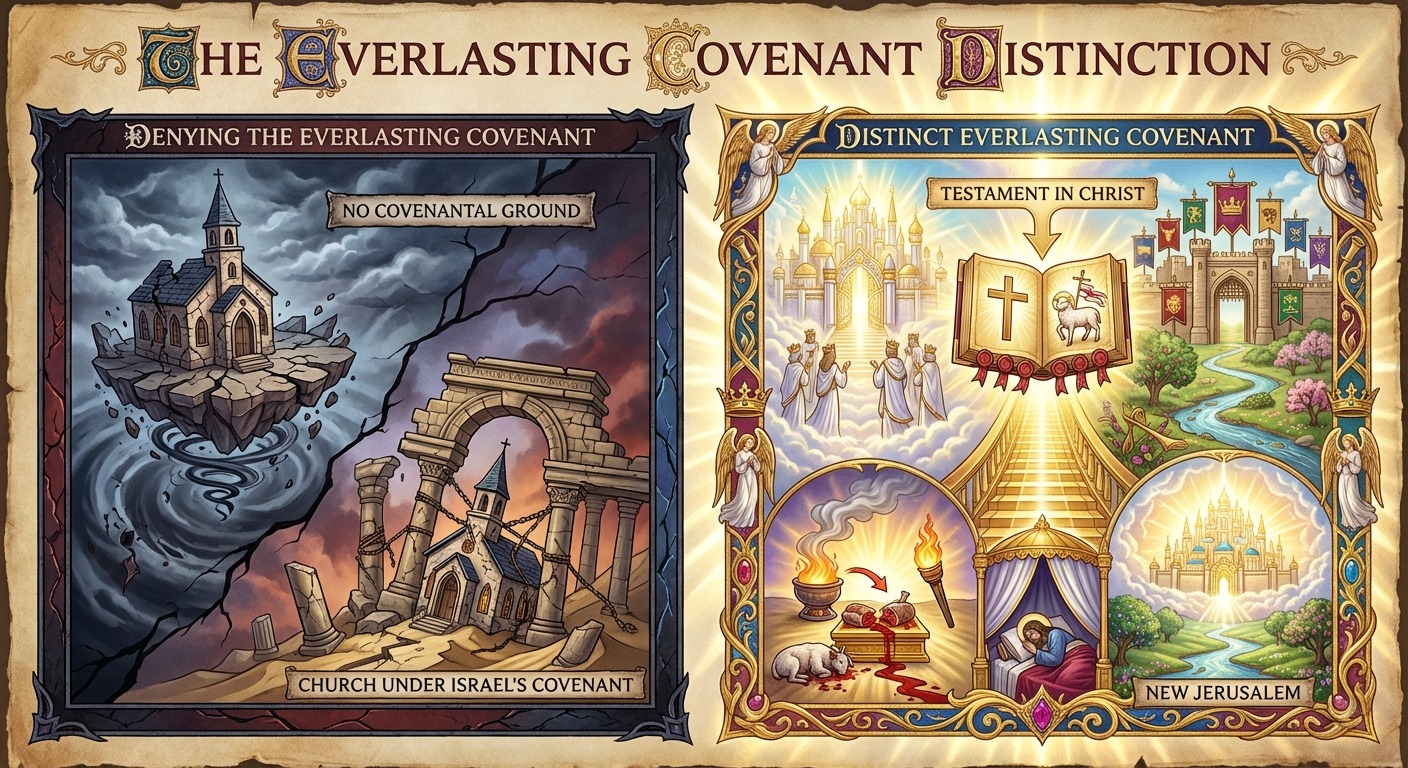
This chart shows the structure. What follows explains each part.
The Distinction of the Everlasting Covenant
The distinction of the everlasting covenant is essential to the integrity of Pauline dispensational theology. If the everlasting covenant is not maintained as a distinct category, two errors present themselves.
On one hand, if the Church is placed under the new covenant, as in progressive dispensationalism, the unique ground of the Church is lost. The Church’s blessings—atonement, sonship, the Spirit of life, and the inheritance of the world to come—do not derive from the new covenant. Rather, they flow from the everlasting covenant, which was ratified with the Seed in Genesis 15, where God alone passed through the blood while Abram slept, signifying a unilateral promise. This covenant is further specified through the Davidic promises and is activated as a testament through the death and resurrection of Christ.
The Church, therefore, is not under a covenant with God at all. The Church is under a testament, joined as co-heirs with the Heir who possesses all things. The inheritance is not distributed on the basis of a bilateral agreement but as a bequest—“the promises are sure to all the seed” (Romans 4:16)—secured by the sacrificial act of Christ and dispensed by His risen life. The legal structure, sacrificial basis, and testamentary mechanics of the everlasting covenant provide the full account for the believer’s position. Grace is not a thin or abstract notion; it is the inheritance of the Heir, distributed to co-heirs through a will that was activated by His death and administered by His resurrection.
Conversely, if the everlasting covenant is not recognized and the new covenant is reserved strictly for Israel, the Church is left without any covenantal ground. This reduction strips grace of its legal and sacrificial foundation, leaving it as a mere divine decision. In such a vacuum, attempts to explain the believer’s position often introduce requirements—faithfulness, perseverance, or works—as supplements to grace, undermining the assurance and security of the inheritance.
The Necessity of the Distinction
The necessity of the distinction, then, is that the everlasting covenant, uniquely ratified in Genesis 15 and fulfilled in the death and resurrection of Christ, provides the Church with its legal and testamentary foundation. The Church possesses everything in Christ through the testament, not through the new covenant. Israel, on the other hand, will be restored as a nation under the new covenant in the millennium, in accordance with the promises made to them. Individual believers in every age are redeemed by the blood of the everlasting covenant, and the entire program converges in the New Jerusalem, where the Seed possesses the world and God is all in all.
Thus, the everlasting covenant, maintained as a distinct category, secures the doctrinal structure: the Church’s blessings are not derivative of Israel’s covenant but are the direct result of the testamentary work of Christ, the true Heir. The promises remain sure and unshakeable, grounded in the unilateral act of God and the finished work of the Seed.
Every chart in this series is free to explore online.
 Get the full chart set (PDF – $8)
Members get all PDFs included → Why Membership
Log in with an active membership to download printable PDFs on this site. Purchased on the shop? Access downloads from your shop account.
If you would like to help fund this work:
Based on the article:
The Everlasting Covenant
A Distinct Covenantal Category in Pauline Dispensational Theology. The full theological foundation paper is available to read online in Writings.
Read it free online