
Visual Theology – The Everlasting Covenant
The Visual Theology charts are designed to help you see the structure and movement of Scripture. They highlight patterns, contrasts, and developments that are often difficult to hold together when reading line by line.
These charts show the structure of the argument. The accompanying articles develop each part in full.
This approach follows a long tradition of visual teaching in the Church. The well-known charts of Clarence Larkin helped many grasp the broad outline of Scripture. In the same spirit, these charts aim to make visible what the Word of God is revealing.
Charts and teaching notes for the book of The Everlasting Covenant. Select a chart below to view the image and article.
Click chart to view larger
From the teaching in: The Everlasting Covenant
15. Hebrews 9:15 and the Pivot from Covenant to Testament
The Pivot of Hebrews 9:15
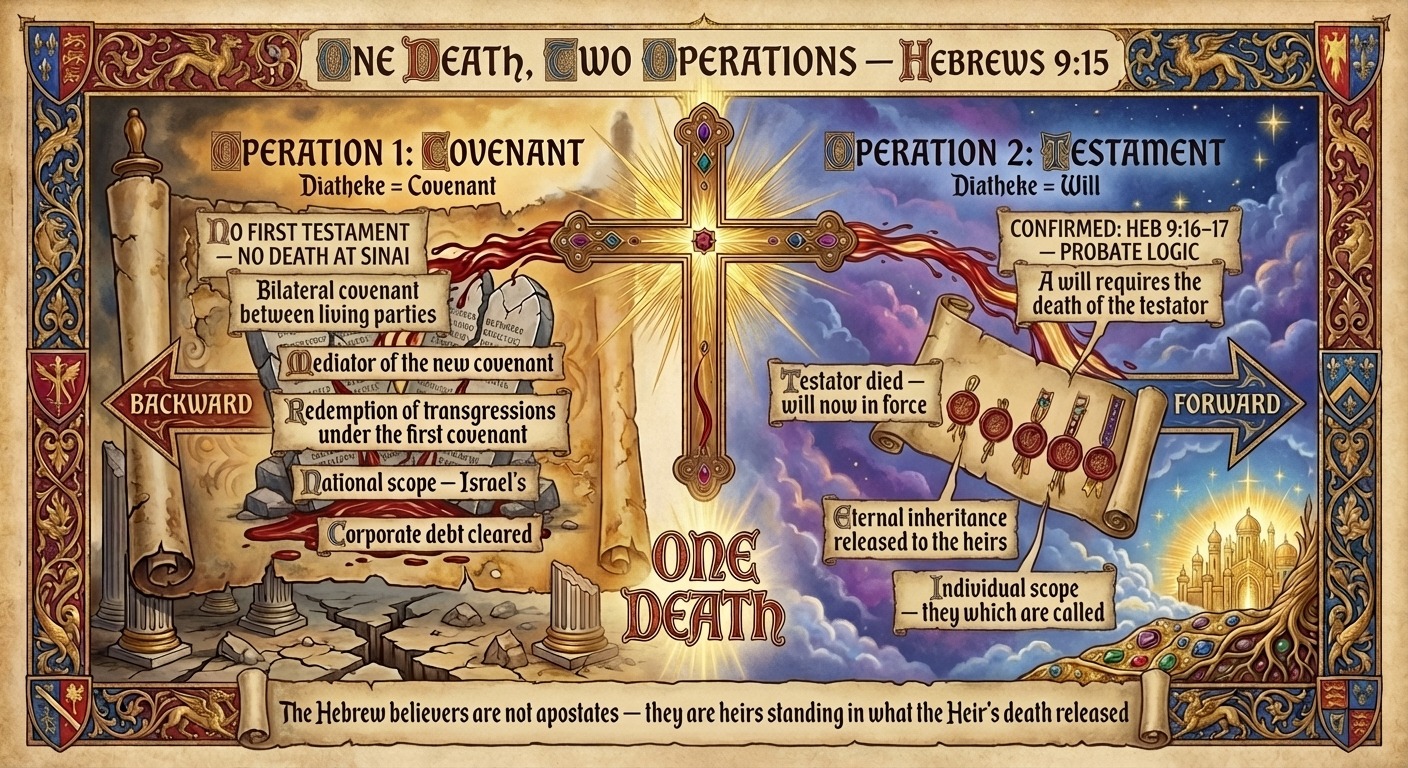
This chart shows the structure. What follows explains each part.
Hebrews 9:15: The Pivot from Covenant to Testament
The Inheritance Question
The book of Hebrews opens with inheritance. "God... hath in these last days spoken unto us by his Son, whom he hath appointed heir of all things" (Heb. 1:2). That's the subject of the letter — not a systematic comparison of old and new covenants, but the question of where the Hebrew believers stand now that the Heir has come, has died, and has entered into His inheritance. These are not Israelites functioning under the national program. They are "partakers of the heavenly calling" (Heb. 3:1), members of the body of Christ, and they are under enormous pressure to return to the temple, the feasts, the Levitical sacrifices — as though leaving those things behind constituted apostasy. The entire letter is the author's argument that they are not apostates. They are heirs. And everything in the letter — the superiority of the Son, the Melchizedek priesthood, the better covenant, the blood that speaks better things — serves that argument.
Why the New Covenant Appears in the Argument
When the author introduces the new covenant in chapters 8 and 9, he is not writing a covenant theology textbook. He is making a specific, strategic, two-pronged argument to Hebrew believers who are wavering.
The first prong is this: your own scriptures anticipated a change. Jeremiah prophesied a new covenant with the house of Israel and the house of Judah — "not according to the covenant that I made with their fathers" (Jer. 31:32). If a new covenant was prophesied, then the old one was already marked as temporary. The Mosaic system was never the final arrangement, even for Israel. So the fact that something has changed does not mean something has gone wrong. It means the plan is unfolding.
The second prong — and this is where Hebrews 9:15 does its real work — is that the death of Christ didn't only set up a better covenant for Israel's future national restoration. It activated a testament. A will. And that will releases the eternal inheritance to the called heirs right now. The Hebrew believers aren't in apostasy for leaving the temple. They're standing in their inheritance because the Heir died, the will is in force, and they are named in it.
The new covenant material is not the destination of the argument. It's the clearing argument that opens the door to the testament — which is the actual subject of the letter from start to finish.
Hebrews 9:15 — The Pivot Verse
The verse reads: "And for this cause he is the mediator of the new testament, that by means of death, for the redemption of the transgressions that were under the first testament, they which are called might receive the promise of eternal inheritance." The KJV renders diatheke as "testament" throughout, but the Greek word carries a double meaning — it can signify either a covenant, a bilateral arrangement between living parties, or a testament, a will activated by the death of the one who wrote it. The author of Hebrews is not careless with this word. He is standing at the exact hinge where both senses are simultaneously at work, and the text itself gives you the key to knowing which sense is operative at each point in the sentence.
How We Know: The "First Testament" That Wasn't
Here's where precision matters. The verse refers to "the transgressions that were under the first diatheke." Now ask the question: was there ever a first testament? Was there a will activated by a death at Sinai? No. There was a covenant — a bilateral arrangement between God and Israel, with terms both parties were obligated to uphold. Nobody died to activate a will under Moses. The Mosaic arrangement required two living parties — God setting the terms, Israel agreeing to keep them. And Israel broke them. You can only break something that requires your participation. A will cannot be broken by its beneficiaries. A covenant can.
So when the author says "the transgressions under the first diatheke," the word has to mean covenant, because a testament requires a death and there was no death of a testator at Sinai. The first diatheke was entered into, maintained, and ultimately violated by living parties. That's covenant territory by definition. And the work Christ accomplishes with respect to that first arrangement is covenantal: He is the mediator of the new covenant, and by His death, the accumulated transgressions of the nation under the old covenant are redeemed. The terms here are all covenant language — "mediator" (one who stands between parties), "redemption of transgressions" (the clearing of corporate guilt), "first covenant" (the Mosaic arrangement). This is national. This is the new covenant doing its specific work: clearing the debt of a nation that broke the old arrangement so that nation can be reconstituted.
But notice — the author is not telling the Hebrew believers that they are under this new covenant. He is telling them that this covenantal work has been accomplished, that it confirms the change their own scriptures anticipated, and that it clears the ground for what he's actually driving toward.
The Pivot: From Covenant to Testament
And then the sentence pivots. "That they which are called might receive the promise of eternal inheritance." Watch how the terrain shifts. An eternal inheritance is not a covenant provision — covenants involve terms, conditions, and the possibility of forfeiture, as the old covenant proved. An eternal inheritance is testament language: the Testator has died, the will is in force, and the heirs named in the will receive what was promised. The inheritance in view is not the tribal land allotments of millennial Israel — those are conditional and temporal while the occupants are mortal. Nor is it simply eternal life conceived as a new covenant benefit. It is the testament estate of the risen Heir — "the world" (Romans 4:13), "all things" (Hebrews 1:2) — now distributed to "they which are called" because the death that activates the will has occurred.
And this is what the Hebrew believers needed to hear. They are not apostates who abandoned the temple. They are heirs who have received the inheritance. The Heir died. The will is in force. They are named in it. Going back to the temple would not be faithfulness — it would be stepping out of the inheritance to return to an arrangement that was already marked for obsolescence by their own prophets.
How We Know the Shift: The Probate Logic of 9:16–17
How do we know diatheke has shifted to its testamentary sense? Because the author tells us explicitly. Hebrews 9:16–17: "For where a testament is, there must also of necessity be the death of the testator. For a testament is of force after men are dead: otherwise it is of no strength at all while the testator liveth." He is not explaining covenant ratification. He is explaining probate. A will has no force while the person who wrote it is alive. The moment He dies, the will is activated and the inheritance passes to the heirs. The author has moved from covenant mechanics to testament mechanics within the span of three verses, and the transition is not accidental — it is the theological point of the entire letter. The death of Christ is the hinge. Looking backward, it redeems the transgressions under the first covenant. Looking forward, it activates the will and releases the eternal inheritance to the heirs.
Confirmation: The Ministry That Proves the Testament
There's a confirming proof in Paul's own usage that most modern translations obscure. In 2 Corinthians 3:6, Paul calls himself a "minister of the new testament" — and the KJV is faithful to translate it that way, because the logic of the passage demands it. Modern translations that render this as "ministers of a new covenant" are importing a theological assumption that flattens the very distinction Paul is making.
Here's why it matters. The new covenant — the one prophesied in Jeremiah 31 — has a defining characteristic that distinguishes it from every other arrangement in Scripture: it eliminates mediated knowledge. "They shall all know me, from the least of them unto the greatest of them" (Jer. 31:34). Under the new covenant, there is no minister standing between God and His people distributing knowledge. The knowledge is immediate, direct, unmediated. That's what makes it "new" relative to the old covenant, which required a priesthood to teach and mediate.
So if Paul has a ministry — if he is a minister — then by definition he cannot be operating under the new covenant, because the new covenant doesn't produce ministers. It produces a nation that doesn't need them. What Paul is ministering is the testament — the will of the Heir. He is a steward of the household, distributing the riches of the inheritance to the heirs through the knowledge of Christ. Apostles, prophets, evangelists, shepherds, and teachers (Ephesians 4:11) — these are testament functionaries, not covenant functionaries. Their job is to make known the contents of the will so that the heirs come into the knowledge of what they possess. The "ministry of the new testament" and the "ministry of the spirit" in 2 Corinthians 3:6–8 are testament administration language — a stewardship of Christ's riches for distribution among co-heirs.
This confirms the Hebrews argument independently. Hebrews tells you a will requires a death. Paul tells you a will requires ministers to distribute the estate. Both are testament mechanics. Neither is covenant mechanics. And both demonstrate that what the Church possesses is not a covenant arrangement with conditions and the possibility of forfeiture — it is an inheritance, activated by a death, distributed by stewards, and secured by the risen Heir who ever lives to administer what the will contains.
One Death, Two Distinct Operations
Hebrews 9:15 does not collapse the everlasting covenant into the new covenant. It does not treat all the benefits of Christ's death as flowing from the new covenant alone. It demonstrates, in a single sentence, why both categories are necessary — and it does so in service of the letter's central argument: the Hebrew believers are not apostates. They are heirs. The national redemption of Israel under the new covenant and the distribution of eternal inheritance to the called heirs under the testament are both accomplished by the blood of Christ, but they are grounded in different covenantal realities. And the text itself — through the impossibility of a "first testament," through the probate logic of 9:16–17, and through the ministerial confirmation of 2 Corinthians 3:6 — tells you exactly where one ends and the other begins.
Every chart in this series is free to explore online.
 Get the full chart set (PDF – $8)
Members get all PDFs included → Why Membership
Log in with an active membership to download printable PDFs on this site. Purchased on the shop? Access downloads from your shop account.
If you would like to help fund this work:
Based on the article:
The Everlasting Covenant
A Distinct Covenantal Category in Pauline Dispensational Theology. The full theological foundation paper is available to read online in Writings.
Read it free online