
Visual Theology – The Everlasting Covenant
The Visual Theology charts are designed to help you see the structure and movement of Scripture. They highlight patterns, contrasts, and developments that are often difficult to hold together when reading line by line.
These charts show the structure of the argument. The accompanying articles develop each part in full.
This approach follows a long tradition of visual teaching in the Church. The well-known charts of Clarence Larkin helped many grasp the broad outline of Scripture. In the same spirit, these charts aim to make visible what the Word of God is revealing.
Charts and teaching notes for the book of The Everlasting Covenant. Select a chart below to view the image and article.
Click chart to view larger
From the teaching in: The Everlasting Covenant
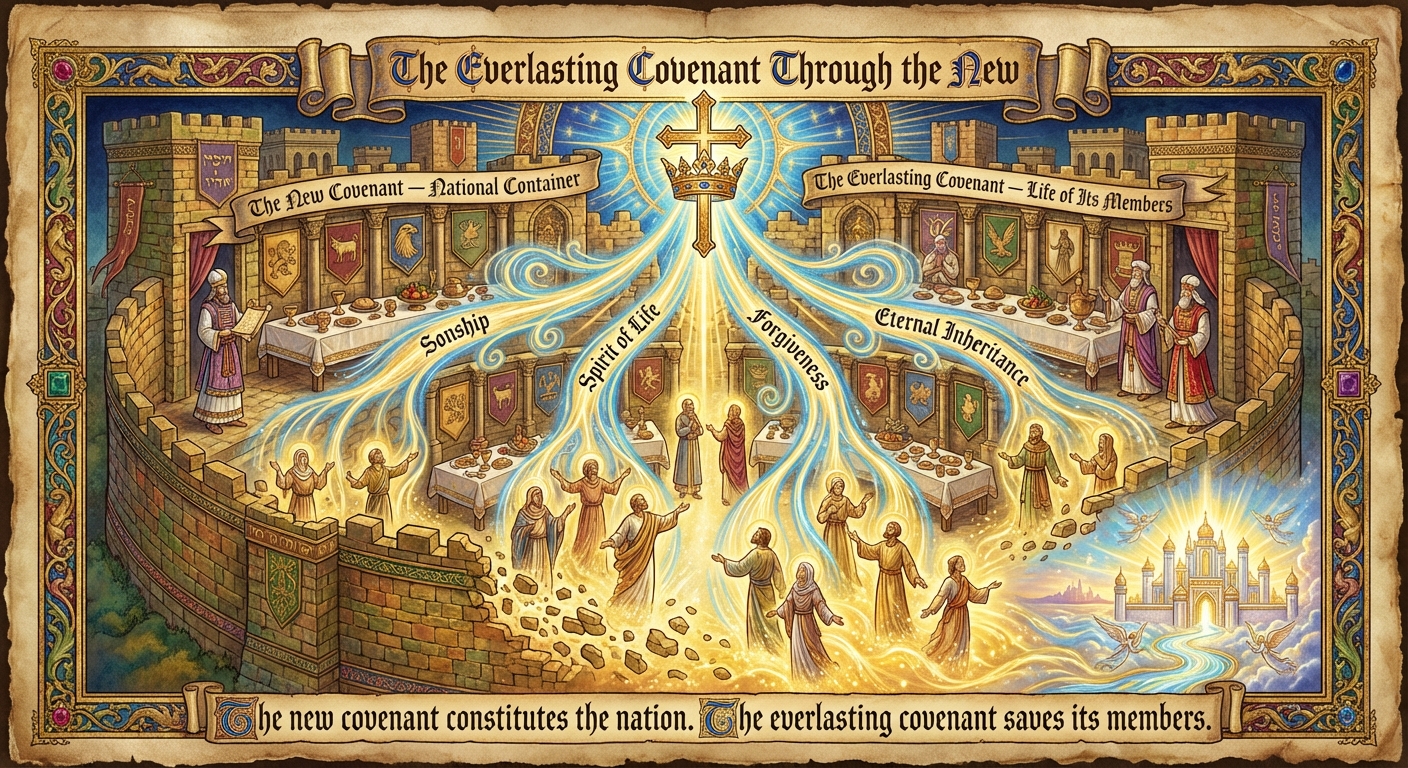
15a. The Everlasting Covenant Through the New Covenant
The Everlasting Covenant Through the New
This chart shows the structure. What follows explains each part.
The Everlasting Covenant Through the New
The New Covenant Constitutes the Nation — The Everlasting Covenant Saves Its Members
One of the most common errors in dispensational theology is the assumption that everything Israel receives in the millennium comes from the new covenant. The forgiveness, the Spirit, the sonship, the eternal inheritance — all of it is attributed to the new covenant as though it were a single package delivered under one covenantal heading. But this attribution cannot survive close examination, because the new covenant and the everlasting covenant are doing different things — even when they operate on the same people at the same time.
The New Covenant: A National Container
The new covenant reconstitutes Israel as a nation. It clears the corporate ledger — the accumulated guilt of transgressions committed under the Mosaic arrangement — and provides the framework within which mortal Israel functions as a priestly kingdom in the land during the millennium. The temple, the feasts, the tribal allotments, the priesthood to the nations — all of this is new covenant administration. It is the visible, corporate structure that allows God to deal with Israel as a recognizable and distinct people, even though they had been cut off.
The Everlasting Covenant: The Life of Its Members
But the individuals who compose that reconstituted nation are not saved by the new covenant. They are saved by the everlasting covenant — by the blood of Christ operating on its testamentary basis to forgive, regenerate, and adopt. The sonship they receive is Davidic in origin, rooted in the promise "I will be his father, and he shall be my son" (2 Sam. 7:14). The Spirit of life they possess is the Heir's distributed inheritance, flowing from the promises made to the Seed. The forgiveness of their individual sins is testament provision — the will of the Heir in force — not national covenant provision.
What the new covenant supplies is the national container. What the everlasting covenant supplies is what fills that container at the level of each person: forgiveness, sonship, the Spirit, eternal life. The everlasting covenant provisions flow through the new covenant arrangement without originating from it. They are older, deeper, and more permanent than the structure through which they pass.
What Survives the Millennium
This distinction becomes visible at the end of the millennium when the new covenant's administrative function is complete. Mortality gives way to resurrection. The temple disappears — "I saw no temple therein: for the Lord God Almighty and the Lamb are the temple of it" (Rev. 21:22). The tribal allotments as territorial assignments for mortals cease to be operative. The priestly nation as a mediating structure between God and the nations is no longer needed, because everyone in the New Jerusalem has full and unmediated knowledge of God.
What remains? Not the national container — that has served its purpose. What remains is what was always flowing through it: the everlasting covenant inheritance. Each individual who was part of reconstituted Israel carries into the eternal state the same thing every believer in every age possesses — sonship, the Spirit, eternal life, co-heirship with Christ. The scaffolding comes down. The building stands.
Why the Distinction Matters
This is why the everlasting covenant must be maintained as a distinct category. If all of Israel's millennial blessings are attributed to the new covenant, then when the new covenant's administration is complete, you have to explain what survived it. The answer is the everlasting covenant — the promises to the Seed, the testament of the Heir, the inheritance that was always underneath the national arrangement and that outlasts it into eternity.
The new covenant constitutes the nation. The everlasting covenant saves its members.
Every chart in this series is free to explore online.
 Get the full chart set (PDF – $8)
Members get all PDFs included → Why Membership
Log in with an active membership to download printable PDFs on this site. Purchased on the shop? Access downloads from your shop account.
If you would like to help fund this work:
Based on the article:
The Everlasting Covenant
A Distinct Covenantal Category in Pauline Dispensational Theology. The full theological foundation paper is available to read online in Writings.
Read it free online