
Visual Theology – The Everlasting Covenant
The Visual Theology charts are designed to help you see the structure and movement of Scripture. They highlight patterns, contrasts, and developments that are often difficult to hold together when reading line by line.
These charts show the structure of the argument. The accompanying articles develop each part in full.
This approach follows a long tradition of visual teaching in the Church. The well-known charts of Clarence Larkin helped many grasp the broad outline of Scripture. In the same spirit, these charts aim to make visible what the Word of God is revealing.
Charts and teaching notes for the book of The Everlasting Covenant. Select a chart below to view the image and article.
Click chart to view larger
From the teaching in: The Everlasting Covenant
16. The New Covenant as Millennial Administration
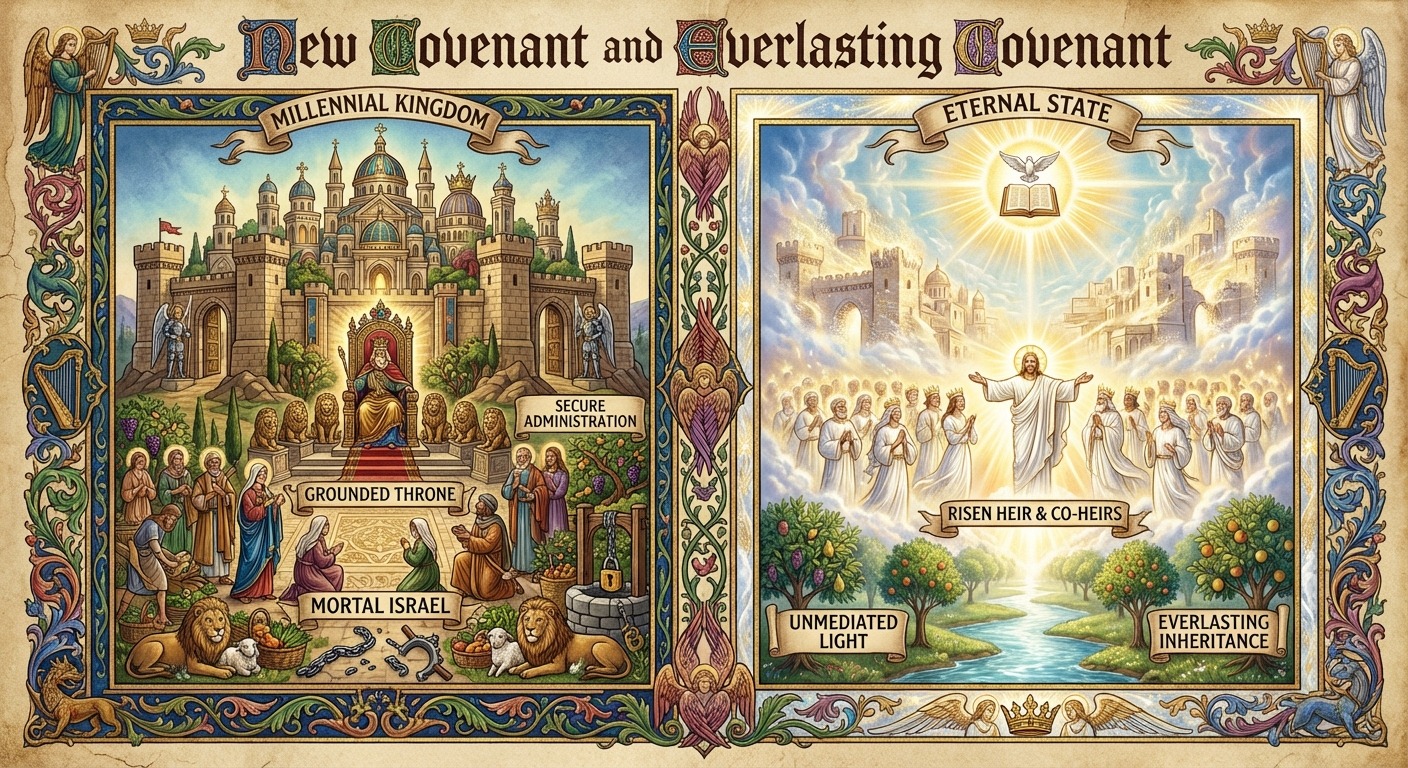
New Covenant and Everlasting Covenant
This chart shows the structure. What follows explains each part.
The New Covenant in the Divine Administration
The new covenant occupies a unique and crucial role in the divine administration of history, serving as the governing framework for the reconstituted nation of Israel during the millennial kingdom. This thousand-year period is marked by Christ’s reign from Jerusalem, with mortal Israel restored to their land and functioning as a holy nation and a kingdom of priests among the nations of the earth. The distinguishing feature of the new covenant is its capacity to secure Israel’s national fidelity in a way the old covenant could not. Under its terms, the failures of the old covenant—divorce, captivity, and loss of the land—are decisively prevented. The difference lies in the mechanism: it is Christ in them, not merely external law, that ensures the nation’s faithfulness. Yet, the function remains fundamentally administrative, designed for mortals living in the land.
Permanence and Function
It is essential to address the question of the new covenant’s permanence and its relation to eternity. The new covenant does not come to an end as the old covenant did, which was brought to a close by violation and divine divorce. In this respect, the new covenant is permanent: it is never broken and never superseded by a further covenant. However, its operative function is bound to the millennial period. During this era, mortal Israel requires a covenantal framework to structure its national life and priestly service among the nations. The new covenant provides exactly this, ensuring that the nation remains faithful and secure throughout the millennium.
The Transition from Millennium to Eternity
When the millennial kingdom concludes and mortality is swallowed up in resurrection, the administrative role of the new covenant is fulfilled. At this point, the nation is no longer composed of mortals in need of a covenant mechanism to guarantee faithfulness. Instead, the people are in resurrection, possessing all things in Christ as co-heirs of the testament inheritance. The need for an administrative covenant ceases, for the conditions that required it—mortality and the risk of failure—are gone.
The New Covenant and the Everlasting Covenant
In this way, the new covenant is not “eternal” in the same sense as the everlasting covenant. The everlasting covenant is eternal because it pertains to the Seed’s inheritance, which is the world to come and has no end. This covenant began as a promise to Abraham in Genesis 15 and finds its ultimate realization in the testament secured by Christ. The everlasting covenant is not an administrative arrangement for mortals, but the eternal testament in which Christ possesses all things and shares them with His co-heirs. As Ephesians 1:10 declares, it is “the dispensation of the fullness of times,” when God gathers together “all things in Christ, both which are in heaven, and which are on earth.”
Thus, the new covenant stands as a permanent, unbroken administration for mortal Israel during the millennium, perfectly suited to its purpose. But when that purpose is complete, what remains is the everlasting covenant—the testament, the inheritance, God dwelling with man in unmediated fellowship, and the Seed possessing the world in the world to come. The covenantal diversity of the ages is resolved into the unity of the everlasting covenant’s fulfillment, and the administrative scaffolding of the new covenant gives way to the boundless radiance of the eternal state.
Every chart in this series is free to explore online.
 Get the full chart set (PDF – $8)
Members get all PDFs included → Why Membership
Log in with an active membership to download printable PDFs on this site. Purchased on the shop? Access downloads from your shop account.
If you would like to help fund this work:
Based on the article:
The Everlasting Covenant
A Distinct Covenantal Category in Pauline Dispensational Theology. The full theological foundation paper is available to read online in Writings.
Read it free online