Visual Theology – The Everlasting Covenant
The Visual Theology charts are designed to help you see the structure and movement of Scripture. They highlight patterns, contrasts, and developments that are often difficult to hold together when reading line by line.
These charts show the structure of the argument. The accompanying articles develop each part in full.
This approach follows a long tradition of visual teaching in the Church. The well-known charts of Clarence Larkin helped many grasp the broad outline of Scripture. In the same spirit, these charts aim to make visible what the Word of God is revealing.
Charts and teaching notes for the book of The Everlasting Covenant. Select a chart below to view the image and article.
Click chart to view larger
From the teaching in: The Everlasting Covenant
1. Genesis 15 and the Unilateral Confirmation
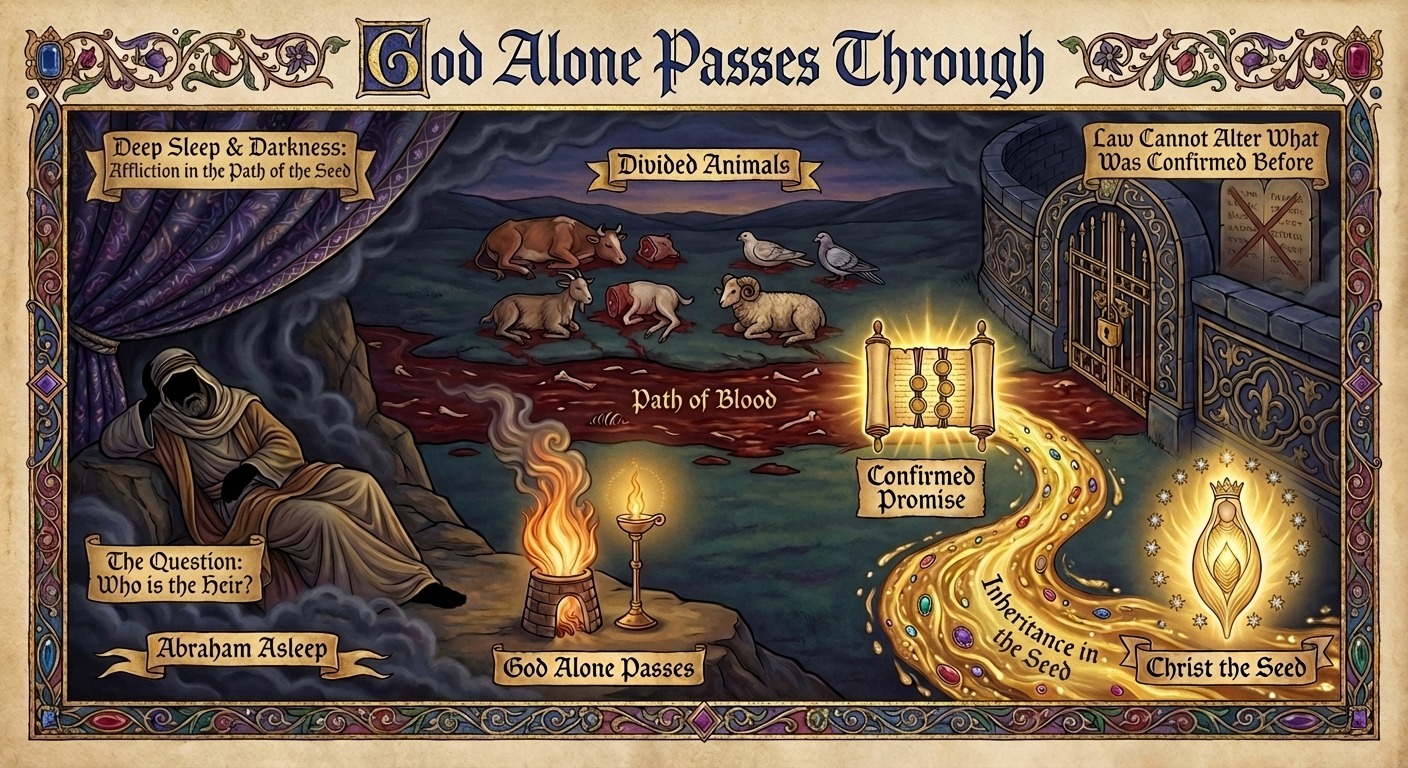
God Alone Passes Through
This chart shows the structure. What follows explains each part.
The Foundational Event
The foundational event for the everlasting covenant is the ratification ceremony recorded in Genesis 15. In this passage, God commands Abraham to prepare a specific sacrifice: a heifer, a she-goat, a ram, a turtledove, and a pigeon. Abraham obeys, dividing the animals as instructed. At this critical moment, Abraham falls into a deep sleep, and a horror of great darkness descends upon him. While Abraham lies unconscious, a smoking furnace and a burning lamp move between the pieces of the divided sacrifice (Genesis 15:9–17). The ancient Near Eastern significance of this act is decisive: to walk between the pieces is to invoke upon oneself the fate of the slain animals should the covenant be broken. The party who traverses the path of blood assumes the full weight of the obligation.
What is most striking in Genesis 15 is that only God passes through the sacrificial path. Abraham, rendered passive by sleep and darkness, contributes nothing to the ratification — not his obedience, not his faith as a condition, and not even his presence as a conscious participant. His faith had already been counted for righteousness in Genesis 15:6, prior to and apart from the ceremony. The covenant is thus not a bilateral contract between God and Abraham, but a unilateral commitment made by God to Himself on behalf of Abraham’s seed.
The Focus of the Promise: The Seed, Not the Land
The central question driving Genesis 15 is not territorial but filial. Abraham’s concern is explicit: “What wilt thou give me, seeing I go childless… and, lo, one born in my house is mine heir?” (Genesis 15:2–3). The issue is not the possession of land, but the identity of the heir. The promise, therefore, is directed toward the Seed through whom the inheritance would come, not the land as an end in itself.
This is critical: Genesis 15 is not the making of a covenant, but the confirmation of one already given in promise. The ceremony answers Abraham’s question regarding the heir and secures the certainty of that Seed. The land functions within the promise, but it is not the focus of the oath. The focus is the One who inherits.
The deep sleep and the horror of great darkness that fall upon Abraham are not incidental. They introduce the reality that the trajectory of the Seed will pass through affliction and opposition. This is first outlined in terms of Israel’s bondage in Egypt (Genesis 15:13–14), but the pattern extends beyond the nation to the Seed Himself. The path to inheritance is marked by suffering.
Abraham, in type, is brought into the understanding that the promise would be secured through death and resurrection. This is not abstract. By the time of Isaac’s offering in Genesis 22, Abraham has come to reckon that “God was able to raise him up, even from the dead” (Hebrews 11:19). What was veiled in Genesis 15 becomes clearer: the Seed who inherits does so through suffering, and ultimately through death and life out from the dead.
This is why the unilateral passing through the pieces matters so profoundly. God alone assumes not only the obligation, but also the path of suffering bound up with the fulfillment of the promise. The covenant is not merely secured by God—it is fulfilled in the Seed who bears its full weight.
Paul’s Interpretive Key
The Apostle Paul’s exposition in Galatians 3:15–18 provides the interpretive key. Paul insists that the promises were made not “to seeds, as of many; but as of one, And to thy seed, which is Christ” (Galatians 3:16). The covenant was “confirmed before of God in Christ” (Galatians 3:17), and this confirmation is decisive: it cannot be annulled or modified by the law, which came 430 years later. Paul’s argument is legal and covenantal: once a covenant is ratified, its terms are inviolable. No subsequent legislation — not even the Mosaic covenant — can alter or add conditions to what God has already confirmed.
This reality is foundational for understanding the everlasting covenant as a distinct and self-contained category. The inheritance, Paul says, “is not of the law” but “of promise” (Galatians 3:18). What God confirmed with the Seed in Genesis 15 stands logically, temporally, and legally prior to any arrangement made with Israel as a nation. The entire structure of the everlasting covenant rests on the unilateral action of God, who alone assumed the obligation and the curse, securing the promise for the Seed, which is Christ.
The Ground of the Covenant
In this framework, Abraham is not a co-maker or co-maintainer of the covenant. He is a spectator to its ratification. The stability and certainty of the everlasting covenant derive from God’s solitary oath. The path of blood is walked by God alone, and the inheritance flows directly from the confirmed promise to the Seed, untouched by any later national or legal arrangement. This is the ground upon which the everlasting covenant stands: a covenant ratified and secured by God alone, with Abraham — and all who are in the Seed — as the beneficiaries of a promise that can neither be broken nor amended.
Every chart in this series is free to explore online.
 Get the full chart set (PDF – $8)
Members get all PDFs included → Why Membership
Log in with an active membership to download printable PDFs on this site. Purchased on the shop? Access downloads from your shop account.
If you would like to help fund this work:
Based on the article:
The Everlasting Covenant
A Distinct Covenantal Category in Pauline Dispensational Theology. The full theological foundation paper is available to read online in Writings.
Read it free online