
Visual Theology – The Everlasting Covenant
The Visual Theology charts are designed to help you see the structure and movement of Scripture. They highlight patterns, contrasts, and developments that are often difficult to hold together when reading line by line.
These charts show the structure of the argument. The accompanying articles develop each part in full.
This approach follows a long tradition of visual teaching in the Church. The well-known charts of Clarence Larkin helped many grasp the broad outline of Scripture. In the same spirit, these charts aim to make visible what the Word of God is revealing.
Charts and teaching notes for the book of The Everlasting Covenant. Select a chart below to view the image and article.
Click chart to view larger
From the teaching in: The Everlasting Covenant
12. Four Dimensions of the Spirit's Work
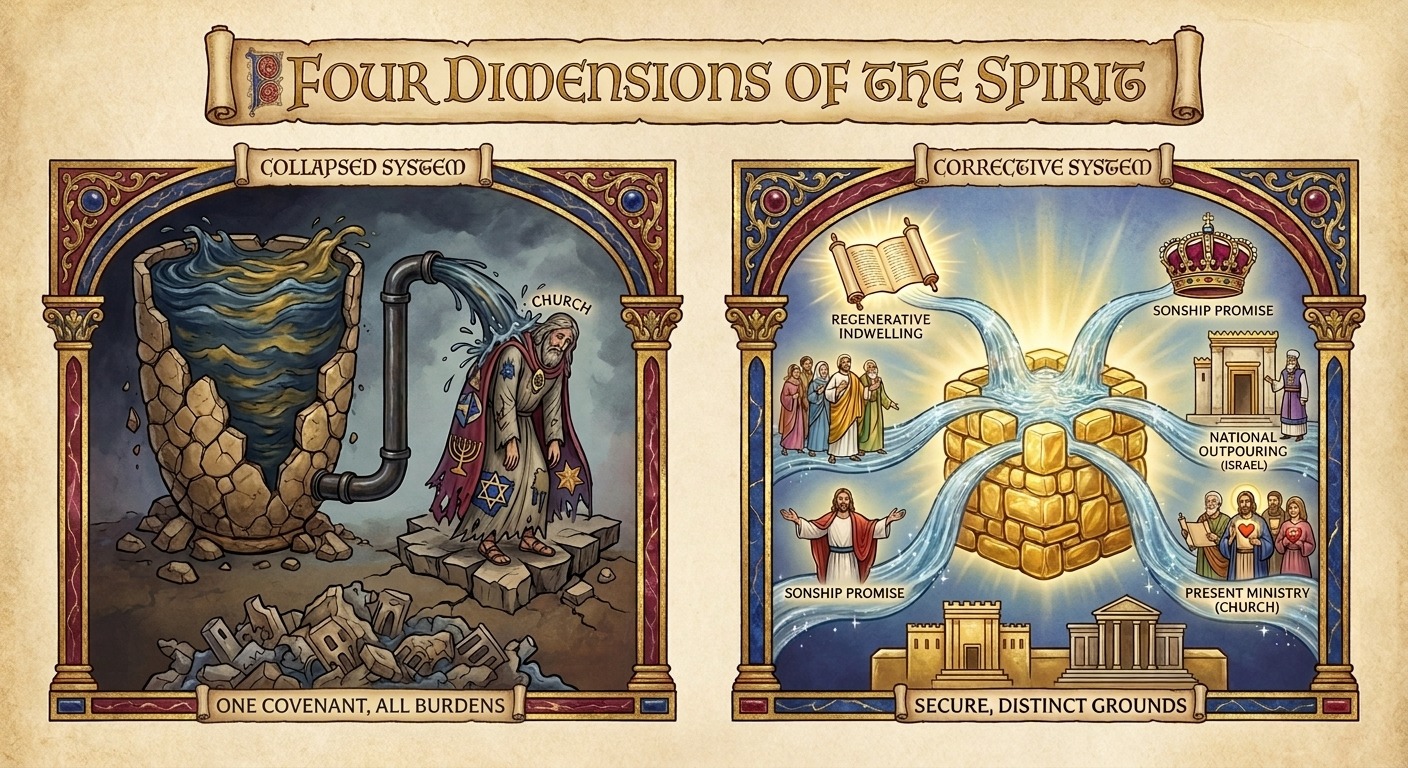
Four Dimensions of the Spirit
This chart shows the structure. What follows explains each part.
Four Dimensions of the Spirit
We've seen that the blood of Christ operates on two distinct legal bases. The same kind of distinction applies to the Spirit's work — and this is where a lot of theology gets flattened, because people assume the Spirit does essentially one thing and then try to fit every reference to the Spirit into that single category. Scripture actually distinguishes the Spirit's work into at least four dimensions, each grounded in a different covenantal or dispensational context.
The Four Dimensions of the Spirit's Work
The work of the Spirit in the eschatological program of God is not a monolithic reality, but is distinguished in Scripture into at least four dimensions, each grounded in a distinct covenantal or dispensational context. The failure to maintain these distinctions leads to theological confusion, particularly the collapse of the Church and Israel into a single category, which the New Testament does not permit.
The Spirit of Life
The first dimension is the Spirit of life. This is the salvific, regenerative indwelling by which the risen Christ imparts His life to those who believe. It is a provision of the everlasting covenant, rooted in the promises to the Seed and dependent on the activation of the testament by the death and resurrection of Christ. As Paul writes, “the last Adam was made a quickening spirit” (1 Corinthians 15:45). Prior to the cross, believers such as Abraham were justified by faith, but did not receive the regenerative indwelling; instead, they experienced theophanies or temporary anointings. David received a kingly anointing tied to his national office, which, though more permanent, was revocable and distinct from the sealed indwelling that marks the Church. The indwelling Spirit of life as the distributed inheritance of the Heir is a reality that became possible only after Christ’s resurrection. It is not contingent on any national covenant, temple, or observance of feasts, but flows directly from the promises to the Seed and is distributed by the risen Heir to all who believe.
The Spirit of Sonship
The second dimension is the Spirit of sonship, the relational reality of being made children of God. This is expressed in Romans 8:15: "ye have received the Spirit of adoption, whereby we cry, Abba, Father." The covenantal ground of this sonship is the Davidic promise, "I will be his father, and he shall be my son" (2 Samuel 7:14). Sonship belongs to Christ by right and is shared with believers through union with Him — and it is Christ Himself, in His high priestly role, who makes this sharing explicit. In Hebrews 2:12, quoting Psalm 22, He declares: "I will declare thy name unto my brethren, in the midst of the church will I sing praise unto thee." He is not ashamed to call them brethren — which is to say, He is not ashamed to name them as sharers in what belongs to Him by right as the Son. This is the high priestly mediation of sonship: the Priest who stands before the Father and declares the name of God into the assembly, drawing the brethren into the filial reality He inhabits. Galatians 4:6 makes the mechanics explicit — "because ye are sons, God hath sent forth the Spirit of his Son into your hearts, crying, Abba, Father." It is the Spirit of the Son that cries — not a generic spirit of adoption, but the very relational consciousness of the Son Himself, distributed into the believer by the risen Heir. Romans 8:15–17 then extends this into its full inheritance logic: the Spirit of adoption leads to joint-heirship with Christ, which is the everlasting covenant ground of the Church's inheritance. This is also the substance of the high priestly prayer of John 17 — "that they may be one, even as we are one" — Christ asking the Father to bring the brethren into the same filial unity that belongs to Him. Sonship is not merely a relational benefit; it is the mode by which the Heir shares what He is with those who are in Him. And it is distinct from the new covenant's promise of the Spirit, which is not about filial relationship but about national equipping for covenant faithfulness.
The Spirit for National Service
The third dimension is the outpouring of the Spirit for national service, which belongs properly to the new covenant. In Ezekiel 36:27, God promises to put His Spirit within Israel and cause them to walk in His statutes; Joel 2:28–29 prophesies the pouring out of the Spirit upon all flesh with prophetic manifestation. The context is the reconstitution of Israel as a functioning priestly nation in the millennial kingdom. This outpouring is the Spirit as the power for covenant faithfulness, enabling mortal Israel to keep the terms of the new covenant. Under this covenant, “they shall all know me, from the least of them unto the greatest of them” (Jeremiah 31:34). This is a direct, unmediated knowledge of God, without minister or intermediary. The Spirit’s equipping role is to produce this immediate knowledge and to sustain the national faithfulness that keeps Israel in the land during the millennium. This dimension is national, temporal, and distinct from the indwelling and sonship experienced by the Church. It is therefore a category mistake to appeal to Ezekiel 36 as though it were the source text for adoption. Ezekiel is about a nation enabled to walk; Romans and Galatians are about sons brought into the cry of the Son.
The Ministry of the New Testament
The fourth dimension is the ministry of the new testament during the present dispensation. The Spirit’s operation in the Church is not reducible to regenerative indwelling, Davidic sonship, or new covenant national equipping. The Church is not a nation, has no land, and keeps no feasts. Rather, the Spirit works through the Church by means of gifted stewards—apostles, prophets, evangelists, shepherds, and teachers (Ephesians 4:11)—whose ministry is to distribute the riches of the household to the heirs through the knowledge of Christ. Paul refers to this as “the ministry of the new testament” and “the ministry of the spirit” (2 Corinthians 3:6–8), not because the Church is under the new covenant, but because the testament—the will of the Heir—requires ministers to make its contents known. Through this ministry, the knowledge of Christ produces in the believer a “weight of glory” (2 Corinthians 4:17) written on the heart, making believers “epistles of Christ... written not with ink, but with the Spirit of the living God” (2 Corinthians 3:3). This glory is not yet manifest; it will be revealed in the age to come as a heavenly glory distinct from the earthly glory of the reconstituted nation. This ministry of the Spirit is temporary, operative during “the dispensation of the grace of God” for the Gentiles (Ephesians 3:2), and will give way to its full realization when the Church is presented to Christ in glory. It is grounded in the testament and the mystery, not in the new covenant’s national equipping.
The Necessity of Distinction
To conflate these four dimensions is to misattribute all Spirit-work to the new covenant, which then necessitates placing the Church under the new covenant and erases the essential distinction between Israel and the Church. Each dimension is irreducible to the others, and the preservation of their differences is vital for a sound understanding of the Spirit’s work in the purposes of God.
Four dimensions of the Spirit's work — each distinct, each grounded in its proper covenantal context. The same precision needs to be applied to the concept of inheritance, because "inheritance" in Scripture also operates in two senses, and conflating them is what produces confusion about Israel's land promises vs. the Church's heavenly position. That's next.
Every chart in this series is free to explore online.
 Get the full chart set (PDF – $8)
Members get all PDFs included → Why Membership
Log in with an active membership to download printable PDFs on this site. Purchased on the shop? Access downloads from your shop account.
If you would like to help fund this work:
Based on the article:
The Everlasting Covenant
A Distinct Covenantal Category in Pauline Dispensational Theology. The full theological foundation paper is available to read online in Writings.
Read it free online