Visual Theology – The Everlasting Covenant
The Visual Theology charts are designed to help you see the structure and movement of Scripture. They highlight patterns, contrasts, and developments that are often difficult to hold together when reading line by line.
These charts show the structure of the argument. The accompanying articles develop each part in full.
This approach follows a long tradition of visual teaching in the Church. The well-known charts of Clarence Larkin helped many grasp the broad outline of Scripture. In the same spirit, these charts aim to make visible what the Word of God is revealing.
Charts and teaching notes for the book of The Everlasting Covenant. Select a chart below to view the image and article.
Click chart to view larger
From the teaching in: The Everlasting Covenant
11. One Blood, Two Covenantal Bases
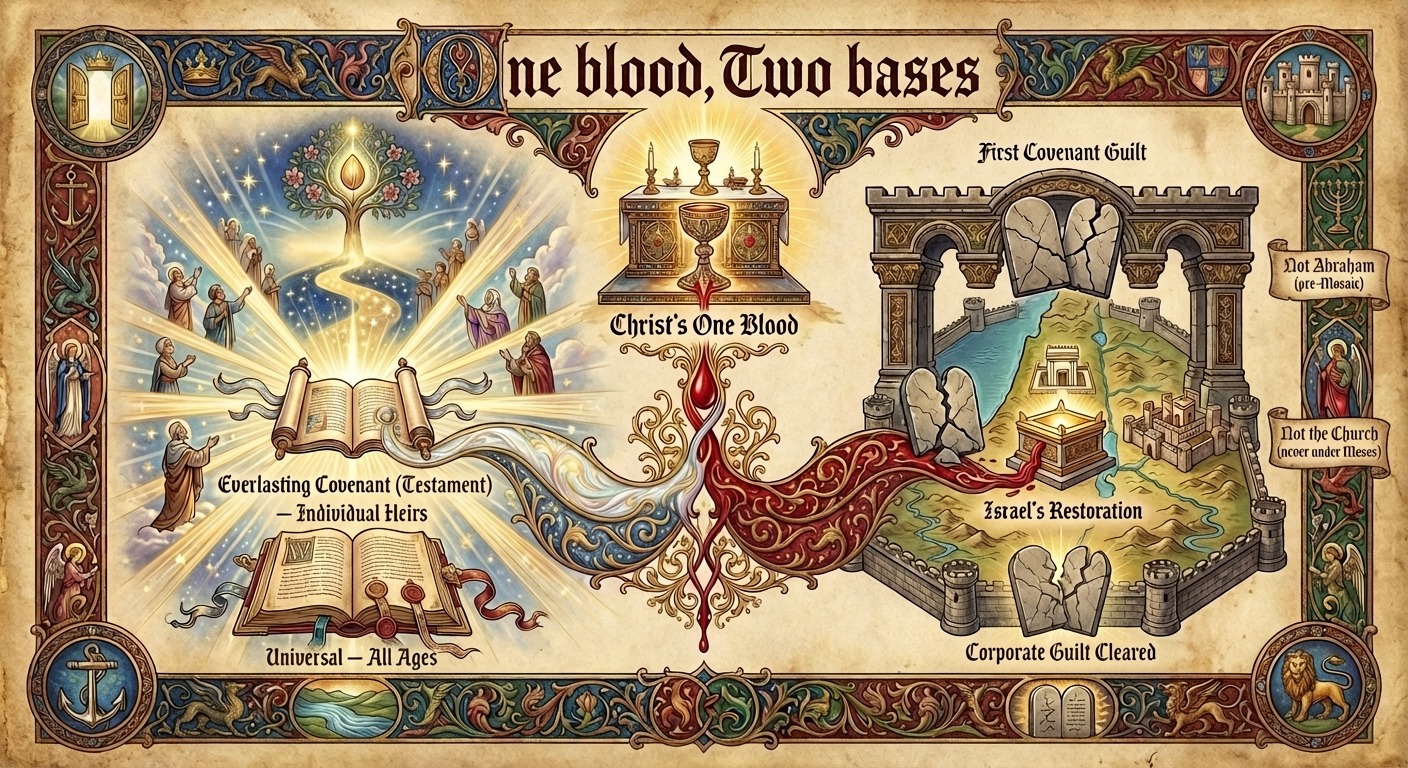
One Blood, Two Bases
This chart shows the structure. What follows explains each part.
One Blood, Two Bases
Everything we've traced so far has been building toward a question that trips up a lot of careful readers: if the blood of Christ is identified in Scripture with both the everlasting covenant and the new covenant, doesn't that mean they're ultimately the same thing? We've just seen that the Church's present ministry is testamentary rather than new-covenant administration, but the question still presses at the level of blood. The answer requires us to be precise about what the blood is actually doing in each case — because one blood accomplishes two legally distinct works.
The Blood of Christ: Two Covenantal Operations
The blood of Christ occupies a unique place in the scriptural testimony, being identified both as the “blood of the everlasting covenant” (Hebrews 13:20) and the blood of the “new testament” or “new covenant” (Matthew 26:28; Luke 22:20; 1 Corinthians 11:25). This dual identification has led many to conclude that the everlasting covenant and the new covenant are simply two names for the same reality. However, a careful reading of the biblical text shows that while the blood is one, the covenantal basis for its application is distinct, depending on the purpose being accomplished.
The Everlasting Covenant: A Testament for Individuals
When the blood of Christ is applied to the individual believer for the forgiveness of sins and the granting of eternal life, it operates on the basis of the everlasting covenant. This covenant was ratified in Genesis 15 with the promises to the Seed. Here, the legal structure is that of a testament: the Testator has died, the will is in force, and the inheritance is distributed unconditionally to all who are in Christ by faith. In this testament territory, the inheritance is not tied to national status, land, or Mosaic law, but is the direct, unconditional gift to those named in the will. Every believer, in every age, receives forgiveness, life, and inheritance on this ground, apart from any national or corporate framework.
The New Covenant: A National Restoration for Israel
By contrast, when the blood of Christ is applied to the nation of Israel for the “redemption of the transgressions that were under the first testament” (Hebrews 9:15), it operates on the basis of the new covenant. This application is strictly national. It addresses the corporate guilt accumulated by Israel under the Mosaic administration. The scope is limited: Abraham is not included, for he lived and died before the first covenant existed—he committed no transgressions under it. The Church is not included, for it was never under the first covenant. The new covenant pertains specifically to the nation that was under the old covenant, broke it, and is to be reconstituted under a new arrangement. The blood here does not distribute testamentary inheritance to individual heirs, but clears the corporate guilt of the nation, enabling its restoration and future covenant faithfulness.
One Blood, Two Distinct Works
It is crucial to see that the distinction is not between two different bloods, but between two different covenantal operations of the same blood. The everlasting covenant explains how every individual believer receives forgiveness, life, and inheritance—testamentary benefits flowing from the promises to the Seed. The new covenant explains how the nation of Israel is corporately restored from the consequences of its national covenant failure—covenantal benefits that address a unique historical and legal problem.
Both operations require the death of Christ, but neither is reducible to the other. The one blood accomplishes two distinct works: it activates the testament for individual heirs, and it redeems the nation for corporate restoration. And here a further clarification is essential: testament heirship is not a Church-age innovation. Every individual sheep in every age — Abel, Abraham, David, the OT saints, tribulation believers, the individual members of millennial Israel — is redeemed on the testamentary basis of the everlasting covenant. The new covenant clears Israel's national ledger; it does not save Israel's individuals. Those individuals are saved the same way every sheep has always been saved: by the blood of the everlasting covenant, applied on the basis of the Testator's death. What distinguishes the Church is not that she alone is a company of testament heirs, but that she occupies that position now, in the present dispensation, before resurrection, through the indwelling Spirit of the risen Heir. In every other age, individual saints enter their full testament standing at resurrection. The Church carries it in the body. This distinction preserves the integrity of God's dealings with individuals and with Israel, and guards against the confusion that arises when the everlasting covenant and the new covenant are collapsed into a single, undifferentiated category.
One blood, two covenantal operations. The same precision applies to the Spirit's work — because the Spirit is identified with regeneration, with sonship, with national equipping, and with the Church's present ministry, and those are not all the same thing either. That's the subject of the next chart.
Every chart in this series is free to explore online.
 Get the full chart set (PDF – $8)
Members get all PDFs included → Why Membership
Log in with an active membership to download printable PDFs on this site. Purchased on the shop? Access downloads from your shop account.
If you would like to help fund this work:
Based on the article:
The Everlasting Covenant
A Distinct Covenantal Category in Pauline Dispensational Theology. The full theological foundation paper is available to read online in Writings.
Read it free online