
Visual Theology – The Everlasting Covenant
The Visual Theology charts are designed to help you see the structure and movement of Scripture. They highlight patterns, contrasts, and developments that are often difficult to hold together when reading line by line.
These charts show the structure of the argument. The accompanying articles develop each part in full.
This approach follows a long tradition of visual teaching in the Church. The well-known charts of Clarence Larkin helped many grasp the broad outline of Scripture. In the same spirit, these charts aim to make visible what the Word of God is revealing.
Charts and teaching notes for the book of The Everlasting Covenant. Select a chart below to view the image and article.
Click chart to view larger
From the teaching in: The Everlasting Covenant
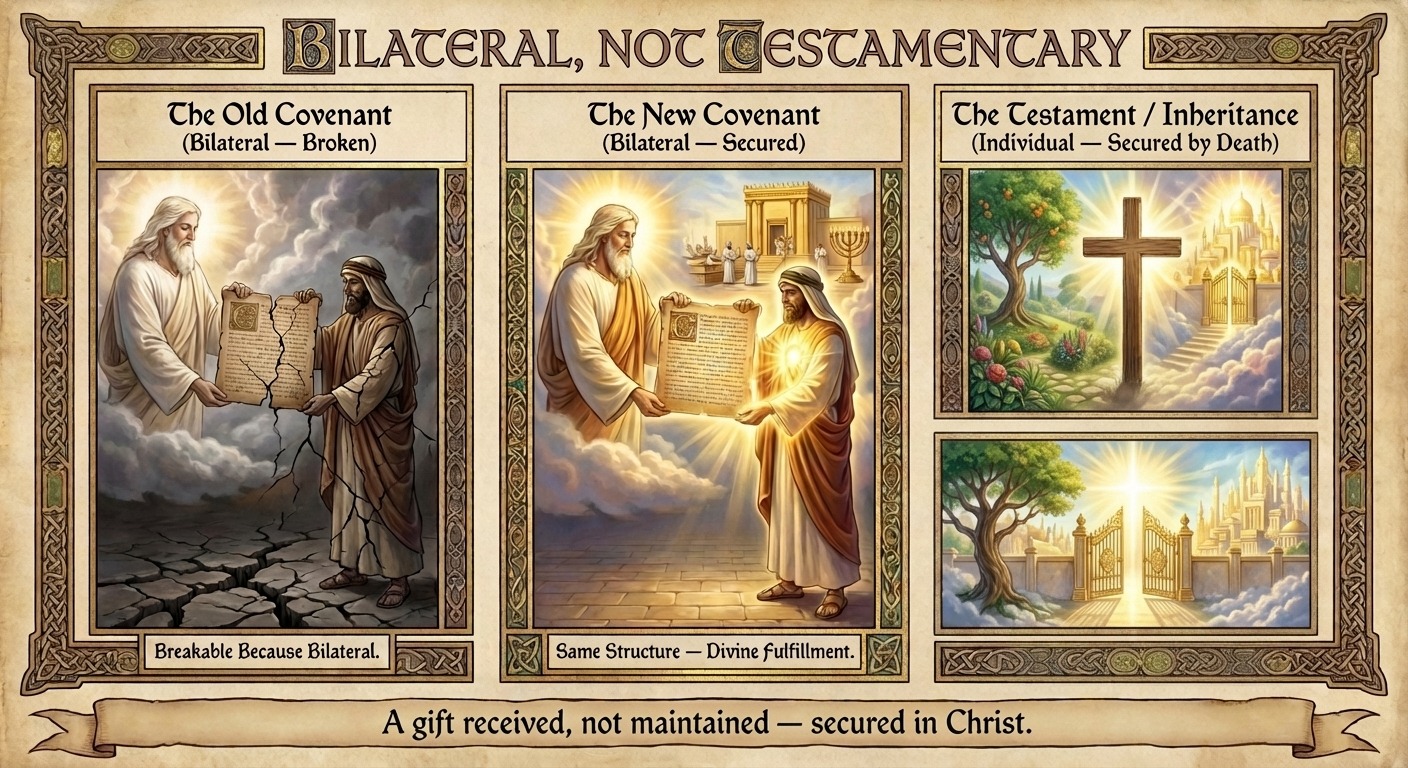
7. The Structure of the New Covenant: Bilateral, Not Testamentary
Bilateral, Not Testamentary
This chart shows the structure. What follows explains each part.
The New Covenant in Jeremiah 31:31–34
The new covenant prophesied in Jeremiah 31:31–34 is addressed directly to “the house of Israel and the house of Judah.” Its terms are not vague or universal but are specific and national: God will write His law on their hearts, all will know Him directly, and He will forgive their iniquity. The passage itself draws a sharp contrast with “the covenant that I made with their fathers in the day that I took them by the hand to bring them out of the land of Egypt; which my covenant they brake” (Jeremiah 31:32). The old covenant’s breakability—its capacity to be violated and, in fact, its historical breach by the nation—is of enormous theological significance. If the arrangement had been unilateral and unconditional in the manner of a testament, there would have been nothing to break. A will cannot be broken by its heirs. The old covenant was broken precisely because it was bilateral in structure: it required something of the nation, and the nation failed to supply it.
A Transformed Means of Compliance
The new covenant addresses this fatal deficit not by erasing the bilateral structure, but by transforming the means of compliance. The terms remain: Israel must function as a holy nation and a kingdom of priests. There will still be feasts, a temple, and a sacrificial system, as outlined in Ezekiel 40–48. The nation is still commanded to walk in God’s statutes. What is new is not the removal of obligation, but the source of its fulfillment. God Himself, through the indwelling Christ, produces in the people the faithfulness that the old covenant required but they could not supply. The bilateral structure is not replaced by a one-sided grant; rather, the mechanism shifts so that God operates both sides of the agreement. The nation is still required to walk, but now Christ in them does the walking.
Covenant Versus Testament
This structure is categorically distinct from a testament. In a testament, the beneficiary receives unconditionally because the testator has died and the will is in force. The arrangement is passive: the heir receives because the will cannot be contested or broken by the recipient. By contrast, in the new covenant, Israel occupies the land and serves as God’s priestly kingdom because the terms of a covenant are actively kept—kept by Christ in them, but kept nonetheless. If the terms were not being fulfilled, the arrangement would not stand. The very existence of a “new” covenant is proof that the “old” one was a breakable, bilateral arrangement, and the new covenant retains that structure while ensuring it cannot fail.
A Restored and Secured Relationship
Thus, the new covenant is not a testamentary dispensation of blessing detached from historical and relational terms. It is a restored and transformed bilateral covenant, national in scope, with the indwelling Christ guaranteeing the faithfulness that Israel failed to supply. The nation’s priestly vocation, the temple, the feasts, and the sacrificial system remain as covenantal realities. What has changed is not the existence of terms, but the certainty of their fulfillment—God Himself, in Christ, keeps the covenant from within the people, securing the relationship on both sides. The new covenant, therefore, is not a will but a living, bilateral bond, upheld by divine initiative without abolishing the structure that defines covenantal life with God.
Every chart in this series is free to explore online.
 Get the full chart set (PDF – $8)
Members get all PDFs included → Why Membership
Log in with an active membership to download printable PDFs on this site. Purchased on the shop? Access downloads from your shop account.
If you would like to help fund this work:
Based on the article:
The Everlasting Covenant
A Distinct Covenantal Category in Pauline Dispensational Theology. The full theological foundation paper is available to read online in Writings.
Read it free online