Visual Theology – The Everlasting Covenant
The Visual Theology charts are designed to help you see the structure and movement of Scripture. They highlight patterns, contrasts, and developments that are often difficult to hold together when reading line by line.
These charts show the structure of the argument. The accompanying articles develop each part in full.
This approach follows a long tradition of visual teaching in the Church. The well-known charts of Clarence Larkin helped many grasp the broad outline of Scripture. In the same spirit, these charts aim to make visible what the Word of God is revealing.
Charts and teaching notes for the book of The Everlasting Covenant. Select a chart below to view the image and article.
Click chart to view larger
From the teaching in: The Everlasting Covenant
19. The Reductive Dispensationalist Collapse
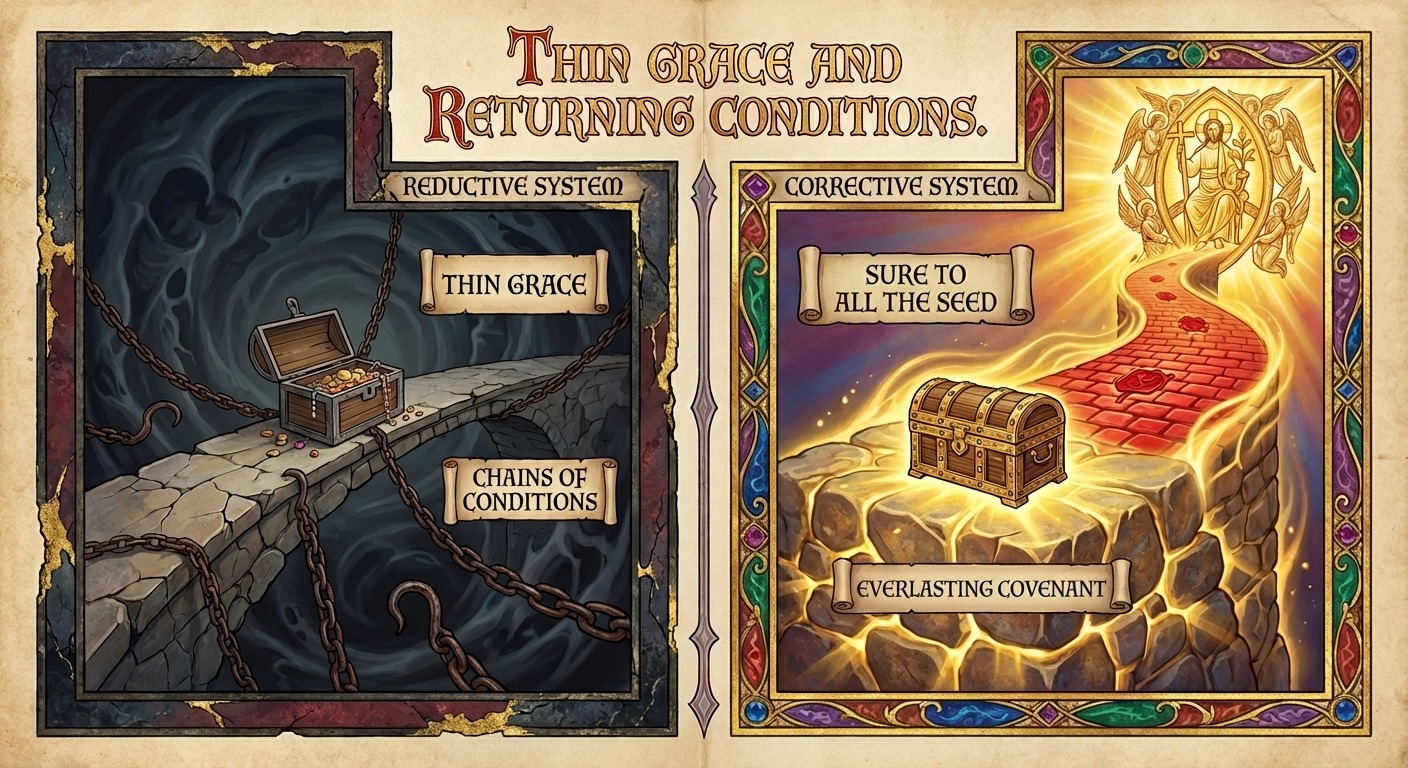
Thin Grace and Returning Conditions
This chart shows the structure. What follows explains each part.
THE DANGER OF A THINNED-OUT GRACE
The reductive dispensationalist gets one thing right: the new covenant belongs to Israel. But the error is in stopping there—in reserving the new covenant for Israel without recognizing that the Church's blessings require their own covenantal ground. If the everlasting covenant is not maintained as a distinct category, the Church is left standing on nothing. It may believe the gospel, receive forgiveness, and possess eternal life—but no robust theological account exists for why these things are available or on what legal and sacrificial basis they rest.
Grace, in this framework, is reduced to a bare divine decision—an act of God's will unmoored from any underlying covenantal reality. The legal structure, sacrificial basis, and testamentary mechanics that give the believer's position its substance are simply absent. Faith becomes transactional: believe the right facts, receive the right benefits, with no account of how the Seed's covenant with the Father constitutes the legal ground of the inheritance. It is grace without architecture.
HISTORICAL CONSEQUENCES OF A VACUUM
A thinned-out grace does not stay thin for long. When the believer's standing is not anchored in a covenantal structure, the vacuum is filled—and it is always filled with conditions. Teachers sensing the lack of structure begin supplementing it: faithfulness, perseverance, obedience, works reinterpreted as the necessary evidence of genuine belief. The language of grace remains; the substance of it does not.
This pattern was visible at Dallas Theological Seminary in the mid-to-late twentieth century. As dispensational theology drifted toward new covenant categories without maintaining the everlasting covenant as the Church's distinct ground, the framework thinned, and legal conditions re-entered through the back door. Miles Stanford recognized the trajectory and pointed toward the everlasting covenant as the necessary category—though he did not develop a full theological architecture for it. The problem he identified was real: a dispensationalism that correctly separates Israel and the Church but leaves the Church without covenantal ground is a dispensationalism that cannot hold the line against law.
THE IMPOVERISHED FOUNDATION
The inheritance was made "sure to all the seed" (Romans 4:16) by a ceremony in Genesis 15 in which only God walked the path of blood while the human beneficiary slept. That is not a thin grace. That is grace with legal structure, sacrificial ground, and testamentary mechanics—the everlasting covenant, ratified unilaterally, confirmed in Christ, activated as a testament by the death of the Testator and vindicated by His resurrection. Without this foundation, what remains is an explanation for the believer's blessings that can only gesture at God's goodwill—and goodwill, however genuine, is not a legal ground. It cannot bear the weight of eternal security, irrevocable sonship, and an inheritance in the world to come.
THE NECESSARY DISTINCTION
The everlasting covenant, maintained as a distinct category, resolves this collapse. The Church is not under the new covenant—and that is not the problem. The problem arises when the alternative is nothing. The everlasting covenant provides precisely what the Church needs: the legal basis, the sacrificial ground, the testamentary mechanics by which the risen Heir distributes the inheritance to co-heirs who did nothing to earn it and nothing to maintain it. Grace is not thin. Grace is the inheritance of the Seed, distributed through a will that was activated by His death and is administered by His risen life. Only by maintaining the everlasting covenant as the Church's distinct ground can that grace be preserved in its full covenantal richness—and the door against conditions kept shut.
Every chart in this series is free to explore online.
 Get the full chart set (PDF – $8)
Members get all PDFs included → Why Membership
Log in with an active membership to download printable PDFs on this site. Purchased on the shop? Access downloads from your shop account.
If you would like to help fund this work:
Based on the article:
The Everlasting Covenant
A Distinct Covenantal Category in Pauline Dispensational Theology. The full theological foundation paper is available to read online in Writings.
Read it free online