Visual Theology – The Everlasting Covenant
The Visual Theology charts are designed to help you see the structure and movement of Scripture. They highlight patterns, contrasts, and developments that are often difficult to hold together when reading line by line.
These charts show the structure of the argument. The accompanying articles develop each part in full.
This approach follows a long tradition of visual teaching in the Church. The well-known charts of Clarence Larkin helped many grasp the broad outline of Scripture. In the same spirit, these charts aim to make visible what the Word of God is revealing.
Charts and teaching notes for the book of The Everlasting Covenant. Select a chart below to view the image and article.
Click chart to view larger
From the teaching in: The Everlasting Covenant
4. The Oath of the Father and the Melchizedek Priesthood
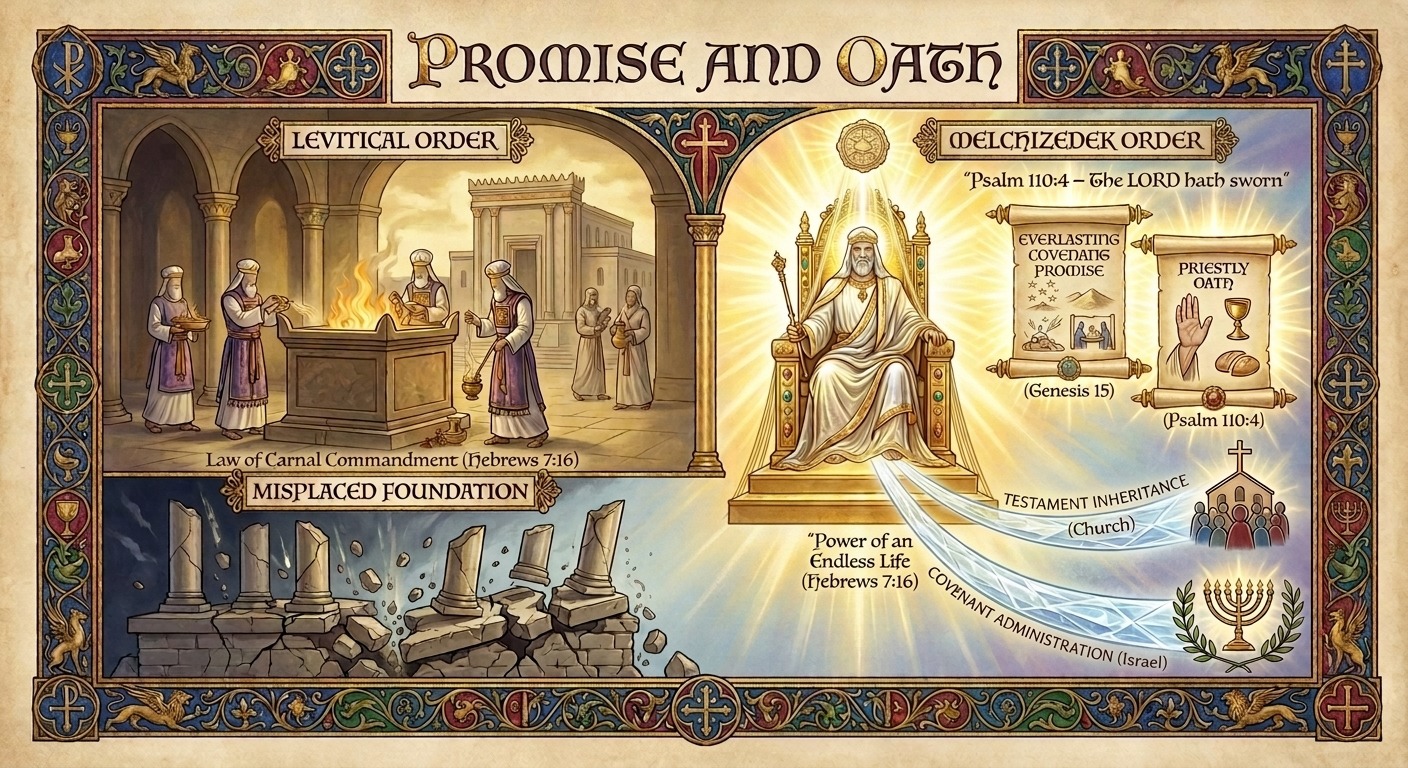
Promise and Oath
This chart shows the structure. What follows explains each part.
The Oath of the Everlasting Covenant
The administration of the everlasting covenant rests not merely on the promises made to Abraham and David, but on the sworn oath of the Father to the Seed. Psalm 110 records two decisive decrees from the Father to the Son. The first is kingly: “The LORD said unto my Lord, Sit thou at my right hand, until I make thine enemies thy footstool” (Psalm 110:1). The second, however, is the foundation for the present priestly ministry of Christ: “The LORD hath sworn, and will not repent, Thou art a priest for ever after the order of Melchizedek” (Psalm 110:4). This oath is not an extension of the Mosaic law, nor is it a provision of the new covenant. It is a direct, irrevocable vow from the Father to the Seed, establishing a priesthood whose ground is the everlasting covenant—the promises made and confirmed by oath.
The Theological Import in Hebrews
The Epistle to the Hebrews draws out the full theological import of this oath. A change of priesthood entails a change of law: “For the priesthood being changed, there is made of necessity a change also of the law” (Hebrews 7:12). If the priesthood now in force is not Levitical but Melchizedekian, then the legal framework is not Mosaic. The Melchizedek priest ministers “not after the law of a carnal commandment, but after the power of an endless life” (Hebrews 7:16). The principle of operation is life, not law. The law “made nothing perfect, but the bringing in of a better hope did; by the which we draw nigh unto God” (Hebrews 7:19). Where the Levitical priests were many—“because they were not suffered to continue by reason of death”—the Melchizedek priest “continueth ever” and possesses “an unchangeable priesthood” (Hebrews 7:23–24). He “ever liveth to make intercession” for those who come to God by Him (Hebrews 7:25).
The Administrative Mechanism
This priestly office, established by the Father's oath, is the mechanism by which the inheritance secured in the everlasting covenant is administered. The question arises: if the Church receives everything through the testament, who maintains it, and under what authority? The answer is found here. The Melchizedek priest, appointed by the sworn oath of the Father, ministers the riches of the everlasting covenant to the heirs. The Church's forgiveness, justification, and eternal security are not rooted in the new covenant's future application to Israel, but in this superior, prior arrangement between the Father and the Son. Christ is the “great Shepherd of the sheep,” brought again from the dead “through the blood of the everlasting covenant” (Hebrews 13:20). It is in His capacity as Melchizedek priest that He dispenses what the everlasting covenant secured.
Moreover, the same priesthood underwrites the new covenant's guarantee to Israel. Christ, as priest of the new order, will maintain Israel's faithfulness in the coming age, ensuring the covenant is kept. The single oath serves both operations: the testament inheritance for the Church, and the covenant administration for Israel. Both flow from the Father's vows to the Seed.
The Double Anchor of Hope
Hebrews 6:17–18 identifies the double anchor of the believer's hope: “God, willing more abundantly to shew unto the heirs of promise the immutability of his counsel, confirmed it by an oath: That by two immutable things, in which it was impossible for God to lie, we might have a strong consolation.” The two immutable things are:
- The promise—the gospel itself, the Abrahamic promise to the Seed confirmed in Genesis 15.
- The oath—the sworn decree of Psalm 110:4 establishing Christ as high priest of the new order.
Both are instruments of the everlasting covenant. The promise secures the inheritance; the oath secures the priest who administers it. Together they constitute an irreversible covenantal reality, logically and temporally prior to the new covenant and not subsumed into it.
Thus, the Melchizedek priesthood, established by the Father's oath to the Seed, is the administrative mechanism of the everlasting covenant. This sworn priesthood is among the strongest evidences that the everlasting covenant is a distinct and necessary category, securing for the heirs both the inheritance and its eternal maintenance.
Every chart in this series is free to explore online.
 Get the full chart set (PDF – $8)
Members get all PDFs included → Why Membership
Log in with an active membership to download printable PDFs on this site. Purchased on the shop? Access downloads from your shop account.
If you would like to help fund this work:
Based on the article:
The Everlasting Covenant
A Distinct Covenantal Category in Pauline Dispensational Theology. The full theological foundation paper is available to read online in Writings.
Read it free online