
Visual Theology – The Everlasting Covenant
The Visual Theology charts are designed to help you see the structure and movement of Scripture. They highlight patterns, contrasts, and developments that are often difficult to hold together when reading line by line.
These charts show the structure of the argument. The accompanying articles develop each part in full.
This approach follows a long tradition of visual teaching in the Church. The well-known charts of Clarence Larkin helped many grasp the broad outline of Scripture. In the same spirit, these charts aim to make visible what the Word of God is revealing.
Charts and teaching notes for the book of The Everlasting Covenant. Select a chart below to view the image and article.
Click chart to view larger
From the teaching in: The Everlasting Covenant
14. National Redemption and Individual Redemption
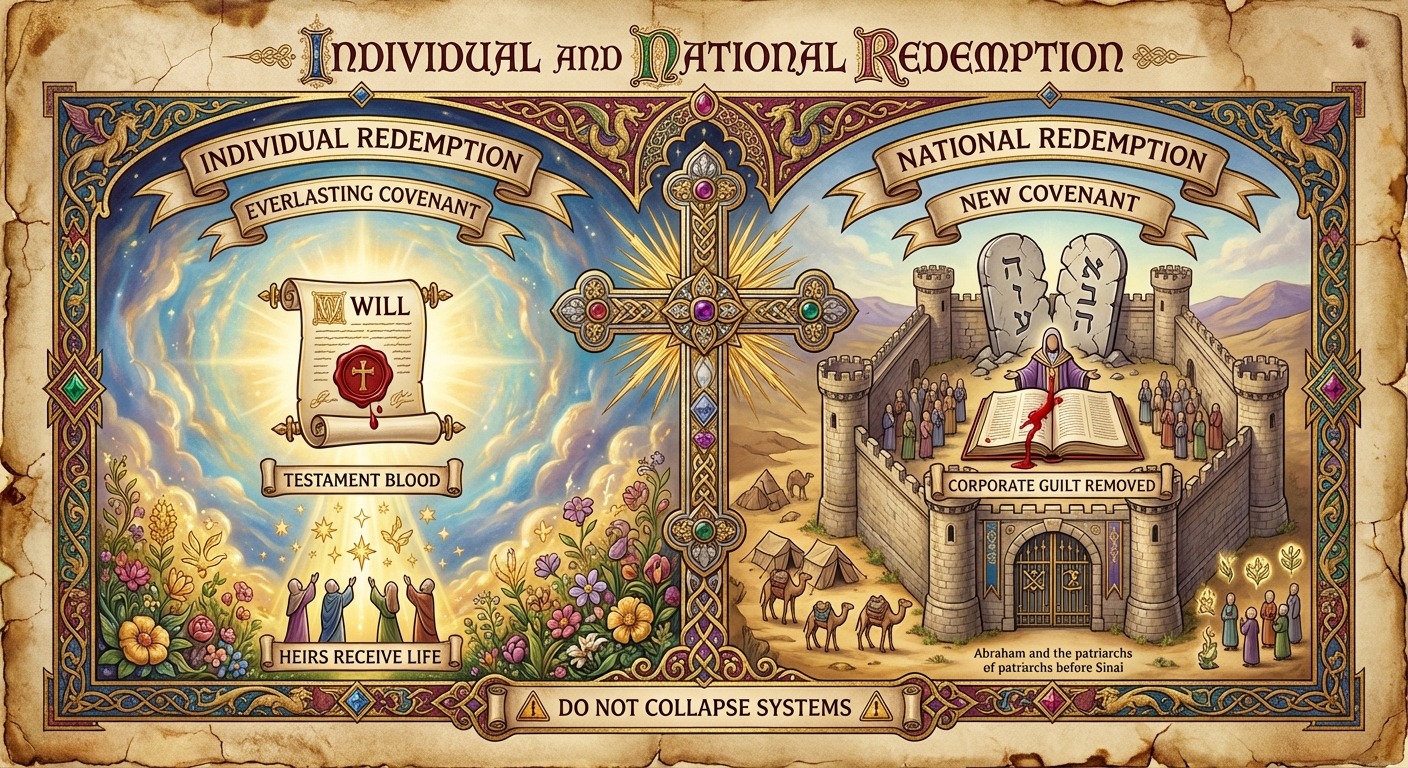
Individual and National Redemption
This chart shows the structure. What follows explains each part.
Individual and National Redemption
We've been making distinctions — between the covenants, between the blood's operations, between the Spirit's dimensions, between the senses of inheritance, and between millennial administration and eternal possession. Now we need to bring those distinctions to bear on the most fundamental question: when Christ died, what exactly was he doing, and for whom? Because Scripture gives us two answers that are not in tension, but they are distinct — and running them together is what produces some of the sloppiest theology in circulation.
A Vital Distinction
A clear distinction must be maintained between the redemption of individuals and the redemption of the nation, as these operate on different covenantal grounds and address distinct problems within the scriptural narrative. Christ's death is the singular event by which both are accomplished, yet Scripture is careful to delineate the scope and application of each.
The Everlasting Covenant: Redemption for the Individual
On the one hand, Christ 'gave himself a ransom for all' (1 Timothy 2:6), dying for the sins of the whole world. This is the provision of the everlasting covenant, universal in its scope and individual in its application. The blood of Christ, in this sense, is testament blood — the blood that seals the will of the Testator. The inheritance of forgiveness and life is distributed to all who believe, in every age, irrespective of their national or covenantal status under the Mosaic law. This is not limited by time, ethnicity, or prior covenantal membership. The everlasting covenant, ratified in Genesis 15, grounds this universal offer: every individual who believes receives the benefits of Christ's death, the inheritance opened by the Testator's sacrifice.
The New Covenant: Redemption for the Nation
On the other hand, the New Testament presents a distinct operation accomplished by the same death, but with a national focus. Christ also died 'for that nation' (John 11:51), and is described as 'the mediator of the new covenant, that by means of death, for the redemption of the transgressions that were under the first covenant, they which are called might receive the promise of eternal inheritance' (Hebrews 9:15). Here, the redemption in view is not universal but corporate, addressing the accumulated guilt of Israel under the Mosaic covenant.
The new covenant is strictly national in this operation. It does not include Abraham, who lived and died before the first covenant existed. It does not include Gentile believers, who were never under the first covenant. Rather, it pertains to the specific transgressions of a specific nation — Israel — under a specific covenant arrangement, namely, the Mosaic covenant.
Why the Distinction Matters
This distinction is vital because the new covenant addresses a problem narrower than the universal problem of human sin. The universal problem — the condition of sin that afflicts every person — is addressed by the everlasting covenant, through the blood of Christ as testament blood, applied to each individual who believes. The national problem — the corporate guilt of Israel for breaking the Mosaic covenant — is addressed by the new covenant, through the blood of Christ as the blood of the new covenant, applied to the nation for the purpose of clearing the ledger of its covenant failure.
These are two different operations, each requiring its own covenantal framework to be intelligible. To collapse them into one is to misunderstand both the universal scope of testament provision and the specific, national scope of the new covenant. The death of Christ stands at the center, but the benefits that flow from it are distributed according to the terms and purposes of distinct divine arrangements: the everlasting covenant for the individual, and the new covenant for the nation of Israel. Only by maintaining this distinction can the scriptural teaching on redemption be preserved in its proper contours.
Individual redemption on the everlasting covenant basis, national redemption on the new covenant basis — the same death, two distinct operations. The hinge verse where these two operations are visible in a single sentence is Hebrews 9:15, and it's worth looking at closely. That's the next chart.
Every chart in this series is free to explore online.
 Get the full chart set (PDF – $8)
Members get all PDFs included → Why Membership
Log in with an active membership to download printable PDFs on this site. Purchased on the shop? Access downloads from your shop account.
If you would like to help fund this work:
Based on the article:
The Everlasting Covenant
A Distinct Covenantal Category in Pauline Dispensational Theology. The full theological foundation paper is available to read online in Writings.
Read it free online