
Visual Theology – The Everlasting Covenant
The Visual Theology charts are designed to help you see the structure and movement of Scripture. They highlight patterns, contrasts, and developments that are often difficult to hold together when reading line by line.
These charts show the structure of the argument. The accompanying articles develop each part in full.
This approach follows a long tradition of visual teaching in the Church. The well-known charts of Clarence Larkin helped many grasp the broad outline of Scripture. In the same spirit, these charts aim to make visible what the Word of God is revealing.
Charts and teaching notes for the book of The Everlasting Covenant. Select a chart below to view the image and article.
Click chart to view larger
From the teaching in: The Everlasting Covenant
9. The New Covenant: Betrothal, Not Inheritance
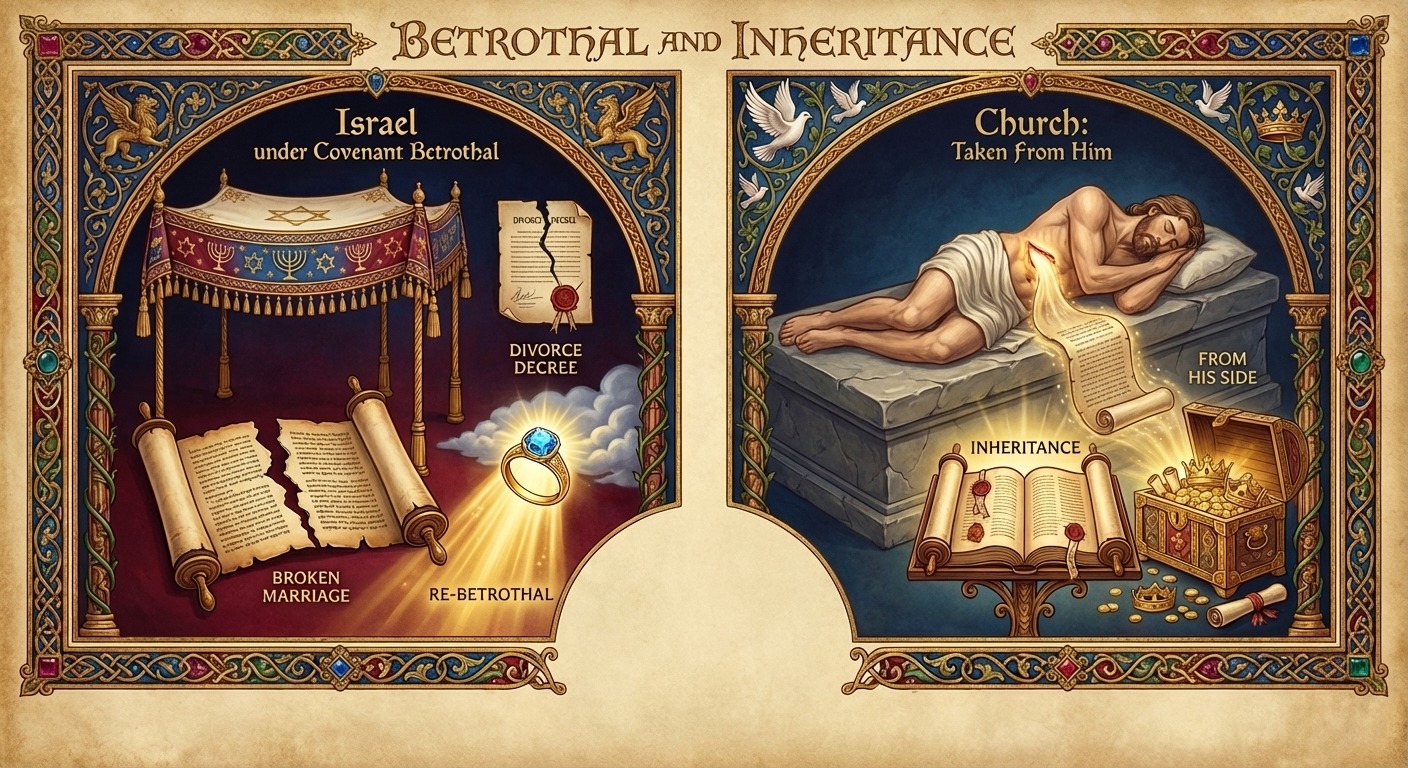
Betrothal and Inheritance
This chart shows the structure. What follows explains each part.
The New Covenant as Re-Betrothal
The new covenant prophesied for Israel is best understood as a re-betrothal, not an inheritance. In Hosea 2:19, God declares, “I will betroth thee unto me for ever; yea, I will betroth thee unto me in righteousness, and in judgment, and in lovingkindness, and in mercies.” This promise is explicitly marital and covenantal, restoring a relationship that had previously been broken. The old covenant was a marriage that ended in divorce, as Jeremiah 3:8 records: “I had put her away, and given her a bill of divorce.” The restoration under the new covenant is not a return to the old terms, which Israel broke, but a new arrangement in which God guarantees faithfulness by indwelling the nation. Yet, the structure remains bilateral and relational. It is a covenant, not a testament; the relationship has terms and obligations, but now with divine enablement.
Covenant for Israel, Testament for the Church
This distinction between betrothal and inheritance is critical for understanding the difference between Israel and the Church. The Church does not have a covenant with God in the sense that Israel does. Rather, the Church possesses a testamentary inheritance through Christ, the Heir who died and rose again. Romans 8:17 states, “And if children, then heirs; heirs of God, and joint-heirs with Christ.” The Church stands as a co-heir, sharing in the estate that belongs to Christ, not as a covenant partner with terms to keep, but as one who receives the inheritance because of the finished work of the Heir. Israel, in the coming millennial age, will have a renewed national covenant, a relationship with God that is restored, structured, and maintained by Christ’s indwelling presence. The two realities—covenant for Israel, testament for the Church—are fundamentally distinct, each grounded in a different divine arrangement.
The Nature of the Bridal Relationship
A common objection arises from the language of the Church as the bride of Christ. While it is true that the Church is called Christ’s bride, the nature of this bridal relationship is categorically different from Israel’s. Israel is a covenant bride—betrothed, married, divorced, and re-betrothed under the new covenant, with a relationship defined by terms and the possibility of breach. The Church, by contrast, is an ontological bride, not entering into a contract but being created out of Christ Himself.
Paul makes this typology explicit in Ephesians 5:30–32: “For we are members of his body, of his flesh, and of his bones... This is a great mystery: but I speak concerning Christ and the church.” The pattern is Genesis 2, where Eve is taken from Adam’s side while he slept—a sleep that foreshadows death. Eve is not joined to Adam by contract but by origin; her existence is his existence, “bone of his bones, and flesh of his flesh.” In the same way, the Church is brought into being out of the death of Christ, created from Him, and her union is organic, not contractual. There are no terms to keep, for there is no distance to bridge; the Church shares Christ’s very life, not by agreement but by creation.
The Danger of Theological Confusion
To collapse these distinct realities—treating the new covenant as a testament, or subsuming the everlasting covenant into the new covenant—obliterates the dispensational distinction between Israel and the Church. If the new covenant is understood as a testament, Israel’s millennial position becomes indistinguishable from the Church’s, undermining the entire structure of biblical dispensationalism. Conversely, if the everlasting covenant is reduced to the new covenant, the Church is placed under Israel’s national covenant, making her a participant in Israel’s program, a confusion that marks progressive dispensationalism.
Maintaining the Proper Distinction
The proper theological distinction must be maintained: Israel’s relationship with God in the millennium is that of a covenant bride—betrothed anew, with terms guaranteed by divine presence. The Church’s relationship is that of a co-heir, an ontological bride created from Christ, sharing His inheritance without the mediation of a covenant. These are two different kinds of relationship, each reflecting a different aspect of God’s redemptive plan, and each grounded in its own covenantal reality.
Every chart in this series is free to explore online.
 Get the full chart set (PDF – $8)
Members get all PDFs included → Why Membership
Log in with an active membership to download printable PDFs on this site. Purchased on the shop? Access downloads from your shop account.
If you would like to help fund this work:
Based on the article:
The Everlasting Covenant
A Distinct Covenantal Category in Pauline Dispensational Theology. The full theological foundation paper is available to read online in Writings.
Read it free online