
Visual Theology – Bible Prophecy Charts
The Visual Theology charts are designed to help you see the structure and movement of Scripture. They highlight patterns, contrasts, and developments that are often difficult to hold together when reading line by line.
These charts show the structure of the argument. The accompanying articles develop each part in full.
This approach follows a long tradition of visual teaching in the Church. The well-known charts of Clarence Larkin helped many grasp the broad outline of Scripture. In the same spirit, these charts aim to make visible what the Word of God is revealing.
Charts and teaching notes for the book of Bible Prophecy Charts. Select a chart below to view the image and article.
Click chart to view larger
From the teaching in: The Master Key: Daniel's 70th Week
Seeing What the Prophets Saw: The Perspective of Prophecy
The Perspective of Prophecy: The Mountain Peaks
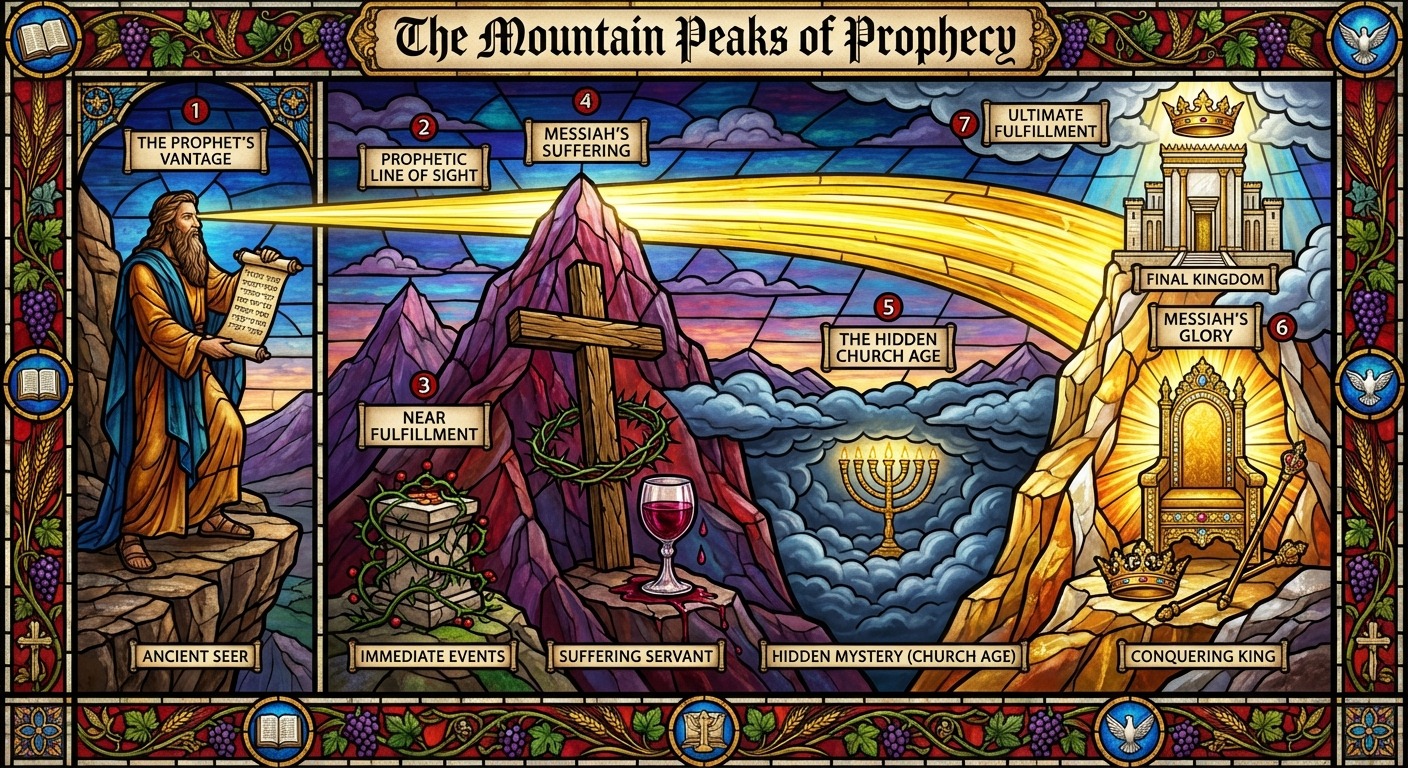
This chart shows the structure. What follows explains each part.
If the prophets spoke accurately -- and by every measure of fulfilled prophecy, they did -- then why does the Old Testament so consistently appear to collapse the suffering of the Messiah and the glory of His kingdom into a single frame, with no apparent space between them? Why does Isaiah 53 seem to belong to the same vision as Isaiah 61, with nothing in the text to indicate the centuries separating what each describes? This compression of events across time is not a flaw in the prophetic witness; it is a structural feature of how God granted vision, and understanding it dissolves not only confusion about the Old Testament but a great deal of the confusion that afflicts New Testament interpretation as well.
If the prophets spoke accurately -- and by every measure of fulfilled prophecy, they did -- then why does the Old Testament so consistently appear to collapse the suffering of the Messiah and the glory of His kingdom into a single frame, with no apparent space between them? Why does Isaiah 53 seem to belong to the same vision as Isaiah 61, with nothing in the text to indicate the centuries separating what each describes? This compression of events across time is not a flaw in the prophetic witness; it is a structural feature of how God granted vision, and understanding it dissolves not only confusion about the Old Testament but a great deal of the confusion that afflicts New Testament interpretation as well.
Understanding the Prophetic Perspective
Understanding the perspective of prophecy requires us to enter into the vantage point of the Old Testament prophets themselves. When these holy men of God received visions of the future, they did not see history as a straightforward sequence with every detail and interval clearly mapped. Rather, their prophetic visions compressed distant and momentous events into a single panorama, much as a traveler in a valley might look toward a mountain range and see two great peaks rising together against the sky, unaware of the vast valley that lies concealed between them.
This "mountain peaks of prophecy" phenomenon is crucial for interpreting passages like Daniel 9:24-27, where the events of Messiah's coming, Israel's restoration, and the establishment of everlasting righteousness are all foretold. The prophets beheld both the sufferings of Christ and the glory that should follow, but the time interval—the Church Age—remained hidden from their sight. As Peter explains, "the prophets have inquired and searched diligently...what, or what manner of time the Spirit of Christ which was in them did signify, when it testified beforehand the sufferings of Christ, and the glory that should follow" (1 Peter 1:10-11). They saw the great peaks, but the valley between—the mystery of the Church—was veiled.
The Pattern in Prophetic Scripture
This pattern appears repeatedly throughout prophetic Scripture. The prophets saw clearly the major features of God's redemptive plan: Messiah's humiliation and exaltation, Israel's rejection and eventual restoration, judgment upon the nations and the coming of the kingdom. Yet the duration of time between these events, and at times even the existence of intervening ages, was not disclosed to them.
For example, Isaiah 61:1-2 presents the Messiah's ministry and the day of vengeance in a single breath, but Jesus in Luke 4:16-21 stopped reading at the point of fulfillment in His first coming, leaving the remainder for a future day—thus revealing a hidden gap. Zechariah 9:9-10 likewise moves from Messiah's humble entry into Jerusalem to His worldwide dominion without indicating the long interval between.
Guarding Against Common Errors
This prophetic perspective guards us from two common errors.
First, it prevents us from insisting that the Old Testament prophets should have described the Church Age explicitly. Their visions were true and accurate, but partial; they revealed certain features of God's plan while leaving others for later revelation. As Paul reminds us, "we know in part, and we prophesy in part" (1 Corinthians 13:9), and "now we see through a glass, darkly" (1 Corinthians 13:12). The prophets did not fail; they simply could not see what God had not yet chosen to reveal.
Second, this perspective helps us understand how prophecy can have both near and far fulfillments. A historical event may serve as a type or shadow of a greater fulfillment to come. The desecration of the temple by Antiochus Epiphanes fulfilled certain prophecies, but also pointed forward to the ultimate abomination of desolation that Jesus referenced in Matthew 24:15, to be fulfilled during Daniel's 70th week. The prophets saw the mountain peak, but in God's design, there would be further peaks—patterns recurring and building toward ultimate fulfillment.
Humility and Confidence
Grasping this "mountain peaks" perspective should produce both humility and confidence in us. Humility, because even with greater revelation, our understanding remains partial and we await the full unveiling when Christ returns. Confidence, because the apparent gaps and discontinuities in prophecy are not errors or oversights but features of God's progressive revelation. When we see Isaiah or Zechariah moving seamlessly from one great event to another, we are not encountering confusion or contradiction, but rather the true vision as the prophets saw it—real, trustworthy, and awaiting God's appointed time for each fulfillment.
Thus, the perspective of prophecy is not merely an academic curiosity, but a vital key for rightly dividing the word of truth. It enables us to honor both the integrity of the prophetic Scriptures and the unfolding of God's plan in history, seeing each mountain peak as a testimony to the faithfulness of the One who declares "the end from the beginning" and brings all things to their appointed consummation.
The mountain peaks phenomenon explains why the gap was hidden from the Old Testament prophets -- they saw the summits without seeing the valley. But that valley is not empty; it is precisely the space in which we now live, and God always intended it. The purpose of the gap -- why God would design an interval of indefinite length between two consecutive weeks of determined history -- is a revelation that was given not to Daniel but to Paul, and it is one of the most astonishing disclosures in all of Scripture.
The mountain peaks phenomenon explains why the gap was hidden from the Old Testament prophets -- they saw the summits without seeing the valley. But that valley is not empty; it is precisely the space in which we now live, and God always intended it. The purpose of the gap -- why God would design an interval of indefinite length between two consecutive weeks of determined history -- is a revelation that was given not to Daniel but to Paul, and it is one of the most astonishing disclosures in all of Scripture.
Every chart in this series is free to explore online.
 Get the full chart set (PDF – $8)
Members get all PDFs included → Why Membership
Log in with an active membership to download printable PDFs on this site. Purchased on the shop? Access downloads from your shop account.
If you would like to help fund this work:
These charts are based on the following book:

The Master Key: Daniel's 70th Week
The Bible's Framework for Understanding Prophecy - 230 Page Paperback Edition
View Related Book