
Visual Theology – Bible Prophecy Charts
The Visual Theology charts are designed to help you see the structure and movement of Scripture. They highlight patterns, contrasts, and developments that are often difficult to hold together when reading line by line.
These charts show the structure of the argument. The accompanying articles develop each part in full.
This approach follows a long tradition of visual teaching in the Church. The well-known charts of Clarence Larkin helped many grasp the broad outline of Scripture. In the same spirit, these charts aim to make visible what the Word of God is revealing.
Charts and teaching notes for the book of Bible Prophecy Charts. Select a chart below to view the image and article.
Click chart to view larger
From the teaching in: The Master Key: Daniel's 70th Week
Why This Prophecy Matters: The Master Key to All Prophecy
Daniel's 70 Weeks as the Prophetic Blueprint
This chart shows the structure. What follows explains each part.
Grant for a moment that prophecy is about inheritance -- that it tracks the movement of God bringing His Son into the promises made to Abraham and David. The question that immediately follows is: where is the blueprint? If God is executing a plan, there should be somewhere in Scripture where the plan is laid out with sufficient precision that everything else can be calibrated against it. This article makes the case that Daniel 9:24-27 is that place -- not one important prophecy among many, but the structural frame without which Jesus's own prophetic teaching, Paul's eschatology, and the book of Revelation cannot hold their shape.
Grant for a moment that prophecy is about inheritance -- that it tracks the movement of God bringing His Son into the promises made to Abraham and David. The question that immediately follows is: where is the blueprint? If God is executing a plan, there should be somewhere in Scripture where the plan is laid out with sufficient precision that everything else can be calibrated against it. This article makes the case that Daniel 9:24-27 is that place -- not one important prophecy among many, but the structural frame without which Jesus's own prophetic teaching, Paul's eschatology, and the book of Revelation cannot hold their shape.
The Master Key of Prophecy
Among all the prophetic passages in Scripture, Daniel’s 70 weeks stands alone as the master key that unlocks the entire edifice of biblical prophecy. Daniel 9:24-27 is not merely an isolated prediction but provides the essential chronological framework without which prophetic interpretation becomes fragmented, inconsistent, and often contradictory. This passage supplies both the ‘what’ and the ‘when’ of God’s prophetic program, establishing a divine timeline that reveals God’s absolute sovereignty over history and the outworking of His redemptive purposes. Just as an architectural blueprint gives a structure its essential form, Daniel’s 70 weeks is the chronological skeleton upon which all other prophetic revelation depends.
The Foundational Role in New Testament Revelation
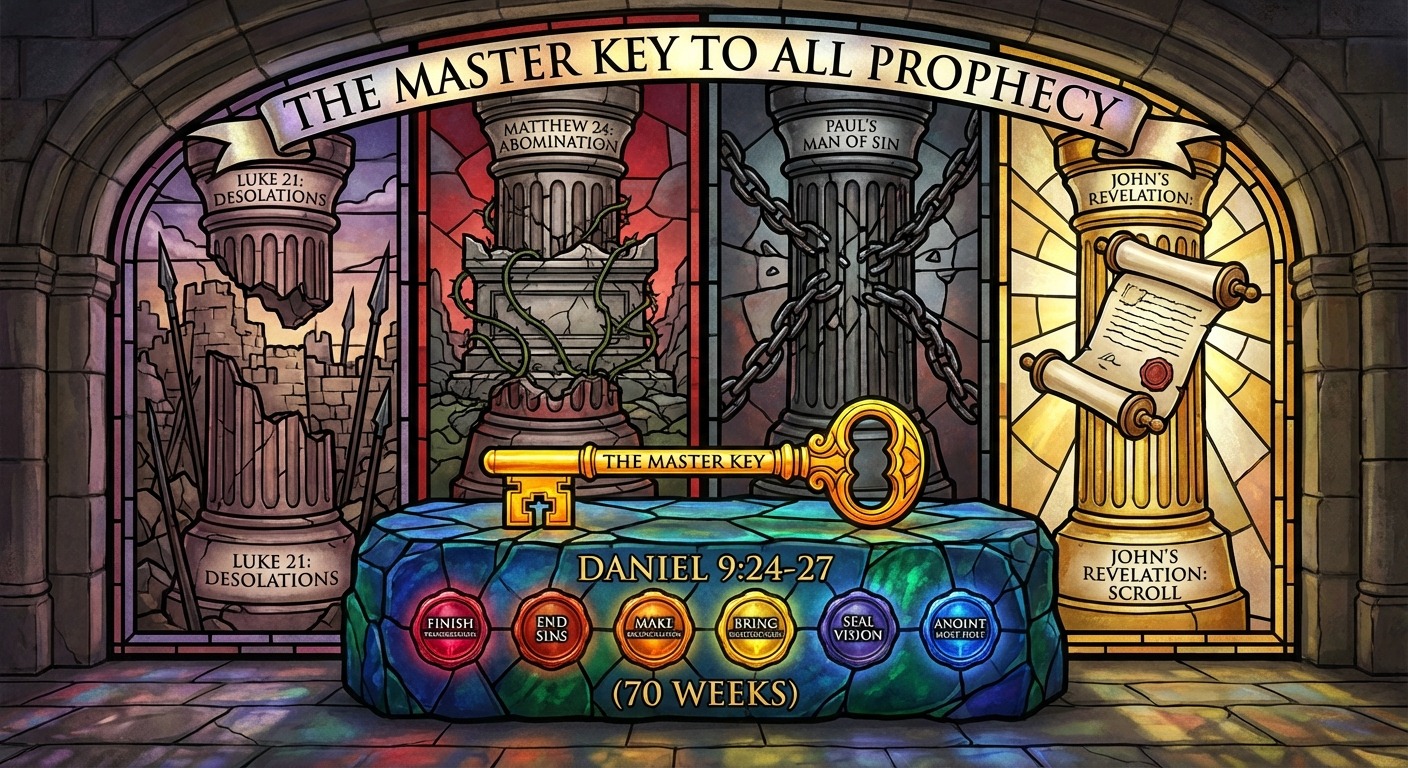
The extraordinary significance of this prophecy is demonstrated by its foundational role in later revelation. Jesus Himself built His prophetic teaching upon Daniel’s framework. What is commonly called the Olivet Discourse is, in fact, two distinct prophetic messages, each rooted in Daniel’s 70 weeks. In Luke 21, Jesus, speaking in the temple, addresses the destruction of the city and sanctuary as foretold in Daniel 9:26. In Matthew 24, speaking privately on the Mount of Olives, He addresses the abomination of desolation and the 70th week as described in Daniel 9:27.
The traditional conflation of these discourses has led to widespread confusion, with many—particularly preterists—erroneously treating Luke 21 and Matthew 24 as parallel accounts of the same events. This confusion arises precisely because Daniel’s chronological framework is neglected, resulting in the disregard of the distinct prophetic markers that Jesus Himself identified.
Recognizing that Jesus gave two separate discourses, both centered on Daniel 9:24-27 but addressing different aspects of the prophetic timeline, dissolves this confusion. Luke 21 addresses the beginning of the “desolations determined,” while Matthew 24 points to their culmination in the 70th week. Jesus explicitly instructed His followers to interpret the sign of the end by reference to “the abomination of desolation, spoken of by Daniel the prophet” (Matthew 24:15), while in Luke 21 He gave the sign of “Jerusalem compassed with armies” as the indicator for the destruction that would initiate the desolations. Both discourses treat Daniel’s prophecy as the authoritative framework, each illuminating a different segment of the divine timeline.
The apostle Paul, too, ordered his eschatological teaching according to Daniel’s structure. His description of the revelation of the “man of sin” in 2 Thessalonians 2:3-4 is couched in terms that directly reference Daniel’s prophecy. Likewise, John’s Revelation, while unveiling new details, is thoroughly dependent on Daniel’s framework—the time references, the beast system, and the tribulation period all connect directly to the vision given to Daniel.
The Necessity of Daniel’s Framework
Absent Daniel’s 70 weeks, the New Testament’s prophetic teaching loses its coherence. Jesus’ words become unmoored from their Old Testament foundation, Paul’s eschatology becomes disconnected from its prophetic roots, and Revelation devolves into an incomprehensible maze of symbols with no clear timeline or structure. But when Daniel’s 70 weeks is rightly recognized as the foundation, all these passages fit together with remarkable unity, testifying to the divine authorship and integrated design of Scripture.
The Heart of the Prophecy
At the heart of Daniel’s prophecy are six specific purposes outlined in Daniel 9:24:
- To finish the transgression
- To make an end of sins
- To make reconciliation for iniquity
- To bring in everlasting righteousness
- To seal up the vision and prophecy
- To anoint the most Holy
These six purposes encompass the entirety of God’s redemptive program—addressing the ultimate resolution of sin, the establishment of everlasting righteousness, and the fulfillment of all prophetic revelation. The scope of this prophecy is not some peripheral detail for enthusiasts of end-times speculation; it is the central structure for understanding God’s revealed plan for human history.
For this reason, every student of Scripture must grapple with Daniel’s 70 weeks. It is not optional material for those interested in prophecy, but the indispensable blueprint by which all other prophetic passages must be understood. Only with this master key in hand do the words of Jesus, Paul, and John “snap into focus,” forming a coherent, unified whole that reveals the glory of God’s sovereign purpose from beginning to end.
The blueprint has been identified: a 490-year framework addressed explicitly to Daniel's people and Daniel's city, with the purposes of God's redemptive program enumerated in six statements. But a blueprint on paper is only as credible as the architect behind it -- and that brings us to Daniel himself, the man to whom this vision was entrusted, and the extraordinary circumstances under which he received it.
The blueprint has been identified: a 490-year framework addressed explicitly to Daniel's people and Daniel's city, with the purposes of God's redemptive program enumerated in six statements. But a blueprint on paper is only as credible as the architect behind it -- and that brings us to Daniel himself, the man to whom this vision was entrusted, and the extraordinary circumstances under which he received it.
Every chart in this series is free to explore online.
 Get the full chart set (PDF – $8)
Members get all PDFs included → Why Membership
Log in with an active membership to download printable PDFs on this site. Purchased on the shop? Access downloads from your shop account.
If you would like to help fund this work:
These charts are based on the following book:

The Master Key: Daniel's 70th Week
The Bible's Framework for Understanding Prophecy - 230 Page Paperback Edition
View Related Book