
Visual Theology – Bible Prophecy Charts
The Visual Theology charts are designed to help you see the structure and movement of Scripture. They highlight patterns, contrasts, and developments that are often difficult to hold together when reading line by line.
These charts show the structure of the argument. The accompanying articles develop each part in full.
This approach follows a long tradition of visual teaching in the Church. The well-known charts of Clarence Larkin helped many grasp the broad outline of Scripture. In the same spirit, these charts aim to make visible what the Word of God is revealing.
Charts and teaching notes for the book of Bible Prophecy Charts. Select a chart below to view the image and article.
Click chart to view larger
From the teaching in: The Master Key: Daniel's 70th Week
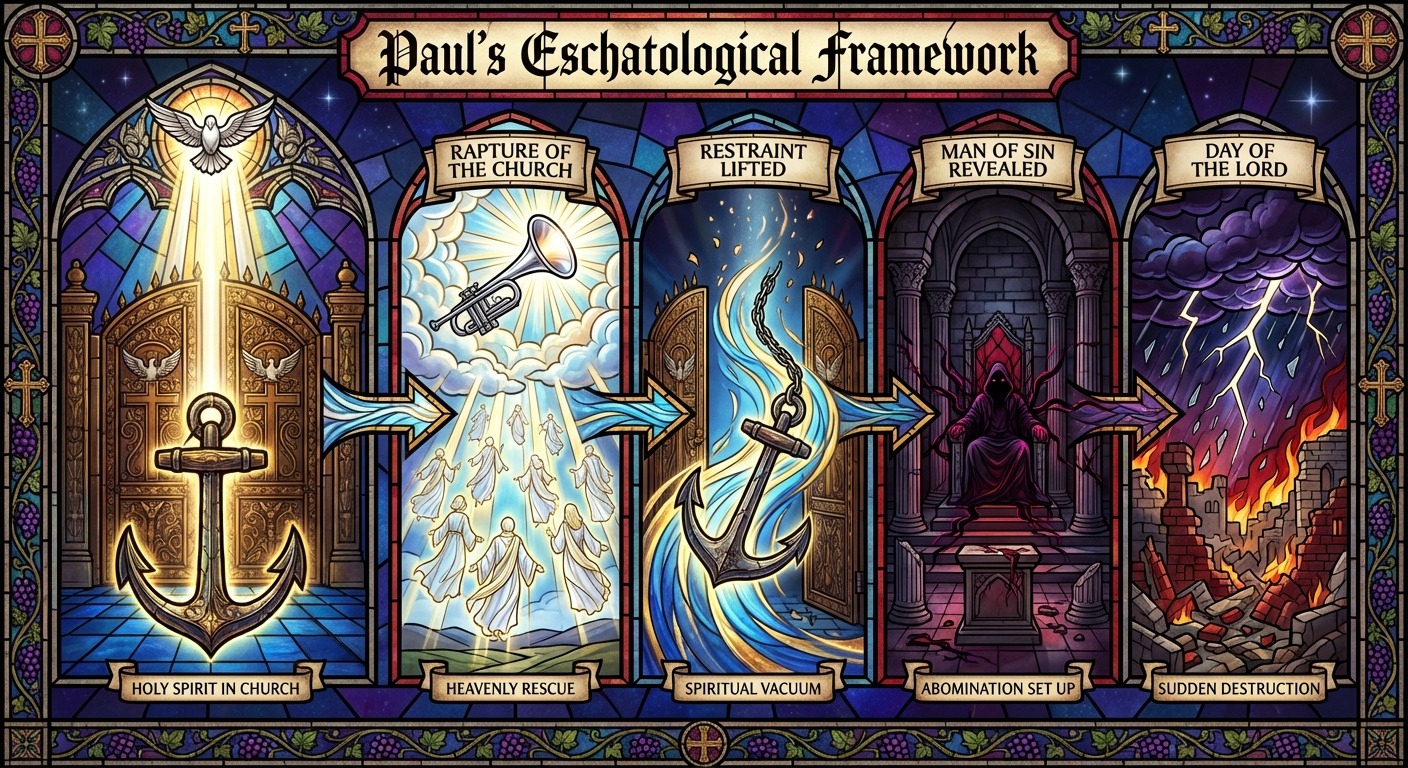
Paul's Eschatological Framework
Paul's Eschatological Framework
This chart shows the structure. What follows explains each part.
Paul does not write systematic eschatology -- he writes pastoral letters, addressing specific anxieties in specific communities about specific events. But the eschatological framework embedded in those letters is more precise and more coherent than it is usually given credit for, because Paul is not constructing his own prophetic system; he is working within Daniel's, and in light of the revelation of the mystery he received. Understanding Paul's eschatological architecture -- the order of events in 1 Thessalonians and 2 Thessalonians, the nature of the restrainer, the relationship between the rapture and the Day of the Lord -- is essential for anyone who wants to know what the Church's hope actually consists of.
Paul does not write systematic eschatology -- he writes pastoral letters, addressing specific anxieties in specific communities about specific events. But the eschatological framework embedded in those letters is more precise and more coherent than it is usually given credit for, because Paul is not constructing his own prophetic system; he is working within Daniel's, and in light of the revelation of the mystery he received. Understanding Paul's eschatological architecture -- the order of events in 1 Thessalonians and 2 Thessalonians, the nature of the restrainer, the relationship between the rapture and the Day of the Lord -- is essential for anyone who wants to know what the Church's hope actually consists of.
The Apostle Paul's Eschatological Teaching
The Apostle Paul's eschatological teaching provides a crucial key for understanding how the Church Age fits within the larger prophetic framework established by Daniel and completed in Revelation. Far from being isolated from the grand sweep of biblical prophecy, Paul's doctrine harmonizes with both Daniel's vision of the 70th week and John's apocalyptic vision, offering clarity on the order of end-time events and the destiny of the Church.
The Sequence of Events in 2 Thessalonians
Paul addresses the Thessalonian believers' anxiety about the timing of the Day of the Lord in 2 Thessalonians 2:1-12. He urges them not to be shaken or troubled by claims that the day of Christ is at hand. Instead, he lays out a sequence that must unfold before that period of judgment begins: "Let no man deceive you by any means: for that day shall not come, except there come a falling away first, and that man of sin be revealed, the son of perdition" (2 Thessalonians 2:3). This "man of sin"—also called the "son of perdition"—is the Antichrist, the same figure Daniel describes as the one who will set up the abomination of desolation (Daniel 9:27) and whom Jesus references in Matthew 24:15.
Paul further describes this figure as one "Who opposeth and exalteth himself above all that is called God, or that is worshipped; so that he as God sitteth in the temple of God, shewing himself that he is God" (2 Thessalonians 2:4). This act of self-deification in the temple is the very climax of lawlessness foreseen by Daniel and confirmed by Jesus and John.
The Restrainer and the Mystery of Lawlessness
Central to Paul's framework is the presence of "the restrainer," a force or person who currently withholds the open manifestation of the Antichrist: "And now ye know what withholdeth that he might be revealed in his time. For the mystery of iniquity doth already work: only he who now letteth will let, until he be taken out of the way. And then shall that Wicked be revealed" (2 Thessalonians 2:6-8). While Paul does not name the restrainer, the understanding presented here is that this refers to the Holy Spirit working through the Church. As long as the Church remains on earth, the full revelation of the Antichrist and the unrestrained outbreak of lawlessness cannot occur.
The Rapture of the Church
This leads directly to Paul's doctrine of the rapture—a mystery revealed to him and explained in 1 Thessalonians 4:13-18. He writes: "For the Lord himself shall descend from heaven with a shout, with the voice of the archangel, and with the trump of God: and the dead in Christ shall rise first: Then we which are alive and remain shall be caught up together with them in the clouds, to meet the Lord in the air: and so shall we ever be with the Lord." Paul concludes with the exhortation, "Wherefore comfort one another with these words" (1 Thessalonians 4:18). The removal of the Church, then, is not an incidental event but the necessary prelude to the unveiling of the man of sin and the beginning of Daniel's 70th week.
Paul elaborates on the nature of this event in 1 Corinthians 15:51-52: "Behold, I shew you a mystery; We shall not all sleep, but we shall all be changed, In a moment, in the twinkling of an eye, at the last trump: for the trumpet shall sound, and the dead shall be raised incorruptible, and we shall be changed." This transformation—living believers being changed without experiencing death—fits perfectly with the Church being removed before the tribulation commences.
The Church and the Day of the Lord
The Day of the Lord, as Paul explains in 1 Thessalonians 5:1-11, is a period of sudden destruction that comes upon the world "as travail upon a woman with child; and they shall not escape. But ye, brethren, are not in darkness, that that day should overtake you as a thief" (1 Thessalonians 5:3-4). Paul draws a clear line between believers and the world: the Church is not appointed to wrath, but to obtain salvation.
A Unified Prophetic Narrative
The result is a coherent, unified prophetic narrative: Daniel's 70th week is yet future and concerns Israel and the nations. The Church Age is a prophetic parenthesis, a mystery not revealed to Daniel but disclosed through Paul. The restrainer—understood as the Spirit within the Church—must be removed before the Antichrist can be revealed. The rapture is the event that removes the Church from the earth, after which the 70th week unfolds in fulfillment of Daniel's vision and the apocalyptic judgments of Revelation.
This harmony between Daniel, Paul, and John assures us that our understanding is not built on isolated proof texts but on the consistent testimony of Scripture. The Church is not destined to endure the wrath of the tribulation, but is called to "comfort one another with the blessed hope" of Christ's imminent return. This prophetic framework is not given to foster speculation or fear, but to provide clarity, assurance, and motivation for holy living as we await the fulfillment of God's redemptive program.
Paul's eschatological framework has been laid out: the rapture, the removal of the restrainer, the revelation of the man of sin, the Day of the Lord -- each in sequence, each anchored in Daniel's seventieth week. The question that naturally follows concerns what that seventieth week will look like in its most distinctive future feature: not the tribulation's judgments, not the man of sin's deception, but the temple -- the millennial temple that Daniel's 'anoint the most Holy' points toward and that Ezekiel describes in stunning detail. What purpose does it serve, and what does it say about the nature of God's promises to Israel?
Paul's eschatological framework has been laid out: the rapture, the removal of the restrainer, the revelation of the man of sin, the Day of the Lord -- each in sequence, each anchored in Daniel's seventieth week. The question that naturally follows concerns what that seventieth week will look like in its most distinctive future feature: not the tribulation's judgments, not the man of sin's deception, but the temple -- the millennial temple that Daniel's 'anoint the most Holy' points toward and that Ezekiel describes in stunning detail. What purpose does it serve, and what does it say about the nature of God's promises to Israel?
Every chart in this series is free to explore online.
 Get the full chart set (PDF – $8)
Members get all PDFs included → Why Membership
Log in with an active membership to download printable PDFs on this site. Purchased on the shop? Access downloads from your shop account.
If you would like to help fund this work:
These charts are based on the following book:

The Master Key: Daniel's 70th Week
The Bible's Framework for Understanding Prophecy - 230 Page Paperback Edition
View Related Book