
Visual Theology – Bible Prophecy Charts
The Visual Theology charts are designed to help you see the structure and movement of Scripture. They highlight patterns, contrasts, and developments that are often difficult to hold together when reading line by line.
These charts show the structure of the argument. The accompanying articles develop each part in full.
This approach follows a long tradition of visual teaching in the Church. The well-known charts of Clarence Larkin helped many grasp the broad outline of Scripture. In the same spirit, these charts aim to make visible what the Word of God is revealing.
Charts and teaching notes for the book of Bible Prophecy Charts. Select a chart below to view the image and article.
Click chart to view larger
From the teaching in: The Master Key: Daniel's 70th Week
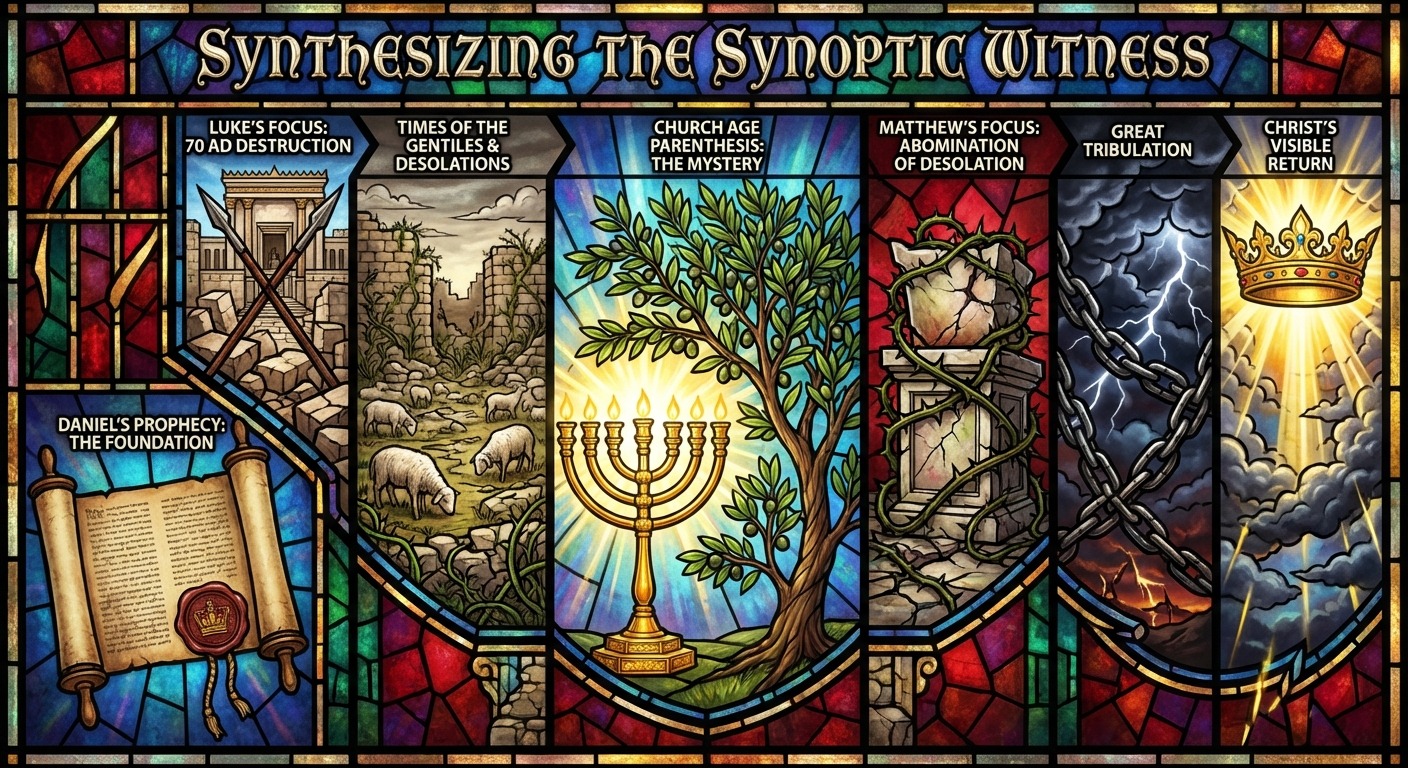
Synthesizing the Synoptic Witness
The Synoptic Prophetic Framework
This chart shows the structure. What follows explains each part.
By the time a careful reader has worked through Luke 21 and Matthew 24 as distinct prophetic accounts, a natural question arises: where does Mark's Gospel fit? And more broadly, how do three accounts that appear to cover the same general territory actually relate to one another -- are they redundant, or is each doing something the others are not? This article draws the full Synoptic picture, showing how Matthew, Mark, and Luke together provide a composite prophetic witness that no single account could supply alone, and confirming that the apparent contradictions between them dissolve entirely once Daniel's framework is held firmly in place.
By the time a careful reader has worked through Luke 21 and Matthew 24 as distinct prophetic accounts, a natural question arises: where does Mark's Gospel fit? And more broadly, how do three accounts that appear to cover the same general territory actually relate to one another -- are they redundant, or is each doing something the others are not? This article draws the full Synoptic picture, showing how Matthew, Mark, and Luke together provide a composite prophetic witness that no single account could supply alone, and confirming that the apparent contradictions between them dissolve entirely once Daniel's framework is held firmly in place.
The Synoptic Gospels and the Prophetic Framework of Christ
When examining the prophetic teachings of Jesus in the Synoptic Gospels—Matthew, Mark, and Luke—it becomes clear that what are often treated as three versions of the Olivet Discourse are, in truth, complementary perspectives that together yield a complete understanding of Christ’s prophetic instruction. Far from presenting contradictory traditions, each Gospel account, under the inspiration of the Holy Spirit, emphasizes different facets of Daniel’s seventy weeks prophecy, serving distinct audiences and purposes while remaining anchored in the same prophetic framework.
Luke’s Focus: The Beginning of the Timeline
Luke’s account, addressed primarily to a Gentile audience, focuses on the beginning of the prophetic timeline. Here, Jesus speaks of the destruction of the city and sanctuary, an event prophesied in Daniel 9:26: “the people of the prince that shall come shall destroy the city and the sanctuary; and the end thereof shall be with a flood, and unto the end of the war desolations are determined.” Luke 21 records Jesus’ warning about Jerusalem being compassed with armies, marking the commencement of the “desolations determined” and the “times of the Gentiles.” This is not merely a historical prediction about the events of 70 AD, but an explanation of how that destruction fits within Daniel’s prophetic program, identifying the beginning of the gap period between the sixty-ninth and seventieth weeks.
Matthew’s Focus: The Conclusion of the Timeline
Matthew, on the other hand, writes with a Jewish audience in view and turns attention to the conclusion of the prophetic timeline. His account in Matthew 24 centers on the final week of Daniel’s prophecy—the seventieth week—highlighting the abomination of desolation “spoken of by Daniel the prophet” (Matthew 24:15; Daniel 9:27) as the key marker that signals the end of the gap period and the onset of the Great Tribulation. Matthew’s narrative moves from this pivotal event to the unparalleled time of trouble, culminating in the visible return of Christ. The phrase “the beginning of sorrows” (Matthew 24:8) is employed to distinguish the preliminary signs from the main event, making clear that the tribulation Jesus describes is of a magnitude the world has never seen, far surpassing the localized devastation of 70 AD.
Mark’s account, though more concise, supplements Matthew and Luke by providing additional details, reinforcing the unity of the prophetic message. When these three accounts are synthesized, they span the entire period outlined in Daniel 9:24-27—from Messiah being cut off, through the long interval of desolations, to the fulfillment of the seventieth week and the return of Christ.
A Crucial Insight and a Common Error
A crucial insight emerges from this comparison: both Luke 21 and Matthew 24 are thoroughly prophetic and both center on Daniel’s seventy weeks as their interpretive foundation. Jesus does not treat prophecy as a collection of isolated predictions but as a unified and coherent unfolding of God’s plan, always governed by Daniel’s framework. This is why all eschatological error can be traced to a failure to appreciate the significance of Daniel 9:24-27. Without this framework, biblical prophecy becomes incoherent.
A common error in interpretation is to assume that similar language in Matthew and Luke means they describe the same event. This is the basis of Preterism, which asserts that all prophecy was fulfilled in 70 AD. However, such an approach ignores the biblical pattern of prophetic foreshadowing, in which historical events serve as types or patterns of greater future fulfillments. The destruction of Jerusalem, while accompanied by wars, famines, and persecution, was only a preliminary fulfillment—a shadow of the far greater tribulation to come during the seventieth week.
Those who attempt to compress all of Matthew 24 into the events of 70 AD must allegorize Jesus’ explicit teaching, spiritualize His visible return, and disregard the chronological structure established by Daniel. The tribulation Jesus describes is unprecedented in all of history and is followed by cosmic signs and the return of the Son of man in glory—events that plainly did not occur in the first century.
The Nature of Revelation and the Present Age
The diversity within unity found in the Synoptic accounts reflects the nature of divine revelation. God speaks with one voice through various human instruments, each contributing to our understanding of His truth. As Paul affirms, “All scripture is given by inspiration of God, and is profitable for doctrine, for reproof, for correction, for instruction in righteousness” (2 Timothy 3:16). The complementary nature of these accounts is evidence of divinely orchestrated testimony, not contradiction.
Moreover, Jesus’ prophetic teaching marks a transition in revelation. It stands at the threshold between the Old Testament program centered on Israel and the New Testament revelation that would encompass the Church Age. Jesus Himself alludes to this shift when He declares, “And this gospel of the kingdom shall be preached in all the world for a witness unto all nations; and then shall the end come” (Matthew 24:14). Paul later reveals the “mystery” of the Church, unknown to previous generations but now disclosed through the apostles by the Spirit (Ephesians 3:3-5). The present age is thus a parenthesis between the sixty-ninth and seventieth weeks, during which God is gathering a people for His name from among the Gentiles.
For believers today, recognizing the unified prophetic framework of the Synoptic Gospels provides assurance in the reliability of Scripture, clarity in understanding God’s unfolding plan, and a reminder that prophecy finds its ultimate meaning in Christ. As Hebrews declares, “God, who at sundry times and in divers manners spake in time past unto the fathers by the prophets, Hath in these last days spoken unto us by his Son” (Hebrews 1:1-2). Christ is the final and definitive word, the one in whom all prophecy is fulfilled.
The Synoptic framework is now complete -- three accounts, one argument, no contradictions, each contributing to a portrait of the prophetic timeline that has Daniel's 70 weeks at its spine. What that framework illuminates next is the specific vocabulary that Daniel introduced and Jesus inherited: the word 'desolations' -- what it means in Daniel 9:26, how it functions as the name of the interval we still inhabit, and what it tells us about where we are in the story.
The Synoptic framework is now complete -- three accounts, one argument, no contradictions, each contributing to a portrait of the prophetic timeline that has Daniel's 70 weeks at its spine. What that framework illuminates next is the specific vocabulary that Daniel introduced and Jesus inherited: the word 'desolations' -- what it means in Daniel 9:26, how it functions as the name of the interval we still inhabit, and what it tells us about where we are in the story.
Every chart in this series is free to explore online.
 Get the full chart set (PDF – $8)
Members get all PDFs included → Why Membership
Log in with an active membership to download printable PDFs on this site. Purchased on the shop? Access downloads from your shop account.
If you would like to help fund this work:
These charts are based on the following book:

The Master Key: Daniel's 70th Week
The Bible's Framework for Understanding Prophecy - 230 Page Paperback Edition
View Related Book